

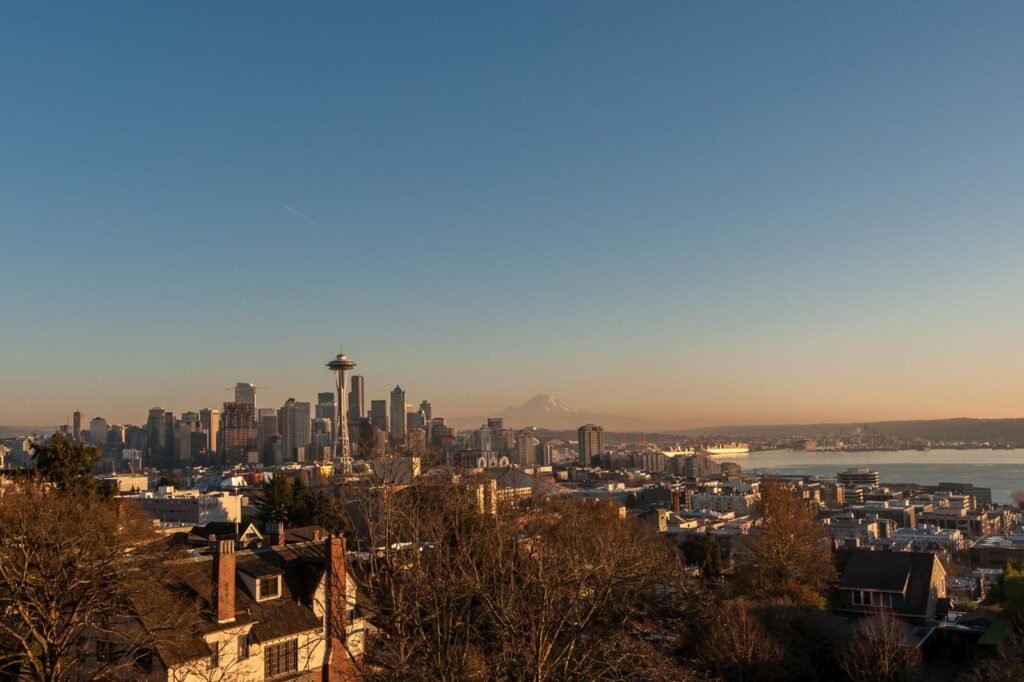
Washington is the better state if your income comes from a paycheck, you want mild summers, and you can afford Puget Sound housing. Arizona is the better state if you want cheap winters, a lower cost of living, and a tax system that treats retirees and investors gently. The washington vs arizona question is really a question about what you earn, what you own, and how much heat you can stand.
Both states have grown fast over the past decade, both lean on tech and aerospace or semiconductor jobs, and both have serious wildfire seasons. Beyond that they diverge on almost every axis that matters when you move: taxes, housing, climate, water, and what happens to your money when you retire or die. This guide walks through each of those using official state sources, so you can weigh the tradeoffs against your own situation instead of a generic ranking.
Taxes: the biggest structural difference
Washington is one of a handful of states with no personal income tax on wages. It funds itself instead through a 6.5 percent state sales tax, local sales taxes that push the combined rate above 10 percent in Seattle and many suburbs, a business and occupation tax on gross receipts, and property taxes. Since tax year 2022 it has also taxed long term capital gains on stocks, bonds, and similar assets.
The Washington Department of Revenue’s special notice on tiered rates confirms that beginning with tax year 2025 the capital gains tax is 7 percent on the first $1 million of taxable gains and 9.9 percent on gains above $1 million. A standard deduction (278,000 dollars for 2025, adjusted for inflation each year) means most households never owe it. Real estate sales, retirement accounts, and several business and farm assets are exempt.
Arizona went the other direction. The Arizona Department of Revenue’s individual income tax highlights state that a flat 2.5 percent rate applies to all income levels and filing statuses, and the old X and Y rate tables are obsolete. Arizona does not tax Social Security benefits, and its state transaction privilege tax (the Arizona name for sales tax) is 5.6 percent before city and county additions.
| Tax | Washington | Arizona |
|---|---|---|
| Wage income tax | None | Flat 2.5 percent |
| Long term capital gains | 7 percent above the standard deduction, 9.9 percent above $1 million in gains | Taxed as ordinary income at 2.5 percent |
| State sales tax | 6.5 percent plus local (often above 10 percent combined) | 5.6 percent plus local |
| Estate or inheritance tax | Yes, state estate tax | None |
| Social Security | Not taxed (no income tax) | Not taxed |
| Business tax | B&O tax on gross receipts | Corporate income tax on profit |
The practical takeaway: a software engineer earning a large salary keeps more in Washington, because 2.5 percent of a big number is still a big number. A retiree living on a pension, a 401(k), and Social Security pays essentially nothing in either state on Social Security, but pays Arizona 2.5 percent on the rest while Washington charges nothing. Where Washington bites retirees is on the spending side (sales tax on nearly everything) and at death, through the estate tax.
Housing and cost of living
Housing is where Arizona wins most decisively. The Seattle metro, Bellevue, and the Eastside are among the most expensive housing markets in the country outside California, and even Spokane and Tacoma have climbed sharply. Arizona’s Phoenix metro went through its own boom, and Scottsdale and Paradise Valley are genuinely pricey, but the typical home in Maricopa County still costs substantially less than the typical home in King County, and Tucson is cheaper again.
Rents follow the same pattern. Washington also has a statewide minimum wage among the highest in the nation and higher labor costs, which show up in restaurant bills, contractor quotes and childcare. Arizona’s everyday costs run closer to the national average.
The one cost that flips is cooling. A Phoenix household running air conditioning from May through September sees summer power bills that many Seattle homes, which often have no air conditioning at all, never do.
Climate: gray and mild versus sunny and brutal
Western Washington is famous for its long gray season. Seattle sees frequent light rain and overcast skies from roughly October through May, summer highs typically in the 70s, and winters that rarely drop far below freezing. Eastern Washington (Spokane, Yakima, the Tri Cities) is drier, sunnier, hotter in summer, and colder in winter.
Phoenix is the opposite problem. It is the sunniest major metro in the United States, and winters are the reason snowbirds fill the Valley every year. But summer is dangerous, not merely uncomfortable. Daily highs above 110 degrees are routine in July, overnight lows often stay above 90, and Maricopa County public health reports track hundreds of heat related deaths each year. Flagstaff, Prescott, and the high country offer four real seasons at elevation, and Tucson runs a few degrees cooler than Phoenix.
Jobs and the economy
Washington’s economy is anchored by Amazon, Microsoft, Boeing, Costco, Starbucks, and a deep bench of cloud, gaming, and biotech employers. Salaries in tech are among the highest in the country, and the lack of an income tax multiplies that advantage. Outside the Seattle area, the economy shifts to agriculture, healthcare, logistics, and the federal Hanford site near Richland.
Arizona’s growth story is semiconductors and everything around them. TSMC’s fabs in north Phoenix, Intel’s Chandler campus, and a wave of suppliers have created a manufacturing cluster, alongside long established strengths in aerospace and defense (Raytheon in Tucson, Honeywell, Boeing’s Mesa plant), healthcare, and finance back office operations. Wages are lower than Seattle for equivalent roles, but so is the cost of living.
If you are relocating a business rather than a job, the comparison gets more nuanced. Washington’s B&O tax is levied on gross receipts, which punishes low margin businesses. Arizona taxes corporate profit instead. We covered the business formation side in detail in our guide to whether Washington is the best state to start an LLC.
Retirement
Arizona is the more conventional retirement destination, and the tax code explains part of it. Social Security is exempt, there is no estate or inheritance tax, property taxes are moderate, and winters are warm. The 2.5 percent flat tax on pension and IRA withdrawals is low enough that most retirees barely notice it. Add the huge network of age restricted communities around Phoenix and Tucson and the case is straightforward.
Washington’s pitch to retirees is different: no tax on withdrawals of any kind, world class healthcare in Seattle, and a climate that never requires fleeing indoors. The costs are the estate tax, which applies at a far lower threshold than the federal exemption, the sales tax on everything you buy, and housing prices that make downsizing less rewarding. Retirees who sell a highly appreciated stock portfolio after moving to Washington can also trigger the capital gains tax, though the exemption for real estate means selling the family home does not.
Water and wildfire risk
This is the section most relocation guides skip, and it matters more every year. Arizona depends heavily on the Colorado River, and the river is over allocated. Under the federal shortage tiers announced by the Bureau of Reclamation, Arizona has absorbed the largest cuts of any state because its Central Arizona Project water has junior priority. Cities have deep groundwater reserves and decades of planning, so taps are not going dry, but new subdivisions in parts of the Phoenix metro have been restricted where developers could not prove a 100 year assured water supply, and long term growth will be shaped by water availability.
Washington’s water problems are regional rather than existential. Western Washington gets plenty of rain, while the agricultural east depends on snowpack that is shrinking in warm years. Both states face wildfire. Washington’s fire season has expanded from the dry east into the Cascades and occasionally the Olympic Peninsula, and smoke from regional fires now blankets Seattle most Augusts. Arizona’s fires are concentrated in the high country and along the wildland boundary around Flagstaff, Prescott, and Payson. If you buy in either state’s forested zones, check insurer availability before you close.
Which state wins by situation
| Your situation | Likely better fit | Why |
|---|---|---|
| High salary, tech or aerospace | Washington | No income tax, highest salaries, deepest job market |
| Retiree on fixed income | Arizona | Cheaper housing, no estate tax, warm winters |
| Investor with large realized gains | Arizona | 2.5 percent versus 7 to 9.9 percent above the WA deduction |
| First time buyer on a median income | Arizona | Home prices far lower outside Scottsdale |
| Outdoor lifestyle, hates heat | Washington | Mild summers, mountains, water, skiing an hour away |
| Low margin business owner | Arizona | Profit based corporate tax instead of gross receipts B&O |
For a similar breakdown against other states, see how Washington stacks up against Massachusetts and against Indiana, which are useful if Washington is your constant and you are still deciding on the alternative.
Frequently asked questions
Is Arizona really cheaper than Washington overall?
For most households, yes. Housing is the dominant line item in any budget and it is much cheaper in Arizona outside the priciest Scottsdale neighborhoods. Washington offsets some of that with no income tax and higher wages, so a high earner can still come out ahead there, but a median income family generally has more left over in Arizona.
Does Washington tax retirement income?
No. Washington has no personal income tax, so pensions, 401(k) and IRA withdrawals, and Social Security are all untaxed at the state level. The state does have an estate tax with an exemption far below the federal level, and it taxes large long term capital gains, so estate planning matters more there than in Arizona.
Which state has better weather?
It depends entirely on your tolerance. Western Washington offers mild summers and gray, damp winters. Phoenix and Tucson offer sunny, warm winters and extremely hot summers that force life indoors for months. Flagstaff and Spokane both give you four real seasons if you want a middle ground.
Is water a real concern in Arizona?
Yes, though not in the sense of cities running dry. Arizona takes the largest Colorado River cuts under the federal shortage system, and new development in parts of the Phoenix area has been limited where an assured 100 year water supply could not be shown. Established cities have groundwater reserves and conservation programs, but growth will be constrained by water.
Which state is better for starting a business?
Arizona is usually simpler and cheaper because it taxes profit rather than gross receipts, has no income tax on the owner above 2.5 percent, and has lower labor costs. Washington’s B&O tax on gross revenue can hurt thin margin businesses, though its lack of personal income tax favors profitable owners who pay themselves well.
The bottom line
Choose Washington if your income is high and salaried, you want to keep every dollar of it away from a state income tax, and you value mild summers, mountains, and water more than sunshine. Accept the tradeoff of expensive housing, high sales taxes, a state estate tax, and a capital gains tax if you ever sell a large investment position.
Choose Arizona if you are retiring, buying your first home, sitting on appreciated stock, or running a lean business. The flat 2.5 percent income tax is low enough to be a rounding error for most people, housing is far more attainable, and the winters are the reason people move there. Go in with clear eyes about summer heat, cooling costs, and long term water limits, and pick your neighborhood with those in mind.
About this article: GeekBlog covers U.S. technology news, AI, phones, smartwatches and gaming. Every story is written and checked under our Editorial Policy. Spotted a mistake or have a story tip? Contact our editors.
