

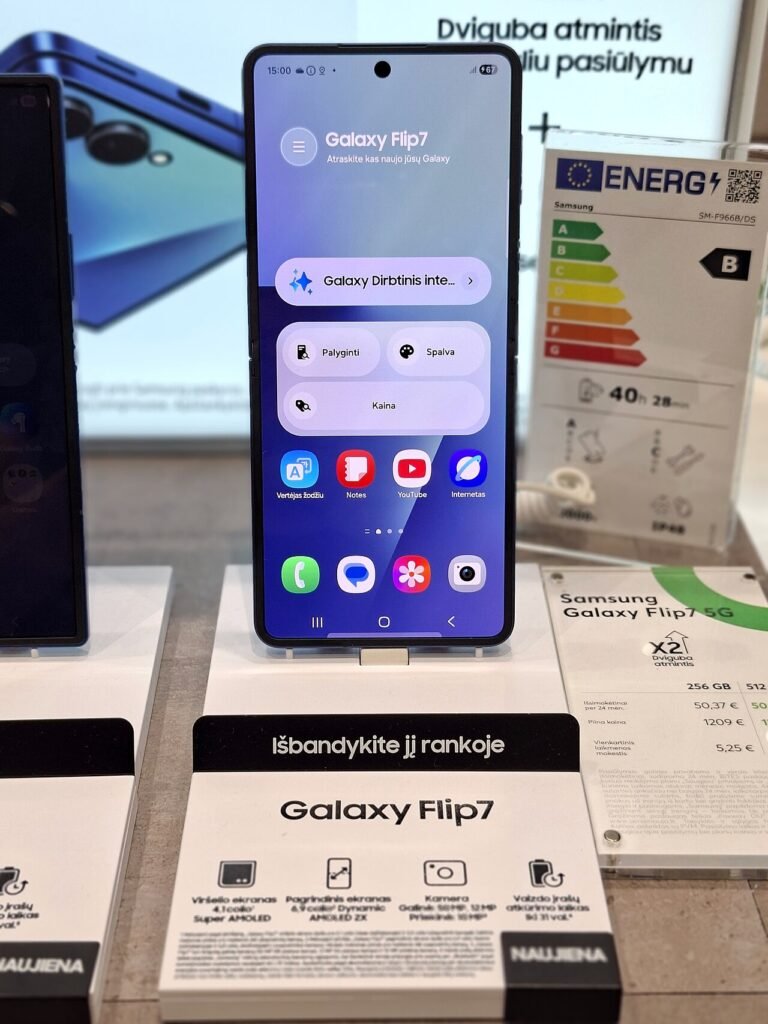
Put a Galaxy Z Flip 8 and a Galaxy Z Flip 7 side by side on a table and most people could not tell you which is which. Same flat sided clamshell. Same 4.1-inch cover screen wrapping around the same two cameras. Same 6.9-inch display when you open it up.
That is not an accident. Samsung treated the Flip 8 as a refinement year, and the list of things it actually changed is short enough to fit on an index card: the chip, the weight, the thickness, the hinge and the software. Everything else carried over. Meanwhile the price went up by $100, and the Flip 7 has spent most of 2026 getting cheaper.
So the honest question is not which phone is better. The Flip 8 is better, slightly, in almost every way that matters. The question is whether the gap is worth paying for, and the answer depends a lot more than usual on which country you are buying in.
Galaxy Z Flip 8 vs Z Flip 7: specs side by side
Rows highlighted in yellow are the ones where the two phones actually differ. Notice how few there are.
| Spec | Galaxy Z Flip 8 | Galaxy Z Flip 7 |
|---|---|---|
| Launch price (256GB) | $1,199.99 | $1,099.99 |
| Chip (US) | Snapdragon 8 Elite Gen 5 for Galaxy | Exynos 2500 (3nm) |
| Chip (most other markets) | Exynos 2600 (2nm) | Exynos 2500 (3nm) |
| Weight | 180g | 188g |
| Thickness (unfolded / folded) | 6.1mm / about 13.1mm | 6.5mm / 13.7mm |
| Software at launch | One UI 9, Android 17 | One UI 8, Android 16 |
| Main display | 6.9-inch AMOLED, 2520 x 1080, 1 to 120Hz | Same |
| Cover display | 4.1-inch FlexWindow, 948 x 1048, 120Hz | Same |
| Peak brightness | 2,600 nits | Same |
| RAM / storage | 12GB / 256GB or 512GB | Same |
| Rear cameras | 50MP main, 12MP ultrawide | Same |
| Selfie camera | 10MP | Same |
| Battery / charging | 4,300mAh, 25W wired, 15W wireless | Same |
| Durability | IP48, Armor Aluminum, Gorilla Glass Victus 2 | Same |
| OS updates | 7 years (to 2033) | 7 years (to 2032) |
Price: the Flip 7 keeps getting cheaper
Samsung announced the Galaxy Z Flip 8 at Galaxy Unpacked in July 2026 and it went on sale on August 7. It starts at $1,199.99 for 256GB and climbs to $1,399.99 for 512GB. The Flip 7 launched a year earlier at $1,099.99 and $1,219.99 for the same two storage tiers.
That is a $100 increase at the bottom and a $180 increase at the top, for a phone with the same memory and storage. Samsung has not said so directly, but the timing lines up with the memory shortage that has pushed up component costs across the industry. It is the same pressure that led Samsung to raise Galaxy S26 prices months after launch.
The Flip 7 has gone the other way. It has repeatedly sold for $899.99 at Amazon and Samsung’s own store during 2026 sales, and with Black Friday a few weeks away, deeper cuts are likely as retailers clear stock.
Performance: why the US buyer gets the bigger upgrade
This is the part of the comparison that changes depending on where you live, and it is the part most spec sheet roundups gloss over.
The Galaxy Z Flip 7 used Samsung’s own Exynos 2500 everywhere, including the United States. That was unusual, since American Galaxy flagships have traditionally used Qualcomm chips, and it showed. The Exynos 2500 is fine for messaging, browsing, split screen and Samsung DeX, but reviewers consistently flagged performance as one of the Flip 7’s weaker areas. It warms up quickly during long gaming sessions and slows down to compensate.
For the Flip 8, Samsung split the lineup. In the US the phone uses the Snapdragon 8 Elite Gen 5 for Galaxy, the same family of chip found in Samsung’s top foldables. In the UK and many other markets it uses the new 2nm Exynos 2600, which Samsung says delivers up to 39% faster CPU performance than the Exynos 2500.
Both are meaningful upgrades. But an American moving from a Flip 7 to a Flip 8 is jumping from a midcycle Exynos to Qualcomm’s current flagship silicon, while a European is moving from one Exynos generation to the next. If you game on your phone, edit video, or lean heavily on Galaxy AI features that run on device, the Flip 8 has noticeably more headroom, and the US model has the most of all.
- US and Australia: Flip 8 with Snapdragon 8 Elite Gen 5 for Galaxy vs Flip 7 with Exynos 2500. Biggest jump.
- UK and most of Europe: Flip 8 with Exynos 2600 vs Flip 7 with Exynos 2500. Solid generational jump.
- Either way: both phones have 12GB of RAM, so the difference is processing power and thermals, not multitasking capacity.
Design and hinge: the upgrade you feel 80 times a day
On paper the Flip 8’s physical changes look trivial. It is 8g lighter (180g versus 188g), 0.4mm thinner when open (6.1mm versus 6.5mm), and around half a millimeter thinner when closed (roughly 13.1mm versus 13.7mm). The footprint is fractionally larger, about 0.2mm taller and wider unfolded.
The change that matters more is the hinge. Samsung revised its Armor FlexHinge to reduce internal friction and widened the inner edges so there is more room for your fingers when prying the phone open. Early hands on testing from multiple outlets describes the Flip 8 as noticeably easier to open and close than the Flip 7.
That sounds like a footnote until you remember how often you do it. A flip phone gets opened and closed dozens of times a day, every day, for years. A smoother, easier action is the kind of improvement you stop noticing after a week and immediately miss if you go back.
Both phones keep the IP48 rating, so they survive submersion in fresh water but should be kept away from sand and dust. Both use an Armor Aluminum frame and Gorilla Glass Victus 2 on the outside.
Displays: a tie, and a good one
Samsung carried both screens over unchanged. Inside, both phones have a 6.9-inch, 2520 x 1080 AMOLED panel with a 1 to 120Hz adaptive refresh rate and 2,600 nits of peak brightness. Outside, both have the 4.1-inch FlexWindow at 948 x 1048 that wraps around the cameras.
The Flip 7’s displays were one of its strongest features, bright and clear even in direct sunlight, so the lack of change is not a problem. The Flip 8’s cover screen does feel more useful in daily life, but that comes from software rather than the panel, and the Flip 7 is getting much of the same software through One UI 9.
Cameras: same hardware, better video tools
Again, nothing changed in the camera bump. Both phones use a 50MP main camera and a 12MP ultrawide on the back with a 10MP selfie camera inside. Neither has a telephoto lens, so zoom beyond 2x is digital cropping on both.
The Flip 7 already took good photos with natural color and a strong portrait mode, and the flip design lets you use the main camera for selfies with the cover screen as a viewfinder. That trick works identically on both.
The Flip 8’s additions are aimed at video. Camcorder Grip puts recording and zoom controls within thumb reach when you hold the half folded phone sideways like an old camcorder. Super Steady with Horizontal Lock keeps footage level even as the phone rotates. Early testers found Horizontal Lock genuinely impressive, with the usual caveat that aggressive stabilization crops the frame and costs some sharpness.
Battery: still a one day phone
Pre launch reports suggested the Flip 8 might get a slightly larger cell. It did not. Both phones use a 4,300mAh battery with 25W wired and 15W wireless charging, which is slow by 2026 standards and well behind the best Chinese foldables.
The Flip 7 generally made it through a full day in testing, with heavy camera use or gaming pushing it toward an evening top up. The Flip 8’s newer, more efficient chip should help a little, especially on the Snapdragon model, but nobody should expect a transformation. Plan on charging both every night.
Software and support: one extra year
The Flip 8 ships with One UI 9 on Android 17, which adds a proper app tray on the FlexWindow and lets you rearrange cover screen widgets without opening the phone or digging into Good Lock. The Flip 7 launched on One UI 8 and Android 16 and is already in line for One UI 9, so most of those cover screen features will reach it. Our guide to One UI 9 rollout dates tracks where each Galaxy device stands.
Both phones get seven years of Android and security updates. Because the Flip 8 starts a year later, its support window ends a year later.
In practice, hinge wear and battery health are more likely to end a foldable’s life than the update calendar. Seven years is a long time for a phone that bends in the middle.
Which one should you buy?
There is one more option worth mentioning. Samsung still sells the cheaper Galaxy Z Flip 7 FE, which uses an older chip and a much smaller 3.4-inch cover screen. It is the budget way into a Samsung foldable, but the full size FlexWindow is half the reason to own a modern Flip, and a discounted standard Flip 7 is usually the smarter buy.
For the full picture of what Samsung launched alongside the Flip 8, including the two new Fold models, see our Galaxy Unpacked 2026 recap.
FAQ
Is the Galaxy Z Flip 8 worth upgrading to from the Flip 7?
For most Flip 7 owners, no. The displays, cameras, battery and charging are the same. The upgrade is mainly a faster chip, a lighter body and a smoother hinge, and the Flip 7 will get One UI 9.
Does the Galaxy Z Flip 8 have a bigger battery?
No. Both phones use a 4,300mAh battery with 25W wired and 15W wireless charging.
What chip does the Galaxy Z Flip 8 use in the US?
The US model uses the Snapdragon 8 Elite Gen 5 for Galaxy. Many other markets, including the UK, get the Exynos 2600. The Flip 7 used the Exynos 2500 in every region.
How long will the Galaxy Z Flip 7 and Z Flip 8 get updates?
Samsung promises seven years of OS and security updates for both, which takes the Flip 7 to 2032 and the Flip 8 to 2033.
Are the cameras different on the Z Flip 8?
The hardware is identical: 50MP main, 12MP ultrawide and 10MP selfie. The Flip 8 adds video features such as Camcorder Grip and Super Steady with Horizontal Lock.
About this article: GeekBlog covers U.S. technology news, AI, phones, smartwatches and gaming. Every story is written and checked under our Editorial Policy. Spotted a mistake or have a story tip? Contact our editors.
