

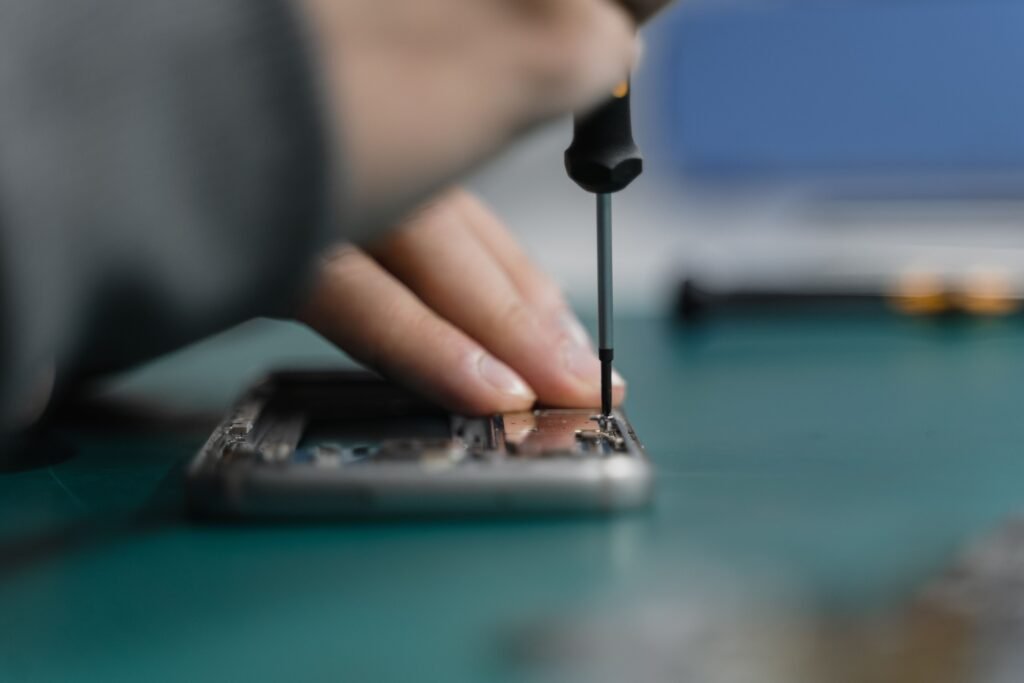
A battery is the dumbest expensive component in your phone. It holds charge, it reports a rough voltage, and it degrades on a schedule nobody can stop. That simplicity is why the third-party replacement market exists at all: a pouch of lithium with two contacts is not hard to copy, and the copies are a fraction of the price of an official repair.
Samsung appears to be about to make it harder. According to a report from South Korean trade publication The Elec, the company is preparing to embed cryptographic authentication chips directly into its smartphone battery packs, starting with the Galaxy A series and a volume of roughly 50 million units in 2027 alone. Samsung has not confirmed it, and a company official told the publication they could not comment on next-generation development direction.
The stated reasons are good ones. The consequences are more complicated than the reasons, and the timing is the most interesting part of the whole story.
What the report actually says
It is worth separating the reported details from the speculation, because most coverage has blurred the two.
| Detail | What is reported | Confidence |
|---|---|---|
| First devices | Galaxy A series, Samsung’s largest selling segment | Reported |
| Volume | Around 50 million units under discussion for 2027 | Reported |
| Technology | VIA PUF, a physical unclonable function | Reported |
| Chip suppliers | Analog Devices and ICTK splitting supply | Reported |
| Process node | Samsung foundry 28nm among others | Reported |
| Pack assembly | Samsung SDI bonds chips to battery pouches | Reported |
| Behavior with a non-genuine battery | Not stated anywhere in the report | Unknown |
| Flagship S series rollout | Not mentioned. A series only, for now | Unknown |
That last-but-one row is the whole ballgame. An authentication chip that logs a warning in a diagnostics menu is a mild inconvenience. An authentication chip that disables fast charging, hides battery health readings, or throws a persistent notification is a different product with the same silicon inside it. Nothing in the reporting tells us which one Samsung is building.
What a PUF chip is, and why it is not just a serial number
The technology choice here is more interesting than the usual “security chip” boilerplate suggests, and it explains why this is hard to defeat.
A conventional authentication chip stores a secret key in memory. Extract the key, and you can clone the part forever. That is why counterfeit accessory chips exist for almost every product that has ever used one.
A physical unclonable function works the other way around. Instead of storing a secret, it derives one from physical randomness that occurs naturally during manufacturing and cannot be controlled even by the fab that made it. VIA PUF specifically exploits microscopic variation in the vias, the tiny vertical connections between metal layers in a chip. Whether a given via forms a complete connection at the margins of the process is effectively a coin flip, and the pattern of those coin flips across thousands of vias becomes a fingerprint. The key is not written to the chip. It is the chip.
This is proven technology rather than a research project. PUFs are already used in automotive parts, payment hardware and industrial supply chain authentication, and ICTK has been shipping VIA PUF commercially for years. Putting one on a 28nm node keeps the die cost low enough to justify across 50 million budget phones, which is the practical constraint that has kept this out of cheap devices until now.
The safety argument is real
It would be easy to treat this cynically, and it is worth resisting that for a moment, because the counterfeit battery problem is genuinely dangerous in a way most component counterfeiting is not.
A fake camera module produces bad photos. A fake battery produces thermal runaway. Counterfeit lithium packs routinely skip the protection circuitry that prevents overcharge and over-discharge, use cells with overstated capacity ratings, and omit the separator quality controls that stop an internal short from becoming a fire. The failure mode is not a phone that works badly. It is a phone that ignites on a nightstand.
Samsung has a particular institutional memory here. The Galaxy Note 7 recall in 2016 cost the company billions and was caused by battery manufacturing defects in packs Samsung itself sourced. Any proposal inside Samsung that reduces the chance of a battery fire being attributed to a Galaxy phone has a very short path to approval, regardless of what else it accomplishes.
We have seen this movie, and we know how it ended
Apple ran this exact experiment first, which gives us something better than speculation about how it plays out.
Starting with the iPhone XR and XS in 2018, Apple began authenticating batteries. A replacement that did not pass would show an “Unknown Part” or service message, and crucially, the Battery Health screen would stop reporting capacity and peak performance capability. The battery worked. The phone simply stopped telling you anything useful about it, including on genuine Apple batteries swapped between two genuine Apple phones, because the pairing was to the specific device rather than to the part’s legitimacy.
That distinction is what made parts pairing a legislative target rather than a consumer grumble. Oregon passed SB 1596 in March 2024, the first state law in the US to ban parts pairing outright, going further than California’s right-to-repair statute by making the practice itself unlawful for devices from 2025. Apple had lobbied against the bill, arguing that pairing protects security and ensures safe operation of critical components, specifically naming the battery. Around the same period Apple announced it would loosen its approach, allowing used genuine parts and moving calibration onto the device itself for the iPhone 16 generation.
| Approach | What the phone does | Where it sits legally |
|---|---|---|
| Inform | Shows a one-time notice that the part is not original, then behaves normally | Uncontroversial, permitted everywhere |
| Degrade | Hides battery health, limits charge speed, nags persistently | The practice Oregon’s law targets |
| Refuse | Will not charge or boot on an unauthenticated pack | Squarely illegal under several statutes |
The useful thing about that table is that the chip is compatible with all three. Samsung gets to choose, and the choice is a software policy decision made years after the hardware ships. That is the part worth watching, and it is the part nobody has reported.
The 2027 collision nobody is talking about
Here is where the timing gets genuinely awkward. The chip rollout is reported for 2027. So is something else.
From February 18, 2027, EU rules require that portable batteries in products including smartphones and tablets be designed so an end user can remove and replace them using commercially available tools. If a specialized tool is needed, it must be supplied free or at reasonable cost with the device. There are carve-outs where waterproofing or safety would be compromised, which is the loophole most manufacturers are expected to lean on, but the direction of travel is unambiguous: Brussels wants the battery to be the part you can swap.
So Samsung’s highest volume phone line is scheduled to acquire cryptographic battery authentication in the same year European law makes those batteries user replaceable. Both things can be true simultaneously. The regulation governs whether you can physically get the battery out. It says nothing about whether the replacement you put in has to be blessed by the manufacturer.
The recycling case Samsung points to is not nothing, incidentally. Lithium recovery today processes packs with wildly different chemistries, ages and degradation states through identical procedures, which is wasteful. A chip carrying charge cycle count and thermal history lets a recycler sort cells by actual condition rather than by label. That is a real efficiency gain, and it is also the kind of benefit that accrues to the manufacturer and the recycler rather than to you.
What this means if you own a Galaxy A
Nothing immediately. No shipping phone has these chips, and the first devices that might would arrive in 2027 at the earliest. If you own a Galaxy A17 or a similar current model today, its battery is as replaceable tomorrow as it was yesterday.
The change matters on a longer horizon, and it matters most for exactly the people who buy this tier of phone. The Galaxy A line is Samsung’s volume seller precisely because it is cheap, and a cheap phone’s economics depend on cheap repair. When an official battery replacement costs a meaningful fraction of a new budget handset, the third-party option is not a preference, it is the difference between repairing and discarding.
How much of this should you believe?
The Elec has a strong record on Korean component supply chain reporting, and the specificity here works in its favor. Named suppliers, a named process node, a named assembly partner and a unit volume are the texture of genuine sourcing discussions rather than rumor. Supply chain stories of this shape are usually accurate about what is being negotiated.
They are less reliable about what ships. A 50 million unit volume “under discussion” is a procurement conversation, not a purchase order, and component plans get cut at this stage regularly. Samsung’s official line is that it cannot confirm technology direction for next-generation products, which is neither a denial nor an acknowledgement.
What seems safe to assume is the direction. Component authentication is becoming standard across the industry for reasons that combine genuine safety, genuine supply chain integrity and entirely genuine commercial interest in the repair aftermarket. The specific question of whether Samsung follows the Galaxy A rollout with flagships, and how much the phone punishes you for an unrecognized pack, will be answered by a software release rather than by this report.
Frequently asked questions
Will my current Samsung phone stop accepting third-party batteries?
No. This is a hardware change that would arrive on future devices from 2027 at the earliest, beginning with the Galaxy A series. Phones already in your hand do not gain authentication chips through a software update, because the chip has to be physically present inside the battery pack.
What is a PUF chip?
A physical unclonable function. Rather than storing a secret key that could be read out and copied, it generates a unique identifier from random physical variations created during manufacturing. VIA PUF, the variant reported here, uses microscopic differences in the vias connecting a chip’s metal layers. Because the randomness is a byproduct of physics rather than something the factory chooses, it cannot be deliberately reproduced.
Is this the same thing Apple does with parts pairing?
The underlying idea is similar, but nothing reported so far says Samsung will restrict functionality on an unauthenticated battery, which is the part that made Apple’s implementation controversial. Apple hid Battery Health data on unpaired batteries. Whether Samsung does anything comparable is unknown and will come down to software policy.
Which Samsung phones get this first?
The Galaxy A series, Samsung’s midrange and budget line, which accounts for the largest share of its smartphone shipments. Around 50 million units are reportedly under discussion for 2027. There is no reporting on whether the Galaxy S flagships follow.
Does the EU replaceable battery rule stop this?
No. From February 2027 EU rules require that users be able to remove and replace phone batteries with commonly available tools. That governs physical access to the battery, not whether the phone authenticates what you install. The two requirements can coexist, and that is the tension at the heart of this story.
Are third-party batteries actually dangerous?
Counterfeit ones can be, genuinely so. Packs that omit protection circuitry or use substandard cells are a real fire risk. Reputable aftermarket batteries from established manufacturers are a different category, but an authentication chip cannot distinguish a good independent battery from a bad one. It only distinguishes genuine from not genuine.
The bottom line
The technology here is sound and the stated justifications hold up. Counterfeit lithium packs really do start fires, PUF authentication really is close to uncounterfeitable, and per-cell history really would make recycling smarter. If Samsung ships this and uses it to warn people that the battery a market stall just installed is not what it claimed to be, that is a straightforwardly good outcome.
The reason to pay attention anyway is that the same chip, unchanged, is also the foundation for locking the repair market down, and that decision gets made in software long after anyone stops reporting on it. Samsung is adding this to the cheapest phones it sells, the ones whose owners are least able to absorb an official repair price, in the same year Europe decides those batteries must come out easily. Whether the thing you put back in has to carry Samsung’s signature is the question that actually determines what a Galaxy A costs to own, and nobody has asked it out loud yet. Devices with batteries the owner can genuinely pop out remain rare enough to be news, and this is a reminder of why.
Sources and further reading
- The Elec: Samsung Electronics to add authentication security chips to smartphone batteries
- TechRadar: Samsung is tipped to add security chips to Galaxy phones
- MacRumors: Oregon’s right to repair law bans parts pairing restrictions
- iFixit: Apple finally promises to enable third-party parts (mostly)
- European Commission: Batteries and the digital product passport
