Close Menu
GeekBlog

    Subscribe to Updates

    Get the latest creative news from FooBar about art, design and business.

    What's Hot

    OpenAI allegedly sent police to an AI regulation advocate’s door

    October 11, 2025

    Samsung Galaxy XR leak shows dual 4K micro‑OLED displays

    October 11, 2025

    The Vampire Lestat New Teaser

    October 11, 2025
    Facebook X (Twitter) Instagram Threads
    GeekBlog
    • Home
    • Mobile
    • Tech News
    • Blog
    • How-To Guides
    • AI & Software
    Facebook
    GeekBlog
    Home»Tech News»2025 Nobel Prize in Physics awarded for macroscale quantum tunneling
    Tech News

    2025 Nobel Prize in Physics awarded for macroscale quantum tunneling

    Michael ComaousBy Michael ComaousOctober 7, 20252 Mins Read
    Share Facebook Twitter Pinterest LinkedIn Tumblr Email Copy Link
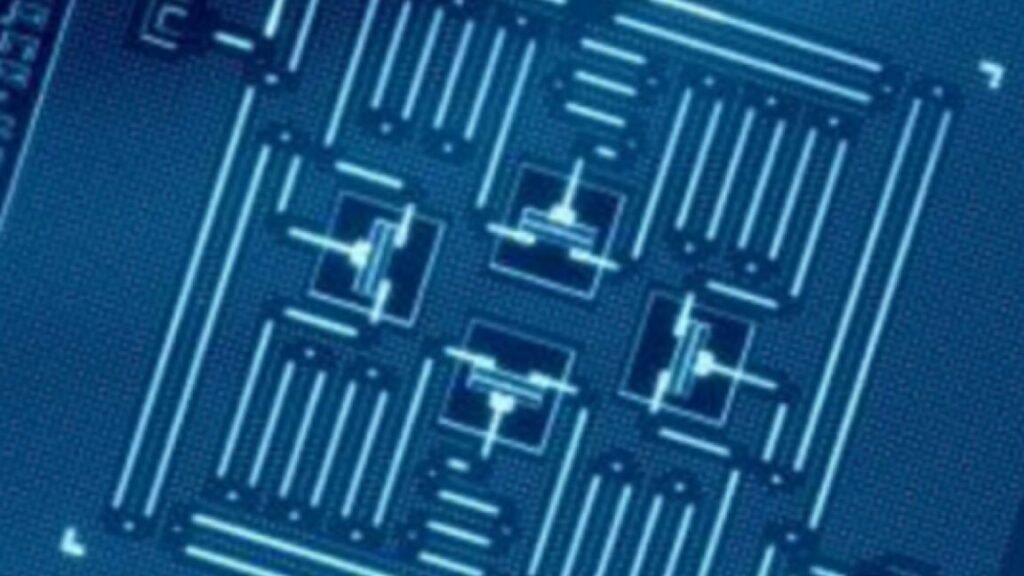
    A device consisting of four transmon qubits, four quantum buses, and four readout resonators fabricated by IBM and published in npj Quantum Information in January 2017.
    Share
    Facebook Twitter LinkedIn Pinterest Email Copy Link

    (l-r): John Clarke, Michel H. Devoret, and John M. Martinis.


    Credit:

    Niklas Elmehed/Nobel Prize Outreach

    From subatomic to the macroscale

    Clarke, Devoret, and Martinis were the first to demonstrate that quantum effects, such as quantum tunneling and energy quantization, can operate on macroscopic scales, not just one particle at a time.

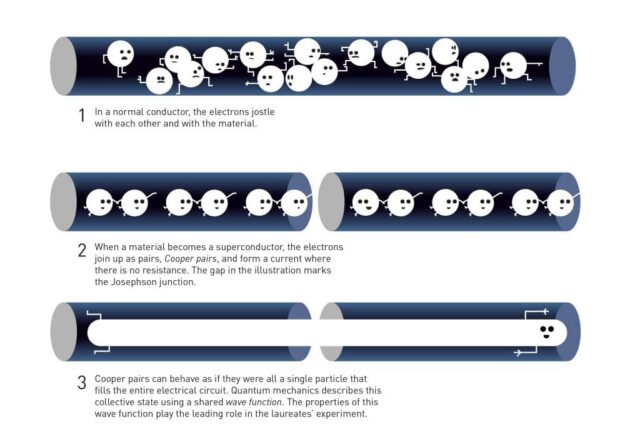
    After earning his PhD from University of Cambridge, Clarke came to the University of California, Berkeley, as a postdoc, eventually joining the faculty in 1969. By the mid-1980s, Devoret and Martinis had joined Clarke’s lab as a postdoc and graduate student, respectively. The trio decided to look for evidence of macroscopic quantum tunneling using a specialized circuit called a Josephson junction—a macroscopic device that takes advantage of a tunneling effect that is now widely used in quantum computing, quantum sensing, and cryptography.

    A Josephson junction—named after British physicist Brian Josephson, who won the 1973 Nobel Prize in physics—is basically two semiconductor pieces separated by an insulating barrier. Despite this small gap between two conductors, electrons can still tunnel through the insulator and create a current. That occurs at sufficiently low temperatures, when the junction becomes superconducting as electrons form so-called “Cooper pairs.”

    The team built an electrical circuit-based oscillator on a microchip measuring about one centimeter in size—essentially a quantum version of the classic pendulum. Their biggest challenge was figuring out how to reduce the noise in their experimental apparatus. For their experiments, they first fed a weak current into the junction and measured the voltage—initially zero. Then they increased the current and measured how long it took for the system to tunnel out of its enclosed state to produce a voltage.

    Credit:

    Johan Jarnestad/The Royal Swedish Academy of Sciences

    They took many measurements and found that the average current increased as the device’s temperature falls, as expected. But at some point, the temperature got so low that the device became superconducting and the average current became independent of the device’s temperature—a telltale signature of macroscopic quantum tunneling.

    awarded macroscale Nobel Physics Prize Quantum tunneling
    Share. Facebook Twitter Pinterest LinkedIn Tumblr Telegram Email Copy Link
    Previous ArticleFederal judge blocks Trump's National Guard deployment to Oregon
    Next Article Illinois, Chicago sue to block President Trump's Guard deployment
    Michael Comaous
    • Website

    Michael Comaous is a dedicated professional with a passion for technology, innovation, and creative problem-solving. Over the years, he has built experience across multiple industries, combining strategic thinking with hands-on expertise to deliver meaningful results. Michael is known for his curiosity, attention to detail, and ability to explain complex topics in a clear and approachable way. Whether he’s working on new projects, writing, or collaborating with others, he brings energy and a forward-thinking mindset to everything he does.

    Related Posts

    2 Mins Read

    OpenAI allegedly sent police to an AI regulation advocate’s door

    3 Mins Read

    Samsung Galaxy XR leak shows dual 4K micro‑OLED displays

    2 Mins Read

    The Vampire Lestat New Teaser

    3 Mins Read

    Yes, your iPhone can track every place you visit – here’s how to turn it off

    2 Mins Read

    These SteelSeries Earbuds Are Great for Gaming and Are 35% Off Right Now

    2 Mins Read

    Trump admin fires more health employees amid government shutdown

    Top Posts

    The Mesh Router Placement Strategy That Finally Gave Me Full Home Coverage

    August 4, 2025166 Views

    Past Wordle answers – all solutions so far, alphabetical and by date

    August 1, 202581 Views

    How to Turn Off Voicemail on Android Quickly and Easily

    August 2, 202567 Views
    Stay In Touch
    • Facebook

    Subscribe to Updates

    Get the latest tech news from FooBar about tech, design and biz.

    Most Popular

    The Mesh Router Placement Strategy That Finally Gave Me Full Home Coverage

    August 4, 2025166 Views

    Past Wordle answers – all solutions so far, alphabetical and by date

    August 1, 202581 Views

    How to Turn Off Voicemail on Android Quickly and Easily

    August 2, 202567 Views
    Our Picks

    OpenAI allegedly sent police to an AI regulation advocate’s door

    October 11, 2025

    Samsung Galaxy XR leak shows dual 4K micro‑OLED displays

    October 11, 2025

    The Vampire Lestat New Teaser

    October 11, 2025

    Subscribe to Updates

    Get the latest creative news from FooBar about art, design and business.

    Facebook
    • About Us
    • Contact us
    • Privacy Policy
    • Disclaimer
    • Terms and Conditions
    © 2025 geekblog. Designed by Pro.

    Type above and press Enter to search. Press Esc to cancel.