

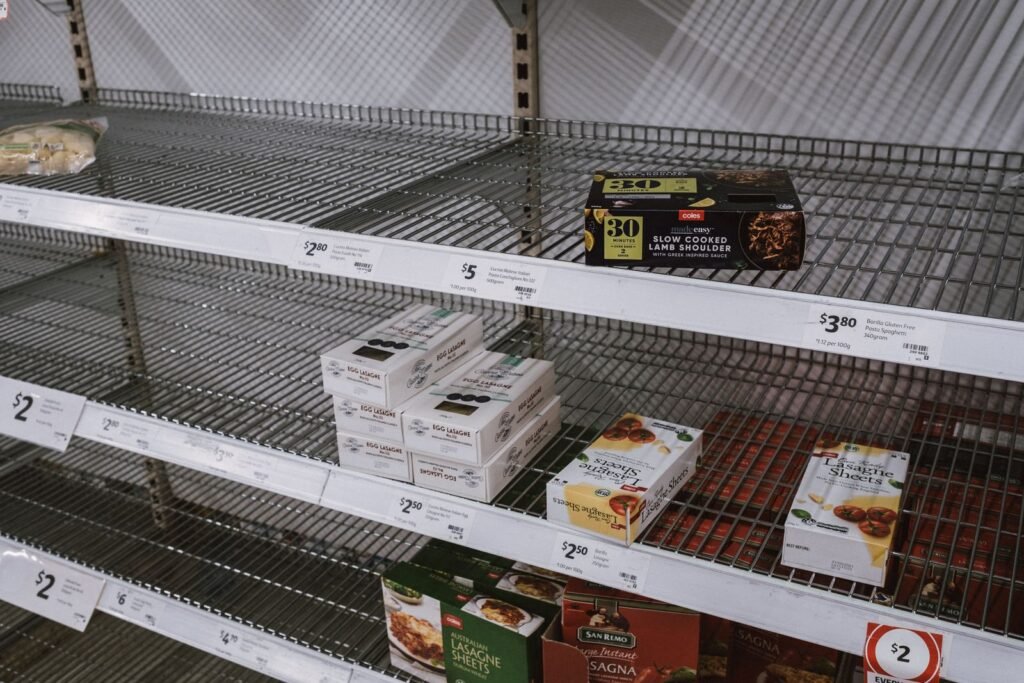
Imagine walking into your grocery store and finding the card readers dark, the freezers warm and the shelves half empty. Now imagine that every store in the country looks like that at the same time.
That’s the scenario Dutch supermarkets are now planning for. They call it “fase zwart,” or phase black. As UNILAD Tech reported, the term has spread far beyond the Netherlands this week, and it lands at a moment when a string of cyberattacks and outages has a lot of people wondering how fragile the food supply really is.
The short version
- Phase black is the Dutch food industry’s name for the worst case: war, a massive cyberattack or a nationwide blackout that stops normal food distribution.
- The plan turns selected existing supermarkets into emergency stores, not new buildings.
- The goal: every resident within 15 minutes by car or 30 minutes by bike of one.
- Those stores need backup generators and a way to restock without computers. Most don’t have either yet.
- Dutch researchers warn shelves can empty in two to three days and now suggest households keep eight days of food.
What “phase black” actually means
The plan is being drawn up by the CBL (Centraal Bureau Levensmiddelenhandel), the trade group for Dutch supermarkets and food service companies, together with the government. The Dutch newspaper AD first reported the details, and Dutch security outlet BeveiligingNieuws followed up.
It covers emergencies ranging from local disruptions to large scale disasters and war. In the worst of them, the normal machinery of grocery shopping simply stops: electricity, payment systems, telecom networks and the warehouse software that tells trucks where to go.
It’s worth being clear on one thing. This is a preparedness plan, not a warning that something is about to happen. Nobody in the Netherlands has declared phase black. The industry is deciding what it would do if it ever had to.
Why now: the attacks that spooked the industry
CBL director Marc Jansen says recent incidents put the planning “in a stroomversnelling,” a Dutch phrase for something that suddenly speeds up. Two events stand out.
Albert Heijn, Netherlands
A cyberattack on the country’s biggest grocery chain led it to shut systems down as a precaution. Shelves emptied temporarily. Food security was never at risk, but the CBL calls it a clear warning.
Cooling systems, France
Attackers hit digital refrigeration controls at hundreds of French stores, including Coopérative U, Intermarché and Carrefour locations. Spoiled stock showed a hack can destroy food, not just data.
That second attack is the one that should worry anyone who thinks “it’s just an IT problem.” We broke down how it worked when hackers turned supermarket freezers up to 122°F across Europe. Grocery stores now run on connected fridges, connected tills and just in time deliveries. When the software stops, so does the food.
How the emergency stores would work
The Netherlands has about 4,500 supermarkets. Only some will be picked, based on where people live. “There will be more in densely populated areas and fewer in sparsely populated ones,” Jansen explained. “Our goal is for everyone to be able to reach a store within 15 minutes by car or half an hour by bike.”
What a phase black store needs that a normal one doesn’t
1. Its own power
Backup generators for lights, doors, tills and cooling. Most stores have none today.
2. Offline operation
A way to sell food when payment networks and store software are down.
3. Analog restocking
Paper based resupply, because rival chains run different computer systems and can’t easily share stock.
4. A short list
A limited range of essential foods instead of the thousands of products on a normal shelf.
Albert Heijn, Jumbo, Lidl, Aldi and nearly every other major and regional chain are involved through the CBL. Big questions are still open, including exactly which products the stores will carry, where reserves will be kept and who pays for all those generators. Those talks are happening with the Dutch Ministry of Agriculture.
Shelves empty faster than you’d think
Researchers at Radboud University have warned that supermarket shelves could be empty within two to three days of a serious disruption. In September 2026, they recommended households keep eight days of food at home, well beyond the standard three day advice.
How long governments say your supplies should last
Official household guidance, in days. Sources: national preparedness agencies, Radboud University
UK, France, Canada, Japan, Mexico, Netherlands, EU: 3 days (72 hours)
Sweden, Norway: 7 days
Radboud University researchers (Netherlands): 8 days
Germany: 10 days
American Red Cross (sheltering at home): 14 days
In the US, FEMA’s Ready.gov tells people to have enough food and water for several days, and the Red Cross suggests a two week supply if you’re staying put at home. Newsweek has mapped 31 countries that have now issued some kind of preparedness warning to citizens, with advice that varies a lot from place to place.
Phase black vs. “Black Sky”
If phase black sounds familiar, you may be thinking of Black Sky, the term emergency planners use for a long, wide area power grid failure. Phase black is basically the food version. Black Sky asks “what happens when the power goes out for days?” Phase black asks “and then how does anyone buy groceries?”
The two overlap a lot. In a real grid collapse, your phone becomes far less useful than you’d expect, which we explained in our look at why a full battery won’t save you in a Black Sky blackout. A battery or hand crank radio quickly becomes the most important gadget in the house.
Should you be worried?
Not panicked, but prepared. Speaking in the Philippines ahead of the APEC summit, President Trump brushed off the recent wave of outages, saying: “It’s life. When you’re big and powerful and have all the money, things like that happen.” Planners in Europe are taking a less relaxed view, but even they stress that the goal is to prepare without triggering panic buying.
A simple phase black kit for a US household
- Water: 1 gallon per person per day.
- Food: canned and dry foods you actually eat, plus a manual can opener.
- Cash: small bills. Card readers don’t work without power or networks.
- Radio: battery or hand crank, ideally with NOAA weather bands.
- Light and power: flashlights, spare batteries and a charged power bank.
- Health: first aid kit and a week or more of any prescription meds.
- Papers: copies of IDs and insurance in a waterproof bag.
One easy rule: build the kit slowly. Add a few extra cans to every grocery trip and rotate them so nothing expires. You’ll have a week of food in a month without ever being “that person” clearing the shelves.
The bottom line
Phase black isn’t a prediction. It’s an admission that modern grocery shopping depends on power, software and networks that can all fail at once, and that the Netherlands would rather figure out the backup plan now than during a crisis. The most useful takeaway for everyone else is the one Dutch researchers keep repeating: shelves can empty in two to three days. Whether your number is three days, eight or fourteen, it’s worth knowing how long your own pantry would last.
About this article: GeekBlog covers U.S. technology news, AI, phones, smartwatches and gaming. Every story is written and checked under our Editorial Policy. Spotted a mistake or have a story tip? Contact our editors.
