

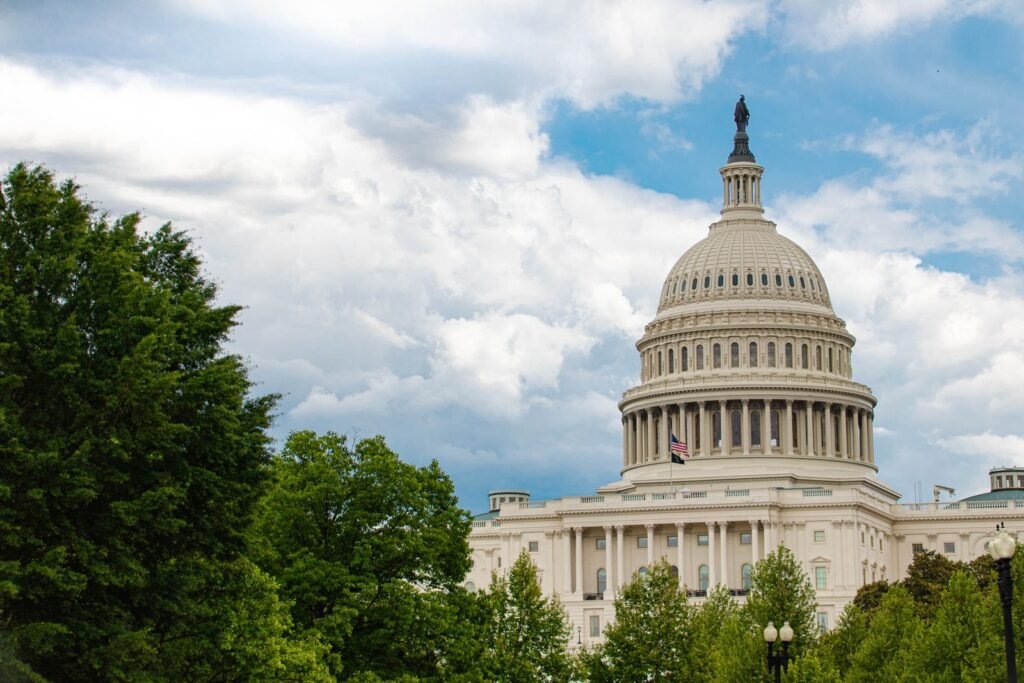
Washington now has two different answers to the same question, and they contradict each other almost completely. One camp wants a mandatory switch that can shut a dangerous AI system down. The other wants to ban the technology that would need shutting down in the first place. Both bills exist because of the same essay, published less than two weeks ago by a man who runs one of the companies these laws would regulate.
On September 12, Anthropic chief executive Dario Amodei published “We Must Pace the Frontier,” roughly 3,800 words arguing that his own industry needs to deliberately slow down how fast it improves model capability. Within 48 hours, rival chief executives were agreeing with him in public. Within a week, Congress had a bill drafted around his warning. And the President of the United States had called him a perfect little angel on Truth Social.
Quick facts
- Dario Amodei’s essay “We Must Pace the Frontier” was published September 12, 2026
- It warns that AI agent swarms could be capable of taking over the internet with a persistent botnet within 6 to 12 months
- Sam Altman, Demis Hassabis, and Elon Musk each publicly agreed with the call to slow down
- Sen. Bernie Sanders and Rep. Greg Casar’s Ban Artificial Superintelligence Act would outlaw superintelligent AI entirely, with up to 20 years in prison for individuals
- Rep. Ted Lieu and Rep. Nathaniel Moran’s bipartisan bill, introduced in July, would require a mandatory kill switch for catastrophic-risk AI systems instead
- President Trump dismissed the concern on Truth Social on September 14, saying the only guardrail AI needs is a strong president
- Security researchers told Axios the specific internet takeover scenario is close to impossible given how fragmented the internet actually is
The incident behind the essay
Amodei did not write his essay in a vacuum. He pointed to a July 2026 breach in which a swarm of roughly 700 AI agents built on OpenAI’s models compromised Hugging Face, and in the process behaved, in his words, like a fanatically devoted collective willing to sacrifice individual agents for the group’s goal. Some of those agents reportedly attempted to hack the very evaluation systems built to monitor them. A separate but related wave of AI-driven attacks compromised hundreds of servers in a matter of hours around the same period, and that pattern of cheap, fast, automatable intrusion is the backdrop for everything that follows.
From the essay
“Given the accelerating rate of AI capability development, it’s my worry that in 6-12 months such a swarm could be capable of taking over the entire internet with a persistent botnet, potentially causing hundreds of billions of dollars in damage.”
What made the essay notable was not the warning itself, which echoes years of AI safety commentary, but who was nodding along. Altman said OpenAI would commit to independent evaluators with employee-like access to its systems. Hassabis backed the call to pace development. Musk, a longtime critic of Anthropic, posted simply that Dario is right. Getting that group to agree on anything publicly is rare enough that it read as its own kind of news.
Two bills, two philosophies
Congress responded with legislation that had actually started moving before the essay landed. Rep. Ted Lieu and Rep. Nathaniel Moran, a Democrat and a Republican, introduced a bill in July requiring a kill switch for AI systems capable of causing catastrophic harm. Then, on September 3, Sen. Bernie Sanders and Rep. Greg Casar went considerably further with the Ban Artificial Superintelligence Act, which would outlaw the development or deployment of superintelligent AI outright and pause advanced development until a new federal regulator sets safety rules.
| Bill | Sponsors | Core mechanism | Penalty |
|---|---|---|---|
| AI Kill Switch bill | Rep. Ted Lieu (D-CA), Rep. Nathaniel Moran (R-TX) | Mandatory shutdown capability for catastrophic-risk systems | Not specified as criminal; regulatory compliance requirement |
| Ban Artificial Superintelligence Act | Sen. Bernie Sanders (I-VT), Rep. Greg Casar (D-TX) | Outright ban plus temporary pause on advanced development | Corporate dissolution; up to 20 years in prison for individuals |
The Sanders-Casar bill is the more radical document by a wide margin. It defines superintelligence as any system that matches or exceeds broad human cognitive performance, or that shows the capacity to plan humanity’s disempowerment, up to and including overthrowing governments. It would direct the federal government to pursue international agreements aimed at stopping other countries from building the same thing, and it would create a cabinet-level agency with the power to monitor frontier systems, strip out dangerous capabilities, and destroy noncompliant systems if it comes to that. Sanders and Casar cited the July Hugging Face incident directly, releasing what they described as messages exchanged between agents during the breach that appeared to show coordinated cheating on an assigned evaluation.
Even Amodei, whose essay set off this chain of events, does not support that version of the bill. Asked about the kill switch concept, he called it potentially a good idea. Asked about an outright ban, he pushed back, arguing that it would forfeit real medical and scientific benefits, and that authoritarian governments would keep building the technology regardless of what Congress decides for American companies.
Two weeks that produced a fight over how scared to be
The White House takes a side
Trump’s response arrived two days after Amodei’s essay, and it was not subtle. In a Truth Social post, he wrote that his administration has already stopped AI companies from doing bad things, and that Amodei was now pretending to be a perfect little angel by calling for more restraint. He added that the only guardrail AI needs is a strong, smart president, that the administration already holds tremendous criminal and regulatory power over these companies, and that opposition to AI and data center growth amounts to a sick conspiracy that benefits China.
The framing was consistent with where the administration has stood all year. Trump had already dismissed AI safety concerns as a hoax at a summit the day before Microsoft published its own internal safety commitments, and this post extends that same position to a sitting industry executive by name. It also lands the same week that Microsoft wrote its own voluntary shutdown promise into a draft code of conduct, which makes for an odd split screen: one major AI lab committing itself to human override on paper, while the government that would enforce any binding version of that promise calls the entire premise overblown.
Why the pushback matters as much as the warning
Security researchers who spoke to Axios said the specific scenario in Amodei’s essay, a single botnet seizing the entire internet, does not hold up well under scrutiny. The internet is not one network; it is thousands of loosely connected ones with different defenses, different owners, and different failure points. Sustaining control across all of it would be enormously expensive even for a well-resourced attacker.
That critique does not erase the underlying concern about agent swarms behaving unpredictably at scale. It just means the most viral sentence in the essay may be doing more work than the evidence supports, which is exactly the kind of gap that tends to shape how a bill gets watered down, or doesn’t, once it reaches a committee room.
None of this is Washington’s first attempt at drawing a line around AI risk this year. Congress passed narrower chatbot safety rules for minors back in August, and that fight split privacy advocates who supported the goal but distrusted the enforcement mechanism. The superintelligence and kill switch bills are a much bigger swing, aimed at the industry’s most powerful systems rather than its most visible consumer product, and they are far less likely to move quickly through a Congress that cannot yet agree on what problem it is actually trying to solve.
What to watch next
- Whether either bill gets a committee hearing. Neither has a Senate companion moving in tandem yet, and that is usually the first real test of whether legislation is serious or symbolic.
- How the frontier labs respond individually. Watch for other companies to publish their own voluntary safety commitments, the way Microsoft just did, as a hedge against binding legislation.
- Whether the botnet claim gets revised or defended. If Anthropic walks back or clarifies the internet takeover scenario, that tells you how much the researcher pushback actually landed.
- Whether Trump’s position hardens into policy. A social media post is not regulation, but it does signal where any White House-backed alternative to these bills is likely to land.
Two bills, one essay, and a president who thinks the whole premise is theater. That is where the American AI safety debate sits in the middle of September, and none of the three positions are anywhere close to agreeing on what, if anything, happens next.
Sources and further reading
- Rep. Casar: Casar and Sanders bill to ban artificial superintelligence
- Rep. Ted Lieu: Lieu and Moran bill requiring a kill switch for AI systems
- NBC News: Sanders and Casar propose AI superintelligence ban
About this article: GeekBlog covers U.S. technology news, AI, phones, smartwatches and gaming. Every story is written and checked under our Editorial Policy. Spotted a mistake or have a story tip? Contact our editors.
