

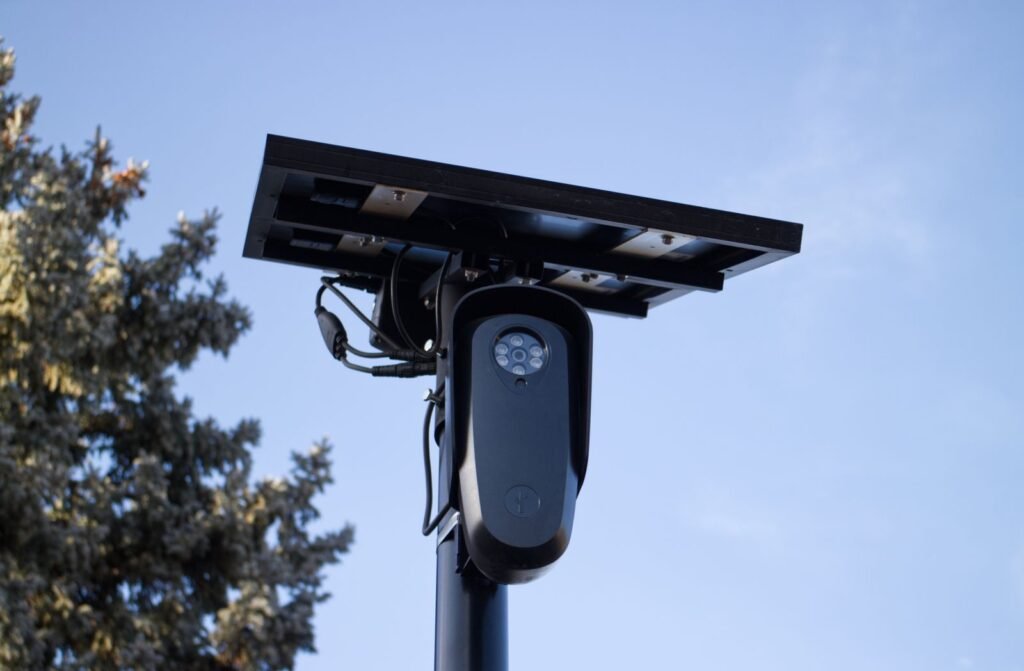
For most of the last five years, the honest answer to “how many automated license plate readers are watching my street” was that nobody outside the industry knew. The cameras went up on utility poles quietly, usually through a purchase order rather than a public vote, and the company that makes most of them has never published a location list.
That information gap is closing, and not because the vendors decided to be transparent. Volunteers built the map instead.
What a Flock Camera Actually Does
The hardware is unremarkable on purpose. A Flock unit is a small solar powered box on a pole, motion activated, usually pointed at a single lane of traffic. It does not need mains power or a data cable, which is the entire reason the rollout has been so fast. A crew can install one in an afternoon almost anywhere a pole exists.
What it captures is more than a plate number. The system runs machine learning over each vehicle image to log make, model, color, roof racks, damage and even bumper stickers. Flock markets this as “Vehicle Fingerprint,” and the practical effect is that a search does not require knowing the plate. An officer can query for a silver sedan with a dent on the rear left panel and get every sighting across the network.
| Common assumption | How the system actually works |
|---|---|
| It reads plates and nothing else | It also logs make, model, color and distinguishing marks, so a plateless search still works |
| Only my town’s police can see my town’s cameras | Agencies can share access with each other, which is how local data reaches distant departments |
| Data is deleted almost immediately | Retention is set per contract, commonly 30 days, and varies by jurisdiction |
| The cameras were approved at a public meeting | Many were bought through routine procurement with no separate public vote |
None of this is secret in the sense of being classified. It is in the marketing material. It is simply that very few residents have read the marketing material for a product they never bought.
The Numbers, and Why They Disagree
Flock’s own figure is more than 120,000 cameras across 49 states. Independent mapping efforts have verified a smaller number, with roughly 95,923 Flock cameras confirmed in the United States as of mid July 2026. The gap is not necessarily a contradiction. Crowdsourced maps only contain cameras somebody has physically spotted and reported, so they will always trail the real total.
The more striking statistic is the growth rate. In the July 2026 dataset, around 85 percent of all logged ALPR locations had been added in the previous twelve months. That is partly a mapping artifact, since the volunteer effort itself scaled up over that period, and partly a genuine reflection of how fast these went up.
| Project | What it gives you | Best for |
|---|---|---|
| DeFlock | Camera locations contributed to OpenStreetMap, plus a running tally of cancelled or rejected contracts | Checking your neighborhood and tracking local policy changes |
| FlockHopper | Interactive map covering 120,000 plus locations, with routing between two points | Seeing which cameras sit along a specific drive |
Both are open contribution projects, which cuts both ways. Coverage is uneven, entries can be stale, and a camera on the map may have been removed months ago. Treat them as a strong indication rather than an authoritative registry.
The Federal Data Question
The sharpest criticism aimed at Flock is not about the cameras. It is about who ends up reading the database.
Flock’s position is that it does not share data with Immigration and Customs Enforcement directly. Reporting over the past year has established a different route to the same outcome: local police departments with Flock access have shared that access with federal agencies, using the network’s agency to agency sharing features. The company can be technically accurate about its own conduct while the data still travels.
This is a familiar shape. The pattern of private platforms becoming a convenient side door for federal requests showed up before, when Reddit, Meta and Google were reported to have voluntarily handed DHS information on anti-ICE users. The mechanism differs, the structural problem does not. A dataset collected for one stated purpose is one policy change away from serving another.
It is also not only about plates any more. The industry is steadily widening what these roadside units collect, and we have covered how license plate readers are learning to track your phone rather than just your car, which turns a vehicle log into something much closer to a personal movement record.
The Backlash Has Teeth Now
Opposition to these cameras used to be a mailing list activity. In 2026 it started winning votes. Dozens of city councils have either cancelled Flock contracts or rejected proposals to buy in, and DeFlock has tallied more than twenty instances of governments ending, rejecting or deactivating deployments since July alone.
The corporate side has felt it too. Ring walked away from its planned integration after public anger, a decision we covered when Ring killed its Flock Safety deal following the Super Bowl ad uproar. When a doorbell company decides an association is toxic, that is a reasonable read on where public sentiment sits.
There is a less constructive strand as well. Damaged and destroyed cameras have been documented in Oregon, Virginia, Michigan and elsewhere. It is worth being clear that this is vandalism, it is prosecutable, and it tends to hand the vendor a sympathetic story at exactly the moment the policy argument is going the other way. The councils cancelling contracts are achieving considerably more than the people with angle grinders.
What Flock Says in Its Defense
The company’s case is straightforward and not frivolous. Departments using the network cite recovered stolen vehicles, located missing persons and closed cases that would otherwise have gone cold. Flock publishes case studies to that effect, and police chiefs turn up to council meetings to defend the tool because they believe it works.
The counterargument is not that the cameras never solve crimes. It is that a permanent, searchable, nationwide record of where ordinary vehicles have been is a significant thing to build without a public debate, and that most of it was built without one. Those two positions can both be true, which is exactly why this is being fought street by street rather than settled in one ruling.
The Bottom Line
The maps changed the argument. It is much harder for a council to wave away a surveillance question when a resident can project an image of the specific pole outside the specific elementary school.
If you want to know what is watching your commute, you can now find out in about two minutes. What you do with that is a local politics problem, and local politics is, at the moment, where this is actually being decided.
