Close Menu
GeekBlog

    Subscribe to Updates

    Get the latest creative news from FooBar about art, design and business.

    What's Hot

    A Toddler Needed a $20,000 Wheelchair. A High School Robotics Team Built Him One Instead.

    August 5, 2026

    AI’s Memory Boom Is Quietly Crushing the Budget Smartphone

    August 5, 2026

    Scientists Didn’t Say Earth Is Becoming Uninhabitable. Here’s What the “Hothouse Earth” Study Actually Says

    August 5, 2026
    Facebook X (Twitter) Instagram Threads
    GeekBlog
    • Home
    • Mobile
    • Tech News
    • Blog
    • How-To Guides
    • AI & Software
    Facebook
    GeekBlog
    Home»Tech News»New York’s ‘Big Bang Machine’ Passes Critical First Test
    Tech News

    New York’s ‘Big Bang Machine’ Passes Critical First Test

    Michael ComaousBy Michael ComaousSeptember 3, 20253 Mins Read
    Share Facebook Twitter Pinterest LinkedIn Tumblr Email Copy Link
    New York's 'Big Bang Machine' Passes Critical First Test
    Share
    Facebook Twitter LinkedIn Pinterest Email Copy Link

    Recommended for you:

    How to Prevent Tech Neck and Sit Properly With Your Laptop (2025)
    Tech News·Sep 4, 2025

    How to Prevent Tech Neck and Sit Properly With Your Laptop (2025)

    We know very little about the first few microseconds after the Big Bang. We have theories, most of which we’re still double- and triple-checking to see if they actually make scientific sense. The research process can seem tedious at times, but a newcomer from Long Island offers promising advances in our quest to understand how our universe came to be.

    In a recent paper for the Journal of High Energy Physics, researchers with the sPHENIX Collaboration announced that it had passed a “standard candle” test with flying colors, correctly catching and measuring the energy level of colliding gold ions traveling close to the speed of light.

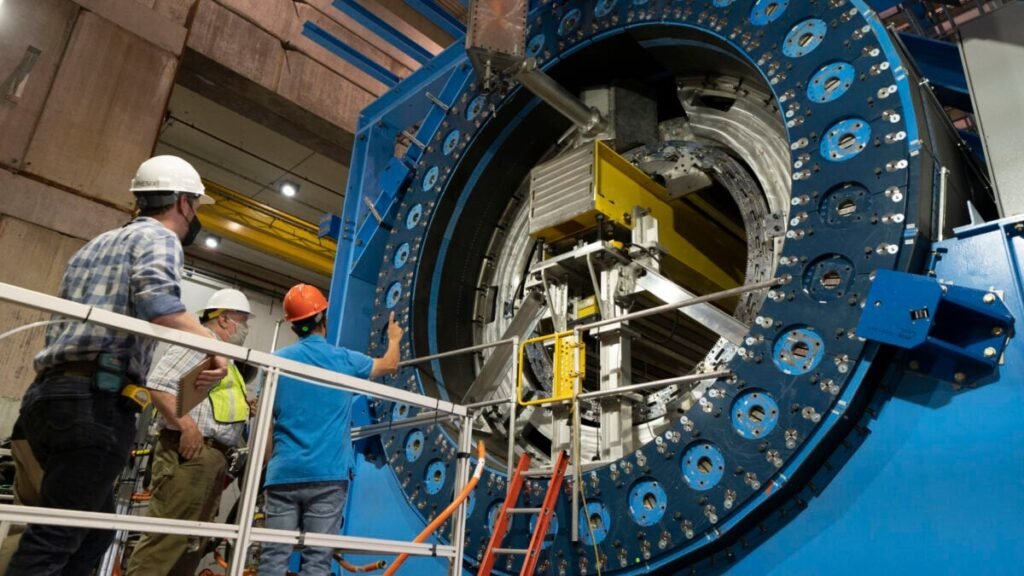
    The sPHENIX detector is a 1,000-ton, two-story-tall instrument equipped with a powerful camera that catches and measures 15,000 particle collisions per second. It’s the much-awaited upgrade to PHENIX, a now-retired detector at the Brookhaven National Laboratory’s Relativistic Heavy Ion Collider (RHIC).

    “This indicates the detector works as it should,” Gunther Roland, a physicist at MIT and the sPHENIX Collaboration, told MIT News. “It’s as if you sent a new telescope up in space after you’ve spent 10 years building it, and it snaps the first picture. It’s not necessarily a picture of something completely new, but it proves that it’s now ready to start doing new science.”

    The hot mess of the early universe

    Quarks and gluons are fundamental particles that make up protons and neutrons. Usually, these two particles are nearly impossible to pull apart, unless they’re in an environment with extremely high temperatures and pressures—such as the few microseconds immediately after the Big Bang.

    Under such conditions, quarks and gluons would have existed separately in a dense, soupy plasma known as the quark-gluon plasma (QGP). The RHIC attempts to replicate these conditions by flinging particles in opposite directions. When some of these particles smash into one another, they release a gigantic load of energy that exists very briefly—for a sextillionth of a second—as QGP.

    “You never see the QGP itself—you just see its ashes, so to speak, in the form of the particles that come from its decay,” Roland said. “With sPHENIX, we want to measure these particles to reconstruct the properties of the QGP, which is essentially gone in an instant.”

    The ‘Big Bang machine’

    Passing the test bodes well for the detector’s future. However, the team wants to put it through a few more quality checks. The sPHENIX detector is like a “giant 3D camera” tracking the number, energy, and paths of particles generated by a single collision, the researchers said.

    A schematic of sPHENIX, a detector with precision particle tracking capabilities. Key components include outer and inner hadronic calorimeters, an electromagnetic calorimeter, tracking systems, and a superconducting solenoid magnet. Credit: Brookhaven National Laboratory

    “sPHENIX takes advantage of developments in detector technology since RHIC switched on 25 years ago to collect data at the fastest possible rate,” Cameron Dean, a postdoctoral student at MIT and a member of the sPHENIX Collaboration, also told MIT News. “This allows us to probe incredibly rare processes for the first time.”

    Ironically, the very features that make sPHENIX so impressive are also why it requires a lot of maintenance. But the researchers are hopeful they’re on the right path. As of now, sPHENIX is busy collecting data for RHIC’s 25th and final run, after which the collider’s successor, the Electric-Ion Collider, will take over.

    “The fun for sPHENIX is just beginning,” Dean said.

    Recommended for you:

    Another iPhone 17 price leak has appeared – and it’s not good news ahead of Tuesday’s Apple event
    Tech News·Sep 4, 2025

    Another iPhone 17 price leak has appeared – and it’s not good news ahead of Tuesday’s Apple event

    Share. Facebook Twitter Pinterest LinkedIn Tumblr Telegram Email Copy Link
    Previous Article52 of the Best TV Shows on Netflix That Will Keep You Entertained
    Next Article The Paper review: it doesn’t hit its stride until it’s out of the office
    Michael Comaous
    • Website

    Michael Comaous is a dedicated professional with a passion for technology, innovation, and creative problem-solving. Over the years, he has built experience across multiple industries, combining strategic thinking with hands-on expertise to deliver meaningful results. Michael is known for his curiosity, attention to detail, and ability to explain complex topics in a clear and approachable way. Whether he’s working on new projects, writing, or collaborating with others, he brings energy and a forward-thinking mindset to everything he does.

    Related Posts

    6 Mins Read

    AI’s Memory Boom Is Quietly Crushing the Budget Smartphone

    6 Mins Read

    Meta Wants an AI Agent Managing Your Life. Wall Street Isn’t So Sure

    6 Mins Read

    MakuluLinux’s New AI-OS Wants to Run Your Whole Desktop, Not Just Answer Questions

    7 Mins Read

    AI Tokens Got 98% Cheaper. Corporate AI Bills Are Exploding Anyway

    7 Mins Read

    Hackers Are Hijacking Hotel Wi-Fi to Steal Microsoft 365 Logins Without a Single Phishing Email

    5 Mins Read

    Microsoft’s Biggest Patch Tuesday Ever Just Showed Us Where Cybersecurity Is Heading

    Top Posts

    Best Stores for Buying MP3 and Digital Music You Can Keep Forever (2026)

    August 2, 202524 Views

    Every iPhone Camera Ranked in 2026 (Best to Worst)

    July 6, 202610 Views

    How to Fix PS5 Controller Stick Drift (2026): 7 Working Methods

    July 10, 20267 Views
    Stay In Touch
    • Facebook

    Subscribe to Updates

    Get the latest tech news from FooBar about tech, design and biz.

    Most Popular

    Best Stores for Buying MP3 and Digital Music You Can Keep Forever (2026)

    August 2, 2025930 Views

    Discord will require a face scan or ID for full access next month

    February 9, 2026770 Views

    Trade in your old phone and get up to $1,100 off a new iPhone 17 at AT&T – here’s how

    September 10, 2025383 Views
    Our Picks

    A Toddler Needed a $20,000 Wheelchair. A High School Robotics Team Built Him One Instead.

    August 5, 2026

    AI’s Memory Boom Is Quietly Crushing the Budget Smartphone

    August 5, 2026

    Scientists Didn’t Say Earth Is Becoming Uninhabitable. Here’s What the “Hothouse Earth” Study Actually Says

    August 5, 2026

    Subscribe to Updates

    Get the latest creative news from FooBar about art, design and business.

    Facebook
    • About Us
    • Contact us
    • Privacy Policy
    • Disclaimer
    • Terms and Conditions
    © 2026 GeekBlog

    Type above and press Enter to search. Press Esc to cancel.