

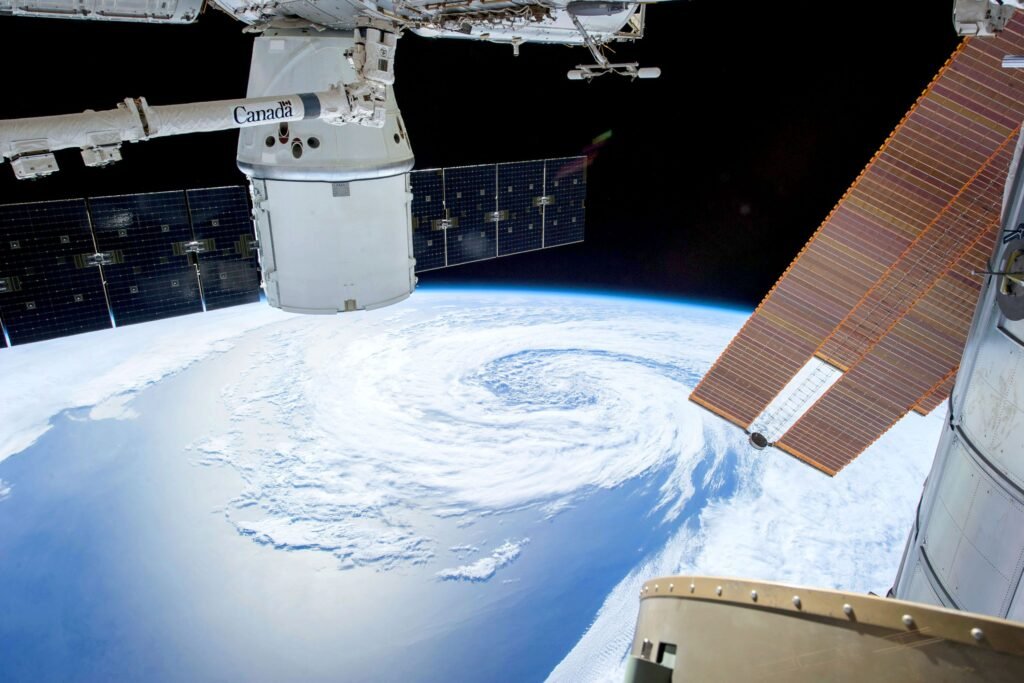
Every big AI company on Earth is currently fighting the same three battles: finding enough power, finding enough land, and finding enough water to keep their server farms running. Local governments are pushing back, utility bills are climbing, and some of the biggest data center projects in the country are getting delayed or scrapped outright over exactly these fights. So a handful of engineers at Google, and a small startup called Starcloud, have started asking a genuinely strange question. What if the easiest place to build the next generation of AI infrastructure isn’t on Earth at all?
It sounds like something out of a science fiction pitch meeting, but the idea has real money and real hardware behind it now. Google has already tested its custom AI chips in orbit conditions, and a satellite carrying an actual Nvidia GPU has already run a language model in space. Whether any of this scales into something that actually matters for the AI boom, or whether it quietly joins the pile of expensive tech ideas that never left the drawing board, is very much an open question.
The Pitch: Power That Never Runs Out
The logic behind orbital data centers starts with a simple physical fact. In the right orbit, roughly 600 kilometers up and aligned with the sun, a satellite can sit in continuous daylight almost all year round. No clouds, no nighttime, no weather delays, and no competing with a neighborhood for space on the local power grid. That is a genuinely appealing proposition for an industry that has spent the last two years running into exactly those constraints. Communities near proposed data center sites have been organizing against new construction over concerns about strained water supplies and rising electricity costs, and some of that same tension is now spilling into state-level fights over water and land use that are slowing down projects across the country.
Put a solar-powered server farm in orbit, the thinking goes, and you sidestep almost all of that. There is no aquifer to drain, no farmland to rezone, and no city council meeting to sit through. It is a pitch built for an industry that is growing faster than the physical world seems able to accommodate it.
Google Is Already Testing Chips in Space
Google’s version of this idea has a name: Project Suncatcher. The plan involves clusters of small satellites flying in a tight formation, spaced somewhere between 100 and 200 meters apart within a roughly one-kilometer radius, all linked together by high-speed optical connections so they behave like a single distributed computer. The company has partnered with the satellite imaging firm Planet to launch two prototype satellites carrying Google’s Trillium AI chips, with a test flight targeted for early 2027.
Before committing to that flight, Google’s engineers ran their chips through a proton beam to simulate years of space radiation exposure, and the results were better than expected. The memory systems on the chips only began showing meaningful errors at roughly three times the radiation dose the satellites would be expected to absorb over a five-year mission. That is a promising sign, but Google itself is careful not to oversell the timeline. Its own research points to 2035 as the earliest point at which space-based AI computing might actually be cost competitive with building the same capacity on the ground, and that assumption depends heavily on launch costs falling to under $200 per kilogram, roughly seven to eight times cheaper than what it costs to send payloads to orbit today.
A Startup Already Has an Nvidia GPU in Orbit
While Google is still in the testing phase, a smaller company called Starcloud has already put real AI hardware to work above the atmosphere. In late 2025, the company launched a satellite carrying an Nvidia H100 GPU, the same class of chip that powers much of the current AI boom on the ground, and used it to run Google’s open-source Gemma model along with a smaller language model trained on the works of Shakespeare. It was a modest demonstration, but a genuine first.
Starcloud’s ambitions go considerably further than a proof of concept. The company has laid out a roadmap for a five-gigawatt orbital data center by 2035, complete with solar and cooling arrays roughly four kilometers across, a scale that would dwarf even the largest power plants currently operating on Earth. Backing that vision are partnerships with Nvidia and cloud infrastructure firm Crusoe, both of which have a clear interest in seeing whether space can actually absorb some of the AI industry’s runaway hardware demand. That demand has already reshaped supply chains on the ground, driving the kind of component shortages that pushed memory chip prices to record highs earlier this year.
The Cooling Problem Nobody Can Fully Solve
Here is where the idea runs into physics that no amount of funding can simply engineer around. On Earth, data centers dump excess heat into air or water. In the vacuum of space, neither option exists. The only way to shed heat is through radiation, which is a far less efficient process, and it requires enormous surface area to work at any meaningful scale.
Engineers estimate that properly radiating away the heat from a single large orbital data center could require more than two million square feet of radiator panels. Even a modest 10-megawatt cluster, tiny by the standards of modern AI infrastructure, would need radiators roughly the size of two football fields just to keep its chips from cooking themselves. Scale that up to the gigawatt ranges companies are actually talking about, and the radiator arrays start to rival the solar panels in size, adding weight, cost, and complexity to every launch.
Radiation, Launch Costs, and a Crowded Sky
Cooling is not the only obstacle. Radiation in orbit steadily degrades electronics over time, which means chips either need heavy shielding, adding mass and cost, or software smart enough to detect and correct errors on the fly. Launch costs remain the single most sensitive variable in the entire equation. Every kilogram of hardware, shielding, and radiator material has to be lifted out of Earth’s gravity well, and even with reusable rockets driving prices down, that expense dominates the economics of any orbital facility far more than it does a terrestrial one.
Then there is the traffic problem. Space is getting crowded. SpaceX’s Starlink constellation alone performed roughly 300,000 collision avoidance maneuvers in 2025, and that was before anyone started launching data center hardware in bulk. Adding thousands more satellites, arranged in the tight formations these designs require, raises real concerns about collision risk and space debris that regulators have barely begun to address.
Is It Actually Greener?
One of the more uncomfortable findings for orbital data center advocates comes from researchers at Saarland University in Germany, who calculated the full emissions picture of launching, operating, and eventually deorbiting a solar-powered satellite cluster. Once rocket launches and atmospheric reentry are factored in, their model suggests an orbital data center could produce meaningfully more emissions over its lifetime than an equivalent facility built on the ground, even accounting for the free solar power. Critics have been blunt about what that implies, with some arguing the entire concept risks becoming a form of greenwashing dressed up as innovation, marketed as clean infrastructure while quietly carrying a heavier environmental footprint than the data centers it claims to replace.
Where This Actually Stands
None of this means orbital computing is a dead end. Google’s 2027 test flight and Starcloud’s continued satellite launches will produce real data over the next couple of years, and that data will do far more to settle this debate than any amount of speculation can right now. Nvidia’s continued involvement is also worth watching closely, given how central the company has become to the broader AI data center buildout happening on the ground.
What seems clear already is that space is not going to solve the AI industry’s power and land problems anytime soon. The most credible timelines put genuinely competitive orbital computing somewhere in the mid-2030s at the earliest, and that is assuming launch costs keep falling roughly on schedule and the cooling problem finds a better answer than bigger radiators. For now, the servers running your favorite chatbot are staying firmly on the ground. But for the first time, there is real hardware in orbit proving the idea is not pure fantasy either. It’s a long shot with a real prototype behind it, which in the AI industry right now, counts as a promising start.
