

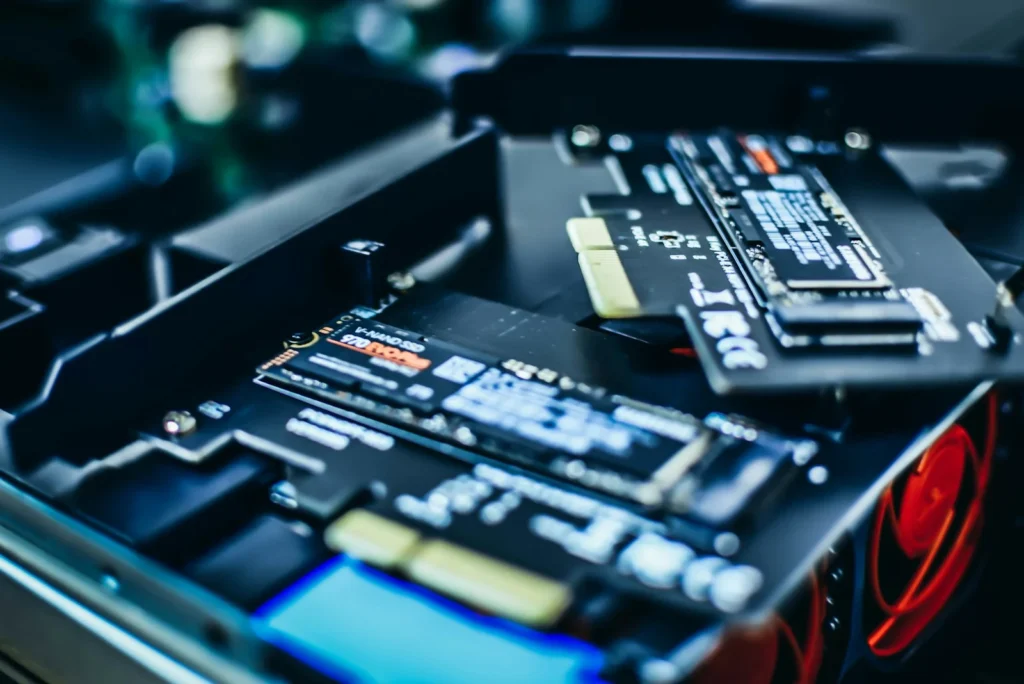
Sandisk has built a 256TB solid state drive, the largest in its UltraQLC enterprise platform, and it is aimed squarely at AI and hyperscale data centers. It is not a drive you will put in a gaming PC, but it shows where storage is heading as AI training sets and data lakes keep growing. Here is what Sandisk has officially announced, how the drive differs from ordinary SSDs, and what we know about availability as of October 2026.
What Sandisk announced
Sandisk revealed the UltraQLC platform on August 5, 2025, ahead of the Future of Memory and Storage conference in Santa Clara. The headline product was a 256TB NVMe SSD, which Sandisk called a milestone for enterprise capacity. Alongside it, the company named the Sandisk SN670, a 128TB NVMe drive on the same platform.
Sandisk positioned both drives for fast, capacity heavy AI work such as data ingestion, data preparation and AI data lakes, where huge volumes of information need to be read quickly and stored densely. The stated goal is lower total cost of ownership for hyperscale cloud operators that deploy storage by the rack.
| Spec | What Sandisk has confirmed |
|---|---|
| Capacity | 256TB (plus a 128TB SN670 model) |
| Interface | NVMe |
| Flash | BiCS8 QLC CBA NAND with 2Tb dies |
| Controller | Custom, scalable multicore design |
| First form factor | U.2, planned for the first half of 2026 |
| Later form factors | Expected later in 2026 |
Sandisk defines a terabyte as one trillion bytes and notes that usable capacity can be lower depending on the operating environment, which is standard wording for storage products.
Why there is no SLC cache
Most consumer SSDs that use QLC flash, which stores four bits per cell, hide its slower writes behind a cache. A slice of the drive acts as faster single bit storage, absorbs incoming data, and later rewrites it as dense QLC. That trick makes short bursts feel quick, but it also means data is written twice and can be exposed during that window if power fails.
Sandisk’s UltraQLC drives skip that step with what the company calls Direct Write QLC. Data goes straight to QLC on the first pass, and Sandisk says this makes writes power loss safe from the start. The tradeoff is the one storage engineers will watch: without a cache, short and spiky write bursts lean entirely on the controller and the parallelism of the flash. For read heavy AI data lakes that matters less than for write heavy databases, which is exactly the market Sandisk is targeting.
No SLC buffer, data lands on QLC in one pass
Up to 10% more performance at the same power, per Sandisk projections
Up to 33% fewer retention recycles than the SN655, per Sandisk projections
Why a 256TB SSD matters for AI
AI clusters are hungry for data, and the storage tier that feeds them has become a bottleneck. Hard drives still offer the lowest cost per terabyte, but they struggle with the parallel reads that GPU servers demand. Packing more flash into each slot helps in three ways:
- Density: doubling capacity per drive means fewer servers and racks for the same data set, which saves floor space.
- Power: fewer devices and features like Dynamic Frequency Scaling aim to cut energy use per terabyte, a growing concern for AI data centers.
- Speed: flash serves reads far faster than spinning disks, which keeps expensive accelerators busy instead of waiting on data.
Sandisk is not alone in this race. Rival Solidigm already sells an enterprise QLC drive in the 122TB class, and the step to 256TB is a sign that capacity per SSD is now climbing faster than many expected a few years ago.
Availability as of October 2026
Sandisk’s own schedule called for the U.2 version to ship in the first half of 2026, with additional form factors arriving later in the year. Enterprise drives like this are usually qualified with each customer before volume orders, so data center buyers should confirm timing and configurations directly with the company or its server partners. These drives are sold to cloud providers, server makers and large enterprises through direct and channel deals, so you will not find them in retail stores, and Sandisk has not announced a public price.
FAQ
Can I buy the Sandisk 256TB SSD?
Not as a consumer. It is an enterprise drive sold to data center customers, and there is no retail listing or public price.
Is the 256TB drive called the SN670?
In Sandisk’s announcement, SN670 is the name of the 128TB model. The 256TB drive is presented as the Sandisk UltraQLC 256TB NVMe SSD on the same platform.
What is QLC flash?
QLC stores four bits in each memory cell. That allows very high capacity at lower cost, but writes are slower and endurance is lower than with TLC flash.
Will consumer SSDs get this big?
Not soon. Consumer drives are limited by the M.2 size, cost and demand, so expect consumer capacities to grow far more gradually.
The verdict
The Sandisk UltraQLC 256TB is a statement about where AI infrastructure is going: denser flash, simpler write paths and lower power per terabyte. Its specs are impressive on paper, but real performance numbers are still thin, so data center buyers will judge it on independent results rather than projections.
Updated October 2026: rewritten as an explainer covering official specs, the cacheless design, the shipping timeline and why the drive matters for AI storage.
Featured photo: Marc PEZIN on Unsplash.
About this article: GeekBlog covers U.S. technology news, AI, phones, smartwatches and gaming. Every story is written and checked under our Editorial Policy. Spotted a mistake or have a story tip? Contact our editors.
