

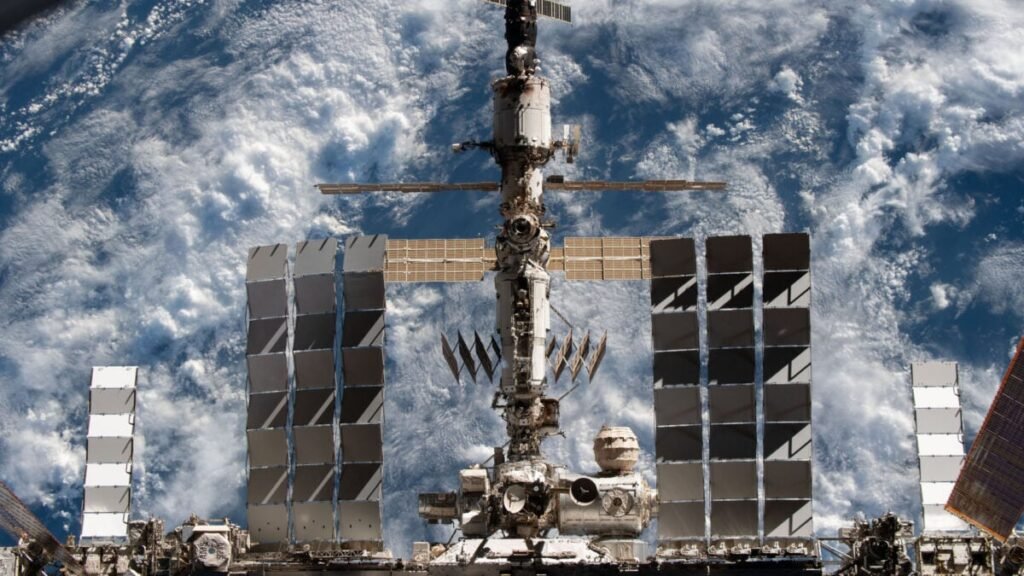
The International Space Station (ISS) is one of the most unique environments where life has ever existed, out in the low orbit of Earth. And research out today finds that bacteriophages—the viruses that prey on bacteria—can behave quite peculiarly in space.
Scientists studied how phages interacted with Escherichia coli bacteria aboard the ISS and compared them to pairs grown on Earth. The space-dwelling phages took longer to infect their hosts, while both the bacteria and viruses developed unusual mutations in response to each other and the microgravity conditions of the ISS, they found. The findings also suggest that phages in space could develop mutations useful to humans back home.
“Microbes continue to evolve under microgravity, and they do so in ways that are not always predictable from Earth-based experiments,” senior study author Vatsan Raman, a biomolecular and cellular engineer at the University of Wisconsin–Madison, told Gizmodo.
Phages in space
Studies have documented that many microbes and other tiny living things can thrive aboard the ISS, including the microorganisms left behind by touring astronauts. But according to Raman, there’s been relatively little research examining how these space microbes interact with each other, especially phages and the bacteria they infect to make more of themselves.
“Most microbial evolution experiments implicitly assume Earth-like physical conditions, but spaceflight changes fundamental aspects of the environment—how fluids mix, how cells encounter one another, and how physical forces shape cellular physiology,” he explained. “Phage infection depends critically on transport, encounter rates, and host physiology, all of which could plausibly change in space. We wanted to test whether microgravity simply slows these processes down, or whether it pushes phages and bacteria along different evolutionary paths altogether.”
They focused on a particular kind of phage that loves to munch on E. coli, known as T7.
The ISS phages were slower to infect their prey at first, likely because fluids don’t mix the same way under microgravity conditions, according to Raman. But once infection occurred, both the phages and bacteria rapidly adapted and often very differently from their Earth counterparts. The bacteria evolved in ways that seemed to boost their defenses against phage infection and enhance their survivability in space, while the phages evolved to more easily infect E. coli. What’s more, some of the genetic changes seen in the space phages were unlike anything seen on Earth.
“The main takeaway is that microgravity doesn’t just delay phage infection—it reshapes how phages and bacteria evolve together,” Raman said. “We observed mutations appearing in unexpected genes, including ones that are poorly characterized in standard laboratory settings.”
The team’s findings were published Tuesday in PLOS Biology.
What this means
The findings obviously have implications for space travel, especially longer-duration missions. The microbes living aboard the ISS and other space stations in the future aren’t just static tourists, and it’s certainly possible they could evolve in ways that have a real impact on the health of astronauts and the environment in general, Raman says.
That scary possibility aside, space phages could also help humanity. The team’s experiments on Earth found that several of the changes seen aboard the ISS made the phages better at attacking T7-resistant strains of E. coli that cause urinary tract infections in people.
Phages are already being developed as an alternative treatment for drug-resistant infections. And while it would be impractical to routinely run these sorts of experiments on the ISS, learning exactly how microgravity can shape the evolution of these microbes could allow scientists like Raman to apply those lessons to studies conducted on Earth.
“I hope this work encourages researchers to think of space not just as a place to reproduce Earth experiments, but as a fundamentally different physical environment that can uncover new biology—insights that ultimately circle back to improve research and applications here on Earth,” he said.
Looking ahead, the researchers now hope to better understand the specific genes and mutations in T7 phages that emerged under microgravity, particularly the ones not easily created in a standard lab. They also hope that similar studies in the future will reveal how space can change the biology of more complex microbial communities or medically relevant bacteria.
Source: gizmodo.com
