

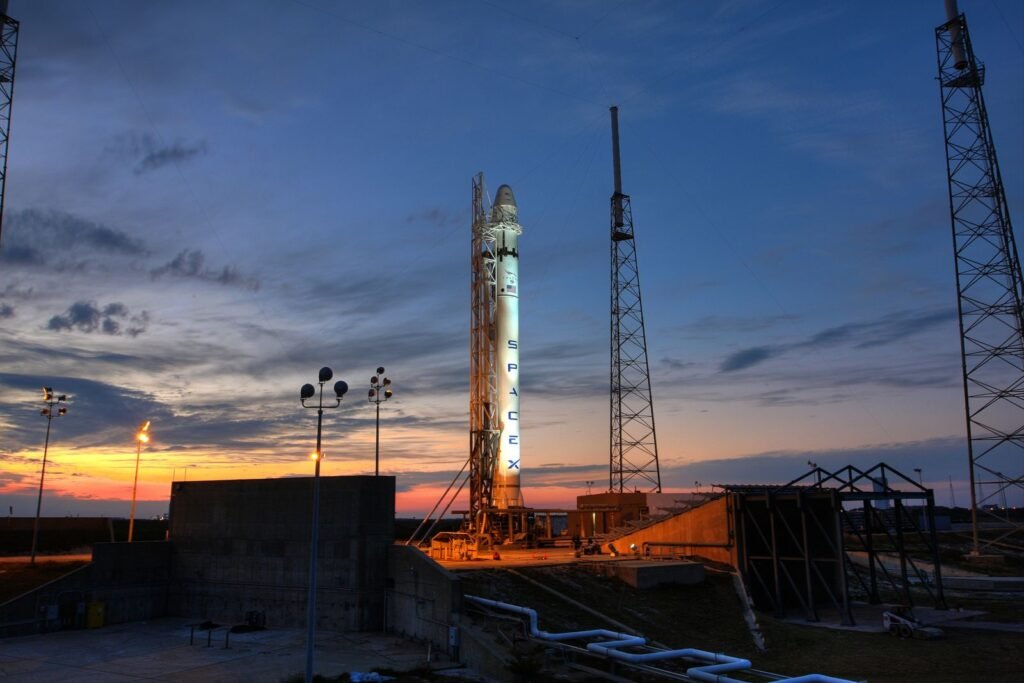
SpaceX says it will spend $100 billion turning 125,000 acres of Louisiana coastal marsh into the largest private spaceport on Earth. The site is Pecan Island, in Vermilion Parish, a stretch of Gulf Coast wetland roughly 150 miles west of New Orleans that most Americans could not find on a map. At full buildout it gets five launch complexes, ten Starship pads, propellant production, its own power generation, deep water shipping, an airport, and housing for the people who will work there.
That is the announcement, and it is genuinely enormous. The part that has gotten less attention is the calendar. Louisiana passed the laws that make this project possible in May. SpaceX confirmed the project in August. Three months separate the two, and the laws were written without anyone officially saying the word SpaceX.
The short version
- Where: Pecan Island, Vermilion Parish, Louisiana. 125,000 acres total, with roughly 40,000 acres given over to launch infrastructure
- How much: $100 billion, SpaceX’s fourth and by far largest launch site
- When: Construction starts in 2027, first launch targeted for 2029 at the earliest
- Jobs: 3,000 direct hires over ten years at an average of $92,600, which Louisiana Economic Development puts at 192% above the Vermilion Parish average wage, plus a projected 8,100 indirect jobs
- The catch: environmental, wetland and launch licensing reviews have not happened yet, and the site sits between two wildlife refuges
What SpaceX actually described
The company’s own framing is unusually plain about the scale of what it wants. “Starbase, Louisiana will be built to support thousands of Starship flights a year,” SpaceX wrote. “This self-sustaining spaceport will have propellant production, power generation, deep-water shipping capabilities, vehicle processing facilities, and an airport.”
Musk added the line that will end up in every retrospective: “We’re preparing to build a spaceport that, until now, has only existed in science fiction.”
Governor Jeff Landry’s response was about money rather than Mars. “This announcement pushes our state beyond $250 billion in new investment and puts us at the center of the next great frontier,” he said. “This is America First. This is Louisiana First.”
Thousands of flights a year, from a rocket that flew twice this year
Here is the number that puts the ambition in perspective. Starship has flown twice in 2026. It flew four times in 2024 and five times in 2025. The vehicle is not yet operational in any commercial sense, and the regulatory ceiling on the two existing sites is 25 launches a year from Starbase in Texas and up to 44 a year from Kennedy Space Center in Florida.
Against that, “thousands of Starship flights a year” is not a forecast. It is a statement of what the infrastructure is being sized for, which is a different thing entirely.
The laws came first
This is the part worth slowing down for. In the 2026 regular session, well before any public confirmation that SpaceX was the company in question, Louisiana lawmakers passed a package of bills tailored to aerospace projects. Governor Landry signed them in May.
| Bill | Became | What it does |
|---|---|---|
| HB 1071 | Act 101 | Exempts most state and local records tied to aerospace projects from public records requests |
| HB 1033 | Act 188 | Adds spaceports to the state’s critical infrastructure list, making unauthorized entry a felony |
| HB 1179 | Act 102 | Creates a property tax exemption for aerospace manufacturing |
| HB 1088 | Act 190 | Authorizes state and local sales tax rebates on materials used at aerospace facilities |
| HB 1250 | Signed | Gives aerospace companies a route to early dismissal of lawsuits over spaceport operations |
Read together, the package does something specific. It reduces what the public can find out about the project, raises the criminal stakes for anyone who walks onto the site, cuts the tax bill, and shortens the runway for litigation. None of that is unique to Louisiana or to SpaceX. States have been writing bespoke incentive law for decades. What is unusual is how completely the sequence ran in one direction, with the legal scaffolding finished before the project was named.
What Vermilion Parish gets instead of property tax
Because of the exemption, the parish will not collect ordinary property tax on the facility. In its place, Vermilion Parish is set to receive $25 million a year for 25 years, plus $20 million up front. The state values the total package of payments at more than $820 million.
For a rural parish, that is transformative money, and it is worth saying plainly that the local case for this deal is not hard to make. Vermilion Parish is not swimming in $92,600 salaries. The trade is a real trade.
The reviews that have not happened yet
State documents attached to the project are explicit that environmental, wetland, natural resource and launch related reviews are still outstanding. Unavoidable wetland impacts have to be fully mitigated by the company. Those are not small footnotes on a coastal site that doubles as a storm buffer for the communities behind it.
Louisiana loses land to the Gulf faster than almost anywhere in the country. Pecan Island’s receding marshes are part of what stands between heavy rain and flooded inland parishes, and the site is bordered on both sides by protected habitat. None of that necessarily stops the project. It does mean the 2029 launch date depends on a process that has not started in earnest.
Fights over what gets built on which land are becoming the defining tech story of this decade, and they do not always go the developer’s way. Earlier this month the Cherokee Nation banned hyperscale data centers on its reservation entirely, having concluded that the water and power costs were not worth the jobs. Different industry, same argument.
Where this fits in SpaceX’s map
| Site | Status | Starship pads | Annual launch ceiling |
|---|---|---|---|
| Starbase, Texas | Flying | Operational, plus expansion | 25 |
| Kennedy Space Center, Florida | Building | LC-39A conversion | Up to 44 |
| Cape Canaveral, Florida | Planned | In development | Under review |
| Starbase, Louisiana | Announced | 10, across 5 complexes | None yet, licensing not started |
Florida remains the workhorse for now, and the pad hardware there is a reminder of how much of a launch site sits below ground. The Apollo era complex SpaceX inherited at 39A still has a sealed blast bunker 40 feet under the pad that crews were meant to reach by slide. Louisiana would be starting from marsh, with no such inheritance and no such constraints.
Why now
The honest answer is satellites. Starship’s near term commercial case is putting very large numbers of very large payloads into orbit, and the demand SpaceX is planning around includes orbital compute and next generation constellations. A site that can process, fuel and fly vehicles at industrial cadence is the bottleneck, not the rocket.
It is also, unavoidably, a story about one person’s capacity to move state legislatures and capital markets at the same time. The scale of the numbers attached to Musk right now is its own genre of news, from a $100 billion spaceport to a Tesla pay package with an $824 billion tail. Treat both with the same skepticism you would apply to any figure announced years before anyone has to deliver it.
What to watch
Three things that decide whether 2029 is real
- The federal environmental review. Wetlands, migratory birds and two adjacent refuges make this a genuinely complicated file, not a formality.
- Starship’s flight rate in 2027. Ten pads only matter if the vehicle is flying often enough to need them.
- Whether the payments hold. The $25 million a year runs for a quarter century. Deals that long tend to get renegotiated at least once.
The spaceport may well get built. Louisiana clearly wants it, the money is real, and SpaceX has a habit of finishing what it starts on the ground even when the schedule slips. The thing worth remembering is that the state decided how this project would be reviewed, taxed and litigated before it told anyone whose project it was.
Sources and further reading
- Louisiana Economic Development: SpaceX $100 billion Louisiana campus announcement
- Louisiana Illuminator: Musk plans $100 billion SpaceX launch site in coastal Louisiana
- Fortune: SpaceX commits $100 billion to its largest spaceport in Louisiana
About this article: GeekBlog covers U.S. technology news, AI, phones, smartwatches and gaming. Every story is written and checked under our Editorial Policy. Spotted a mistake or have a story tip? Contact our editors.
