


Featured image: official EA Sports FC 27 key art. Source: Electronic Arts, official EA Sports FC 27 website
If you played FIFA in the late 1990s, you can probably still hear it: a warm, slightly fussy English voice reading out team sheets, reminding you of an obscure statistic, and getting genuinely excited when a long-range shot hit the top corner. That was John Motson, and as of today he is back in EA’s football series, three years after his death.
EA Sports FC 27’s Title Update v1.3.0, which went live on November 26, adds Motson as an optional commentator. His lines are a blend of the audio he recorded for EA between FIFA 96 and FIFA 2005 and brand new commentary produced by a generative AI model trained on those recordings. It is the first time the series has ever featured a commentator who has died, and EA paid his family for the right to do it.
The family calls it a touching tribute. A lot of players call it something much less flattering. Both reactions are worth taking seriously, because this is probably the cleanest version of “AI brings back a dead voice” the games industry is going to get, and it is still making people uneasy.
The short version
- What: an AI-assisted John Motson commentary option in EA Sports FC 27
- When: Title Update v1.3.0, November 26, 2026, on PlayStation, Xbox, PC and Nintendo Switch 2
- How: almost 10 years of his original FIFA recordings, extended with a generative AI model
- Consent: his widow and his son Fred approved it. EA paid an undisclosed fee
- Optional: Motson is not part of the default broadcast team. You have to pick him
- The debate: campaigners argue family approval should not replace a person’s own consent
What EA actually added to FC 27
EA’s own pitch notes describe the feature in a single sentence: “Building on almost 10 years of Motson’s in-game recordings and with the blessing of his family, we used AI-assisted tools to help update his commentary for this tribute.” The rest of the details came from interviews EA staff gave to the BBC.
Motson sits alongside FC 27’s existing English commentary teams rather than replacing anyone. If you never open the audio settings, you will never hear him. If you do switch him on, you get a mix of two things: the lines he actually recorded in the 1990s and 2000s, and new lines that a model trained on his voice has generated to cover everything that has changed in football since he last stepped into an EA recording booth.
That second part is the whole reason AI was involved. Senior game design director Mat Prior explained that the archive simply doesn’t contain Motson saying the names of modern players. He used Paris Saint-Germain winger Bradley Barcola and England forward Chloe Kelly as examples. Women’s football wasn’t in FIFA at all during Motson’s run, so there was never going to be an old recording of him calling a Lionesses goal.
“From a gaming standpoint, it’s something we’ve used for many years, like machine learning to help drive animation systems and so on. It’s not there to replace commentators in any way, shape or form… There are certainly no plans to replace anyone with AI.”
Mat Prior, senior game design director, EA Sports FC
Prior also said EA would not have gone ahead without the family fully on board. That is the core of EA’s defense, and it is a stronger one than many AI voice projects can claim.
How to turn on John Motson commentary
There is no separate download or purchase. Once FC 27 has installed Title Update v1.3.0, Motson appears as an extra choice among the English commentary options in the game’s audio settings. Pick him there and he will call your matches. Pick one of the regular teams again and he is gone.
Quick checklist
- Update FC 27 to v1.3.0 on PlayStation, Xbox, PC or Switch 2
- Set your commentary language to English
- Choose the John Motson tribute in the audio settings
- Not seeing it? Restart the game after the update finishes installing
Who was John Motson, and why FIFA players remember him
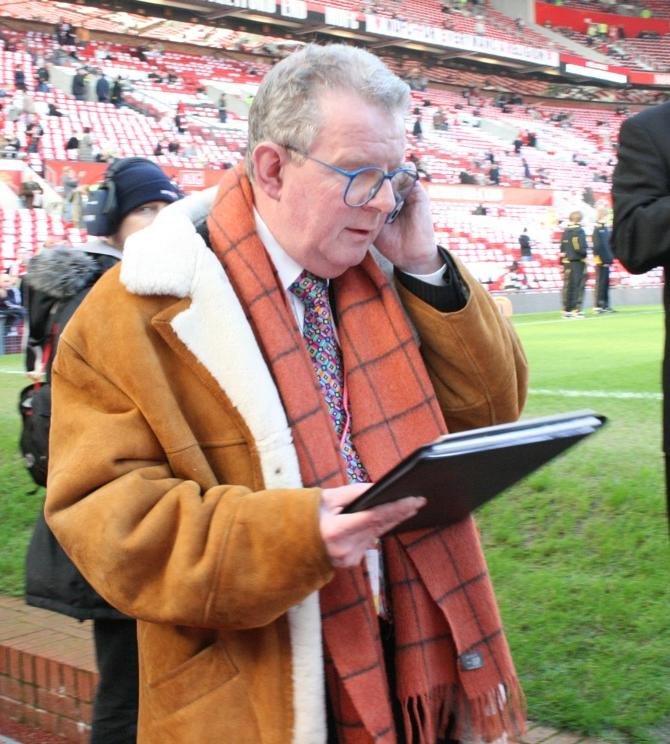
To British football fans, “Motty” was much more than a video game voice. He joined the BBC in the late 1960s, made his Match of the Day debut in 1971, and became a household name a year later when his commentary on non-league Hereford United knocking Newcastle out of the FA Cup turned into one of the most replayed clips in English football. Over five decades he called roughly 2,500 televised matches, including 10 World Cups, 10 European Championships and 29 FA Cup finals. The sheepskin coat became a trademark of its own.
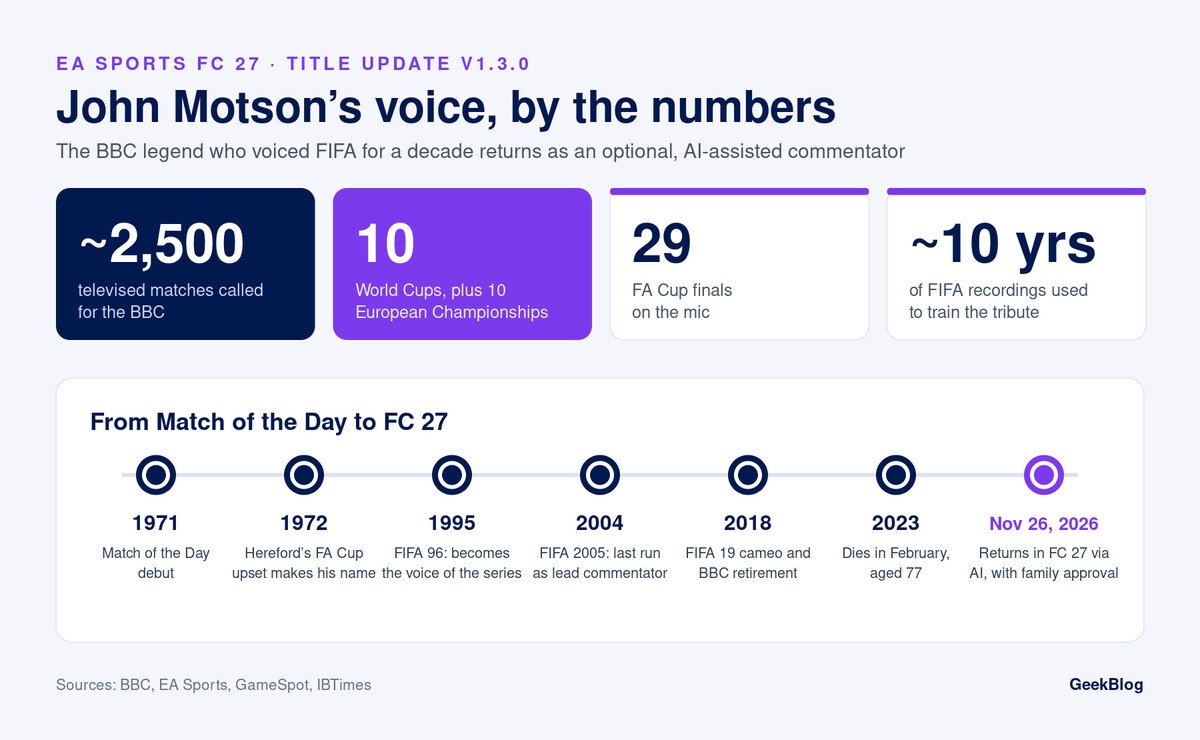
For gamers, though, he was the voice of FIFA. He became the series’ lead commentator with FIFA 96 and stayed in the role until FIFA 2005, which covers the PlayStation era that turned EA’s football games into a global phenomenon. He returned briefly for a cameo in FIFA 19, the same year he retired from the BBC. He died in February 2023, aged 77.
That history matters for understanding the reaction. For a lot of players in their 30s and 40s, Motson’s voice is tied to childhood memories of the original PlayStation and the PS2. EA is clearly betting on that nostalgia. The question is whether nostalgia survives the knowledge that some of what you hear is synthetic.
The family said yes
EA approached Motson’s widow and his son, Fred, for permission to recreate his voice and use his likeness. Both agreed. Neither side has disclosed how much EA paid. Fred Motson has been the public face of the family’s support, and his comments are some of the most human parts of this story.
“My dad was the least technological person in the world. Till his dying day, he had a typewriter on his desk. So I don’t think he would have quite understood what the AI was doing technologically, but I think, on the other hand, he was always really keen to get involved in these kinds of projects.”
Fred Motson, John Motson’s son
He also told the BBC that he “grew up with FIFA” and used to tell his parents he needed the newest console every Christmas “because otherwise dad couldn’t see how the game worked.” In EA’s official statement, he said his father “adored being the voice of the game” and that a whole new generation of players would now get to experience his commentary.
It is hard to read that and see a family being exploited. This looks like people who loved him, believe he would have enjoyed it, and are happy to see his work live on.
The problem nobody can fully solve: consent after death
The pushback isn’t really about the Motson family. It is about who gets to decide. Peter Caulfield, founder of the campaign group Save Our Voices Now, put the objection plainly.
“If someone has signed a deal allowing their likeness to be used after they die, I have no issue with that. But in life or in death, unless you have specifically agreed to it, AI cloning of any kind should not be allowed. Being a family member shouldn’t automatically give you that right either.”
Peter Caulfield, founder of Save Our Voices Now
Motson never signed anything like that, for the simple reason that the technology didn’t exist in a usable form while he was working. Every one of his FIFA lines was recorded under contracts written for a world where a recording was just a recording. Using those sessions as training data for new speech is a use nobody imagined at the time.
Legally, EA is on solid ground. In the UK there is no general posthumous right of publicity, and in the US, laws like California’s 2024 rules on digital replicas of deceased performers generally put the decision in the hands of the estate, which is exactly the consent EA obtained. The debate is ethical, not legal, and that is why it feels unresolved.
Video games have been here before. The table below shows how a few recent cases compare.
| Case | Who approved it | How it went |
|---|---|---|
| John Motson in FC 27 | Widow and son, paid by EA | Live today. Optional. Fan reaction split |
| James Earl Jones as Darth Vader in Fortnite | His estate | Players got the conversational bot to say racist and vulgar lines. Quickly patched. SAG-AFTRA filed a labor charge against Epic |
| Robin Williams AI videos | Nobody | His children publicly objected to fan-made AI content |
The Fortnite case is the one most people bring up, and the differences are important. Fortnite’s Vader was an interactive chatbot, so players could steer it into saying things Jones never would have said. Motson’s tribute is a sports commentary system with tightly scripted triggers. It is far less likely to go off the rails in the same way. The Robin Williams situation, which pushed his family to reactivate his Instagram account to push back against AI likeness content, is the opposite end of the spectrum: no consent at all. Motson’s case sits much closer to the respectable end, which is exactly why it is such a useful test.
How players and commentators are reacting
The fan response has been loud. Comments collected by RealSport101 and PC Gamer include words like “shameful,” “an insult,” “gross” and “bleak.” Some players question the point of the exercise entirely: Motson hasn’t been FIFA’s lead voice for over two decades, so reviving him with generative AI feels, to them, like EA reaching for a headline more than honoring a legacy.
Others see it differently. Plenty of older players are curious to hear him again, and the fact that the feature is optional takes a lot of the sting out of it. Nobody is being forced to listen.
The current commentators have been notably calm. Guy Mowbray, one of FC 27’s English voices, described it as a relatively positive use of AI that lets Motson’s legacy continue. Derek Rae said he was excited to see Motson included and doesn’t believe AI is about to replace his own work. In his view, AI can handle routine surnames and straightforward filler lines, while expressive commentary still needs a human performance. Asked whether he would let his own voice live on through AI one day, Rae answered: “I’m hopefully many years away from having to make a decision like that.”
The case for it
- Family consent and payment
- Built on real recordings, not a stranger’s imitation
- Fully optional, nobody is replaced
- A tribute to a genuine part of the series’ history
The case against it
- Motson himself never agreed to AI recreation
- Original contracts never covered AI training
- New lines are words he never actually said
- Sets a precedent for less careful projects
Why this is bigger than one commentator
Sports games are the perfect place for AI voices to creep in. Commentary is enormous, repetitive and always out of date. Every season brings hundreds of new player names, transfers and promoted clubs, and recording all of it with humans is expensive. That is why Rae’s point about AI handling “routine surnames” is the part to watch. The Motson tribute is framed as a one-off, but the same tools could quietly fill gaps in living commentators’ lines too.
Performers are well aware of this. The year-long SAG-AFTRA video game strike, which ended in 2025, was fought largely over consent and disclosure rules for digital replicas. Game developers have pushed for similar protections, with Blizzard’s union recently winning the right to bargain before Microsoft can use AI on their jobs. Meanwhile, the voice cloning business is booming, with companies like ElevenLabs reaching a $22 billion valuation on the back of demand for synthetic speech.
Against that backdrop, EA’s careful framing makes sense. It went to the family, it paid, it made the feature optional, and it repeated “no plans to replace anyone” in every interview. Whether that sets a responsible standard or simply normalizes the idea is the argument players are having right now.
What else is in Title Update v1.3.0
Motson grabbed the headlines, but v1.3.0 is also a significant gameplay patch. The biggest changes target tactics that competitive players have been abusing since launch.
| Area | What changed |
|---|---|
| Near-post finishing | Goalkeepers take stronger starting angles, and shots from tight angles get more error and spread |
| Tall players | More responsive left-stick dribbling, first touch and skill move agility |
| Physicality | Shorter players can no longer easily bump much taller opponents off the ball |
| Shoulder challenges | Challenges from directly behind are less likely to cause an unnatural stumble |
| Flicks | Chained right-stick flicks are less effective, and players slow down after a flick-up |
| Referees | Light barges in the box are less likely to be given as penalties |
| The Grounds | World matchmaking improvements and Amps functionality in small-sided football |
| Commentary | Optional AI-assisted John Motson tribute commentary |
Fullback positioning fixes are listed as upcoming rather than included, and EA says new Ultimate Team features will arrive with Season 3.
Our take
If anyone was going to do this, this is roughly how it should be done. EA asked the people closest to Motson, paid them, built the voice from his real work, and made it something you opt into rather than something forced on every match. Compared with the Fortnite Vader mess or the flood of unauthorized AI clips of dead celebrities, it is a careful, almost conservative use of the technology.
And yet the discomfort is real, because the question at the center of it can’t be answered. Motson can’t tell us whether he would have loved hearing himself call a Chloe Kelly goal, or whether he would have found it strange to have words put in his mouth. His son thinks he would have been delighted, and he knew him better than anyone. But “probably would have been fine with it” is a lower bar than “said yes,” and once that bar is accepted for a beloved commentator, it gets easier to accept for everyone else.
The best thing EA can do now is be transparent: clearly label which lines are original and which are generated, and keep the feature optional for good. The best thing players can do is make up their own minds. Turn it on, listen for a few matches, and decide whether it feels like a tribute or a séance.
Sources: EA Sports, Title Update v1.3.0 pitch notes, GameSpot, PC Gamer, RealSport101, IBTimes UK, Player.One, Wikipedia, John Motson.
About this article: GeekBlog covers U.S. technology news, AI, phones, smartwatches and gaming. Every story is written and checked under our Editorial Policy. Spotted a mistake or have a story tip? Contact our editors.
