

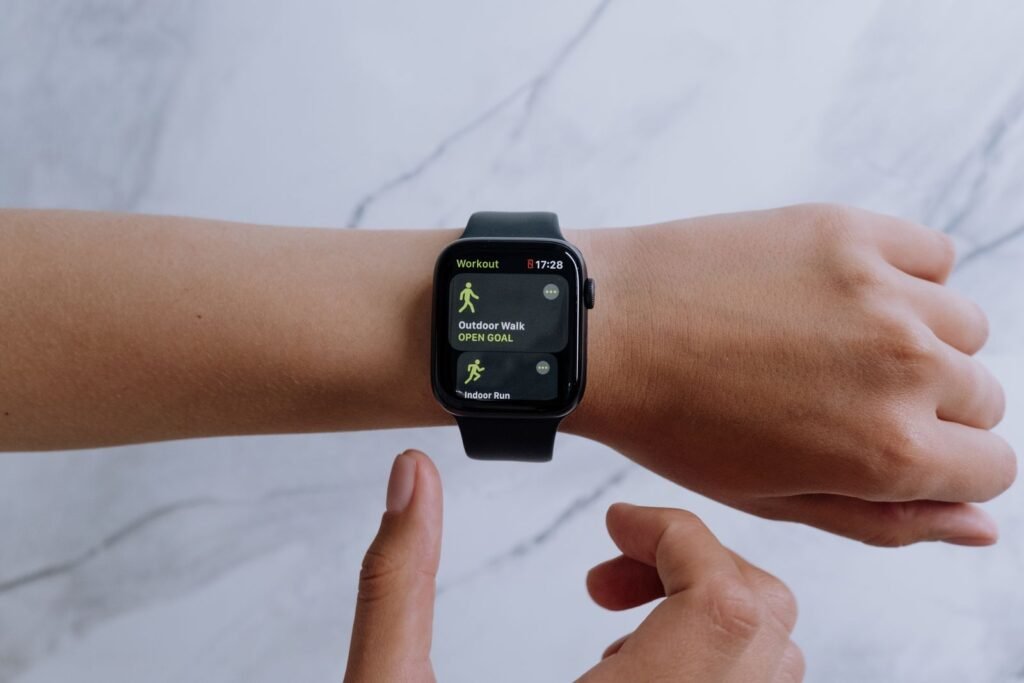
Walk into any electronics aisle and the wearables wall looks like one big blur of black rectangles. Some cost $60, some cost $800, and the boxes all promise the same things: steps, heart rate, sleep, better health. So which one do you actually need? The smartwatch vs fitness tracker question used to be easy to answer. In 2026 the lines have blurred so much that a $80 smartwatch can outlast a $160 tracker, and some trackers no longer have a screen at all.
This guide breaks down what really separates the two, where the research says they are equally good (and equally bad), what each costs once you count subscriptions, and how to pick the right one for the way you live. Prices are list prices from manufacturers and change often, especially in late November, so check before you buy.
Quick answer
Buy a fitness tracker if you mainly want steps, sleep and heart rate, hate charging, and want something light enough to forget you are wearing. Buy a smartwatch if you also want notifications you can reply to, contactless payments, apps, built-in GPS for runs, or safety features like fall detection and cellular calling. For basic health tracking, the two are about equally accurate, because they use very similar sensors.
Sources: Rock Health 2025 Consumer Adoption Survey; manufacturer specifications; umbrella review of wearable validation studies (PMC, 2024).
What Is the Difference Between a Smartwatch and a Fitness Tracker?
The simplest way to think about it: a fitness tracker is a health sensor that happens to sit on your wrist, while a smartwatch is a small computer that happens to track your health. Both measure the same core things. The difference is everything that sits around those sensors.
A fitness tracker is usually a slim band with a small screen, or no screen at all. It counts steps, estimates calories, tracks sleep and reads your heart rate around the clock. You check the details in a phone app. Models like the Fitbit Charge 6, Fitbit Inspire 3, Garmin Vivosmart 5, Samsung Galaxy Fit3 and Xiaomi Smart Band 11 fit here. So do screenless bands like the Garmin Cirqa, Fitbit Air and Whoop, which skip the display entirely.
A smartwatch has a larger, sharper screen and runs a real operating system such as watchOS or Wear OS. That means third-party apps, replies to messages, voice assistants, music storage, maps, payments and, on cellular models, calls without your phone nearby. The Apple Watch Series 12, Samsung Galaxy Watch 9 and Google Pixel Watch 5 are the obvious examples. Budget models from Amazfit blur the line, with smartwatch screens and tracker battery life.
If you are new to the category, our explainer on how a smartwatch works covers the hardware in more detail.
Smartwatch vs Fitness Tracker at a Glance
| Feature | Fitness tracker | Smartwatch |
|---|---|---|
| Typical price | $60 to $200 | $80 to $800+ (flagships $249 to $400) |
| Battery life | About 5 to 14 days in real use | 1 to 2 days on flagships, 7 to 14 on Garmin and Amazfit |
| Screen | Small or none | Large, bright, touch |
| Weight and comfort | Very light, easy to sleep in | Heavier, can feel bulky at night |
| Steps, heart rate, sleep | Yes | Yes |
| Built-in GPS | Some models (Charge 6, Fitbit Edge) | Almost always |
| Notifications | Read only, short previews | Read, reply, take calls |
| Apps and payments | Limited or none | Full app store, tap to pay |
| Safety features | Rare | Fall detection, SOS, cellular on many |
| Advanced sensors | ECG on some (Charge 6, Edge) | ECG, skin temperature, more health trends |
Battery Life: The Biggest Real-World Difference
If there is one spec that decides this for most people, it is battery. A tracker with a small screen sips power. A smartwatch with a bright, always-on display, Wi-Fi, apps and a voice assistant drinks it. That is why Apple still rates the Apple Watch Series 12 at “up to 24 hours”, even though independent rundown tests have stretched it past 40 hours.
The chart below uses manufacturer ratings for typical use. Real life is usually shorter, especially if you turn on the always-on display, blood oxygen tracking or GPS workouts.
That last point matters. “Smartwatch” no longer automatically means charging every night. Watches that skip a full app store, like the Amazfit Bip 6 at $79.99, can run 10 to 12 days in real use. If long battery is your top priority but you still want a bigger screen, our list of smartwatches with the longest battery life is the place to start.
Is a Fitness Tracker Less Accurate Than a Smartwatch?
Mostly no. This is the part that surprises people. A $100 band and a $400 watch usually rely on the same type of optical heart rate sensor (green LEDs that read blood flow under the skin) and the same kind of motion sensor. Price buys you a nicer screen and more features, not a dramatically better step count.
The research backs this up. A large umbrella review that pooled systematic reviews of wrist wearables found that step counts were usually within about 9% to 12% of the real number, and tended to undercount rather than overcount. Heart rate was the strongest metric, with an average bias of around 3%. Calories were the weak spot for every brand. A separate 2022 systematic review in the Journal of Medical Internet Research found that no tested device measured energy expenditure accurately, with average errors above 30%.
Where smartwatches do pull ahead is in extras. The Apple Watch, Galaxy Watch and Pixel Watch add features like ECG, irregular rhythm alerts, skin temperature trends and, on some models, blood pressure or sleep apnea alerts. A few trackers now cover some of that too. The Fitbit Charge 6 and the new $180 Fitbit Edge both have ECG, and the Edge adds GPS and a battery you can replace yourself.
Accuracy tips that work on any device
- Wear it about a finger’s width above your wrist bone, snug but not tight.
- Tighten the band one notch during workouts. Loose bands are the top cause of bad heart rate readings.
- Enter your real height, weight and age in the app. Calorie estimates depend on them.
- For hard interval training, pair a chest strap. Wrist sensors lag at high intensity.
Smart Features: What You Actually Get for the Extra Money
Here is where the categories really split. A tracker shows you that a text arrived and lets you read a short preview. A smartwatch lets you dictate a reply, answer a call, pay for coffee, start a podcast, check a map at a trail junction or ask an assistant to set a timer while your hands are full.
Some of these are luxury features. Others are genuinely important:
- Fall detection and SOS. Apple, Samsung, Google and many Garmin watches can call for help if you take a hard fall and do not respond. Most trackers cannot. For older adults or anyone who hikes or runs alone, this alone can justify a smartwatch.
- Cellular. LTE models let you leave your phone at home and still call, text and stream. Expect to pay about $10 a month to your carrier for the watch line.
- Built-in GPS. Runners and cyclists get accurate pace and distance without carrying a phone. Some trackers like the Charge 6 and Fitbit Edge have GPS, but the small screen makes mid-run stats harder to read.
- Payments. Apple Pay, Google Wallet and Samsung Wallet are standard on smartwatches. A few trackers support them, often only in certain regions or on pricier versions.
The flip side: every one of those features is a reason to look at your wrist. If you are trying to cut down on screen time, a screenless band like the Garmin Cirqa or Fitbit Air can be a feature, not a compromise.
Price and Total Cost of Ownership
Sticker price is only part of the story. Several brands now put their best insights behind a monthly plan, and that adds up over the two or three years most people keep a wearable.
| Device | Type | List price | Optional subscription | Rated battery |
|---|---|---|---|---|
| Samsung Galaxy Fit3 | Tracker | About $60 | None | Up to 13 days |
| Fitbit Inspire 3 | Tracker | $99.95 | Google Health Premium, $9.99/mo | Up to 10 days |
| Fitbit Charge 6 | Tracker | $159.95 | Google Health Premium, $9.99/mo | Up to 7 days |
| Garmin Vivosmart 5 | Tracker | $149.99 | Garmin Connect+, $6.99/mo | Up to 7 days |
| Garmin Cirqa | Screenless band | $199 | Garmin Connect+, $6.99/mo | Up to 10 days |
| Amazfit Bip 6 | Smartwatch | $79.99 | None required | Up to 14 days |
| Apple Watch Series 12 | Smartwatch | From $399 | Fitness+, $9.99/mo | Up to 24 hours |
| Google Pixel Watch 5 | Smartwatch | From $399 | Google Health Premium, $9.99/mo | About 1 to 1.5 days |
Prices are US list prices at the time of writing and are often discounted. Every device listed tracks steps, heart rate and sleep without a subscription.
The good news is that none of these devices need a subscription for the basics. The plans add coaching, deeper trends and AI features. If you want to keep running costs at zero, it is worth reading our guide to the best smartwatches with no subscription before you buy.
Which One Should You Buy?
Forget the spec sheets for a second and think about your typical day. The right choice usually becomes obvious.
Get a fitness tracker if you…
- Want sleep tracking and a device you forget you are wearing
- Hate charging and want a week or more per charge
- Mostly walk, do gym classes or casual workouts
- Want to spend under $150
- Prefer fewer pings and less screen time
Get a smartwatch if you…
- Want to reply to texts and take calls from your wrist
- Run or cycle and want GPS stats on a big screen
- Want tap-to-pay, maps, music and apps
- Need fall detection, SOS or cellular for safety
- Want ECG and the widest range of health features
And if you are torn between the two, look at the middle ground. Budget smartwatches like the Amazfit Bip 6 and Amazfit Active 2 give you a real watch screen, GPS and about a week or more of battery for under $100, though their app selection is thin. On the tracker side, the Fitbit Edge is the most watch-like band Google has made, with GPS and ECG for about $180.
Our quick picks
- Best tracker overall: Fitbit Charge 6. Built-in GPS, ECG, accurate heart rate and Google Wallet in a slim band.
- Best cheap tracker: Samsung Galaxy Fit3 for Android users, or the Fitbit Inspire 3 if you use an iPhone.
- Best screenless band: Garmin Cirqa, because its recovery data does not require a membership.
- Best budget smartwatch: Amazfit Bip 6, the closest thing to a tracker-like battery in a smartwatch body.
- Best smartwatch for iPhone: Apple Watch Series 12, or the cheaper Apple Watch SE 3 from $249.
- Best smartwatch for Android: Samsung Galaxy Watch 9 or Google Pixel Watch 5.
Common Myths Worth Ignoring
“Smartwatches are always more accurate.” Not for the basics. Steps and heart rate are close across price ranges, and calories are rough on everything.
“Fitness trackers are just pedometers.” Not anymore. Many now track sleep stages, heart rate variability, blood oxygen and skin temperature, and some offer ECG.
“You need a smartwatch to get healthier.” The habit is what counts. Studies on activity trackers link them to roughly 1,800 extra steps a day on average, and that benefit comes from simple feedback, not from apps or a fancy screen.
Frequently Asked Questions
Is a fitness tracker or smartwatch better for sleep tracking?
A fitness tracker is usually more comfortable to sleep in because it is smaller and lighter, and long battery life means you are not charging it overnight. Sleep data quality is similar between the two, since both rely on heart rate and motion to estimate sleep stages.
Can a fitness tracker replace a smartwatch?
For health and activity tracking, yes. For apps, replying to messages, payments in every region, music and safety features like fall detection, no. If you only glance at notifications, a tracker is usually enough.
Do fitness trackers work with iPhone?
Most do, including Fitbit, Garmin and Xiaomi bands. Samsung’s Galaxy Fit3 is the main exception, as it only works fully with Android phones. Apple does not make a standalone fitness tracker, so iPhone users who want a band usually pick Fitbit, Garmin or Whoop.
Which lasts longer, a smartwatch or a fitness tracker?
On a single charge, trackers win by a wide margin, often 7 to 14 days against 1 to 2 days for flagship smartwatches. In terms of years of use, smartwatches can lose software support after a few generations, while simple trackers tend to keep working as long as the app supports them.
Are fitness trackers good for seniors?
They can be, thanks to light weight and simple screens. But for older adults living alone, a smartwatch with fall detection and SOS calling is usually the safer pick, because most trackers cannot call for help.
The Bottom Line
The smartwatch vs fitness tracker decision comes down to one honest question: do you want a health device or a wrist computer? If you want to know how you slept, how much you moved and what your heart rate is doing, a $60 to $160 tracker does that about as well as a $400 watch, and it will last a week or more between charges. If you want calls, texts, apps, payments, GPS on a big screen or safety features, a smartwatch earns its higher price and its nightly charge. And if you want a bit of both, a budget smartwatch like the Amazfit Bip 6 is the sweet spot in 2026.
Sources: Rock Health, 2025 Consumer Adoption Survey; Germini et al., “Accuracy and Acceptability of Wrist-Wearable Activity-Tracking Devices,” Journal of Medical Internet Research, 2022; umbrella review of wearable validation studies, PMC11560992, 2024; Ferguson et al., The Lancet Digital Health, 2022; manufacturer specifications from Apple, Samsung, Google, Garmin, Amazfit and Xiaomi; Tom’s Guide, Android Authority and Samsung buying guides.
About this article: GeekBlog covers U.S. technology news, AI, phones, smartwatches and gaming. Every story is written and checked under our Editorial Policy. Spotted a mistake or have a story tip? Contact our editors.
