

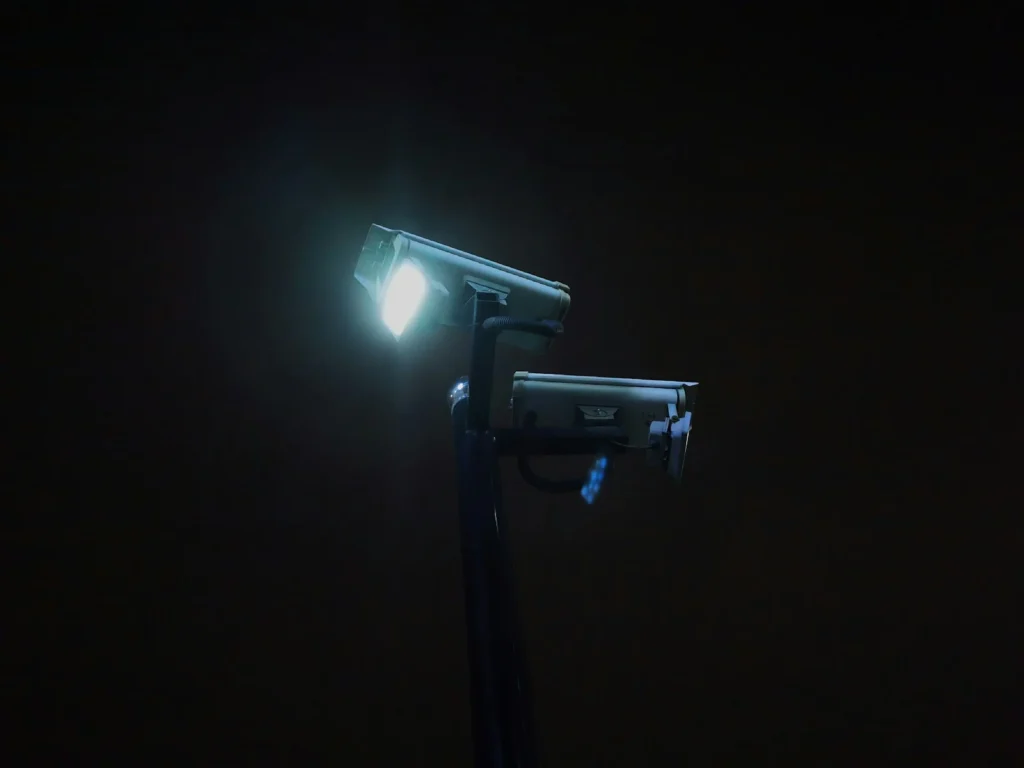
A security camera that goes blind after sunset is only doing half its job. Night vision is what lets a camera keep recording useful footage when your porch light is off, and it comes in several forms: classic infrared, low light color sensors, so called starlight cameras and models with built in spotlights. Each one makes different trade offs between detail, color, range and stealth, so it pays to know which you are buying.
Infrared night vision: the standard
Look closely at almost any security camera and you will see a ring of small dark dots around the lens. Those are infrared LEDs. They flood the scene with light just beyond the red end of the spectrum human eyes can see. Camera image sensors can detect that light, so the camera sees a lit scene while you see darkness.
During the day, a small part called an IR cut filter sits in front of the sensor and blocks infrared, because infrared would wash out colors and make daytime images look strange. When light drops, the camera moves the filter out of the way, often with an audible click, switches on its infrared LEDs and starts recording in black and white. Infrared footage is monochrome because the sensor is capturing a single band of light, not the mix of red, green and blue that makes color.
Home cameras mostly use one of two infrared wavelengths:
- 850 nanometers: the most common choice. It gives a brighter image and longer reach, but the LEDs show a faint red glow if you look straight at the camera.
- 940 nanometers: completely invisible to the eye, which makes it more discreet indoors or in a nursery. The trade off is less range, with some security makers estimating it at roughly 30 to 40 percent less effective than 850 nanometers.
The strengths of infrared are reliability and cost. It works in total darkness, needs no other light source and is cheap to build, which is why it appears on cameras at every price. The weaknesses are the lack of color, which makes it hard to tell a navy jacket from a black one or read a car’s paint color, and limited reach on entry level models.
Color night vision and starlight sensors
Color night vision takes the opposite approach. Instead of adding invisible light, the camera tries to capture as much of the existing light as possible, from streetlights, the moon or a neighbor’s window, and keep the IR cut filter in place so colors stay true.
Two hardware choices make that possible. The first is a wide aperture lens that lets more light reach the sensor. The second is a more sensitive image sensor. Many security cameras use back illuminated sensors, such as Sony’s STARVIS line, which place the wiring behind the light sensitive layer instead of in front of it, so more incoming light is converted into image signal. Starlight is a marketing label rather than a formal standard, but it generally refers to cameras built around sensors like these.
The limitation is simple physics: these sensors amplify light, they do not create it. In a pitch black backyard with no lights at all, a color night vision camera has nothing to work with, so most will fall back to infrared and black and white.
Spotlight and floodlight cameras
A spotlight camera adds white LEDs that switch on when motion is detected. That gives the sensor plenty of light for full color video and doubles as a deterrent, since a sudden bright light tells anyone on your property that they have been noticed. Floodlight cameras take the idea further with much brighter panels that can light up an entire driveway.
The downsides are visibility and annoyance. A light that turns on every time a cat crosses the yard can bother neighbors, and it signals exactly where the camera is. Many models let you adjust brightness, set schedules or limit the light to certain motion zones.
The four types side by side
| Type | Color at night | Works in total darkness | Visible to others |
|---|---|---|---|
| 850nm infrared | No | Yes | Faint red glow |
| 940nm infrared | No | Yes, shorter range | No |
| Color or starlight sensor | Yes, with some ambient light | No, falls back to infrared | No |
| Spotlight or floodlight | Yes | Yes | Very |
Buying tips for better footage at night
- Check the stated night range: makers usually list how far infrared reaches. Make sure it covers the distance to your gate, driveway or door.
- Treat low light ratings with care: spec sheets often list a minimum illumination in lux, where lower is better, but companies measure it under different conditions, so it is hard to compare across brands.
- Combine technologies: a camera with infrared plus a spotlight, or infrared plus a porch light on a motion sensor, covers both total darkness and color detail.
- Keep the lens clean: dust, rain spots and cobwebs reflect infrared and cause haze and false motion alerts.
FAQ
Why is my security camera footage black and white at night?
The camera has switched to infrared mode. Infrared light carries no color information, so the image is monochrome. Adding a light source or using a color night vision model can restore color.
Can people see infrared night vision?
With 850 nanometer LEDs, a faint red glow is visible when you look directly at the camera. With 940 nanometer LEDs, nothing is visible.
Is thermal imaging the same as night vision?
No. Thermal cameras detect heat given off by people and animals rather than reflected light. They are rare and expensive in home security, where infrared and color sensors dominate.
Does color night vision work in complete darkness?
No. It needs at least a little ambient light. In total darkness, most models switch to infrared and record in black and white.
The verdict
Infrared remains the dependable backbone of night vision, color sensors add useful detail where there is some light, and spotlights deliver color plus deterrence. Match the type to where the camera will sit, mount it outside of glass, and pair it with a light when you need to identify faces, clothing or cars.
Updated October 2026: rewritten as a plain English guide to infrared, color, starlight and spotlight night vision, with buying and mounting tips.
Featured photo: Shawn Xiao on Unsplash.
About this article: GeekBlog covers U.S. technology news, AI, phones, smartwatches and gaming. Every story is written and checked under our Editorial Policy. Spotted a mistake or have a story tip? Contact our editors.
