

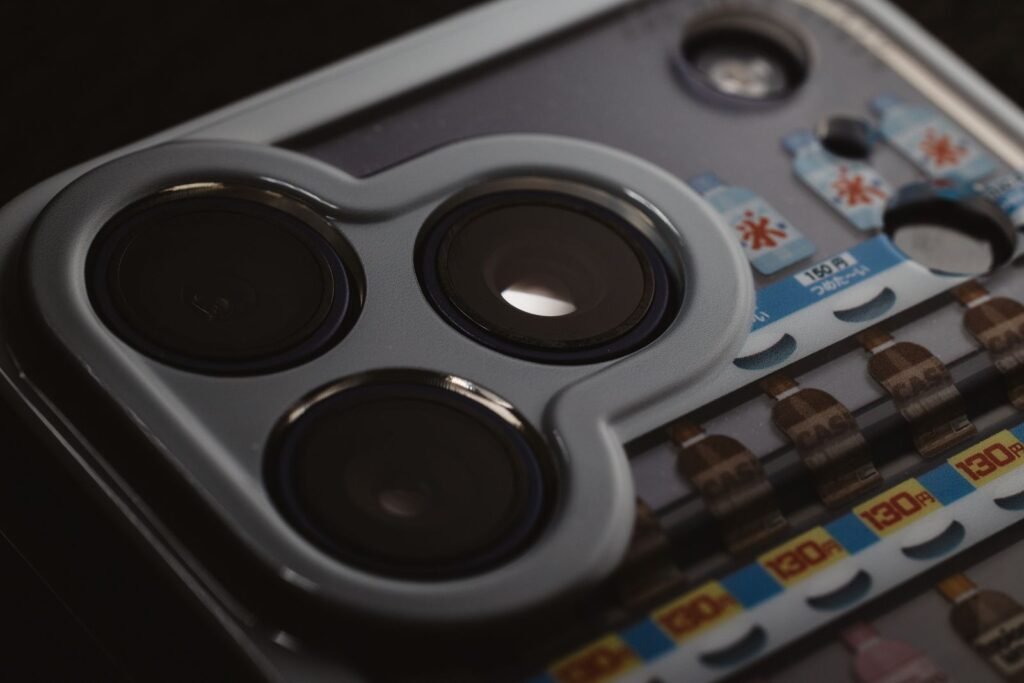
Phone cameras have been stuck with one aperture since the beginning. The lens opening is a fixed hole, and every decision about depth of field, diffraction and light gathering has to be made by software after the fact.
The iPhone 18 Pro is the first iPhone where that is no longer true. Its 48MP Fusion main camera has six physical blades that move, opening as wide as f/1.48 and closing down to f/4. Each blade is thinner than a human hair. It is the most mechanically ambitious thing Apple has put in a phone camera, and it is the reason to care about this generation.
It also costs $100 more than last year. Pre-orders open Saturday, September 12, and both models go on sale Friday, September 18 in more than 65 countries.
The short version
- A real variable aperture on the 48MP main camera, with stops at f/1.48, f/1.8, f/2.8 and f/4, driven by six laser-cut blades.
- f/1.48 gathers about 45 percent more light than the f/1.78 lens on the iPhone 17 Pro.
- The A20 Pro is Apple’s first 2nm phone chip, with 50 percent more memory bandwidth than the A19 Pro.
- A 7-core GPU that runs up to 40 percent faster, and a dual 16-core Neural Engine, 32 cores in total.
- The Dynamic Island was rebuilt and now shows up to three Live Activities at once.
- $1,199 for the Pro, $1,299 for the Pro Max, both $100 above their predecessors.
- Pre-orders September 12, on sale September 18.
What a variable aperture actually buys you
An aperture is just a hole, and its size controls two things at once: how much light reaches the sensor, and how much of the scene is in focus.
A wide aperture like f/1.48 lets in a lot of light, which is what you want in a dim restaurant, and throws the background out of focus, which is what you want for a portrait. A narrow aperture like f/4 does the opposite. Less light, but far more of the frame sharp from front to back, which is what you want for a landscape, a group shot, or a page of text.
Every iPhone until now had to pick one and live with it. The iPhone 17 Pro is f/1.78 always, and when you asked for a blurred background it faked one in software. That fake is good, and it has also always had the same tell: hair, glasses frames and anything with a complicated edge confuse the depth map.
Real blades produce real optics. There is nothing to get wrong at the edges because nothing is being computed.
The practical gain at the wide end is easy to quantify. Light gathering scales with the square of the aperture ratio, so moving from f/1.78 to f/1.48 is about 45 percent more light hitting the sensor. In a dark room that is the difference between a usable shutter speed and a smeared one.
The gain at the narrow end is subtler and possibly more useful. Stopping down to f/4 is how you photograph a whiteboard, a menu, a receipt or a row of people without the edges going soft. Phone cameras have always been bad at this because their apertures are permanently wide open.
Both Pro models get the system. Apple did not reserve it for the Max, which it easily could have.
The obvious worry
Six moving parts inside a camera module is six things that did not previously exist to fail. Apple says the blades are laser cut and built to be both light and durable, but there is no track record here. Anyone who has owned a compact camera with a sticky aperture knows what the failure looks like, and it will take a year of real phones in real pockets before anyone can say this is solved.
The A20 Pro is the first 2nm chip in a phone
Apple moved the Pro line to a 2 nanometer process this year, ahead of every competitor. Smaller transistors mean more of them in the same space and less power burned per operation, which is the whole reason anyone bothers with a node shrink.
The headline number is memory bandwidth. The A20 Pro moves data 50 percent faster than the A19 Pro, which matters more than raw clock speed for the things phones are actually doing now. Running a language model on device is almost entirely a memory bandwidth problem. So is high resolution video processing, and so is reading a 48MP frame off a sensor while simultaneously deciding where to set an aperture.
| Silicon | A19 Pro (iPhone 17 Pro) | A20 Pro (iPhone 18 Pro) |
|---|---|---|
| Process | 3nm class | 2nm, an industry first for a phone |
| CPU | 6 cores | 6 cores with integrated Neural Accelerators |
| GPU | 6 cores | 7 cores, up to 40 percent faster |
| Neural Engine | 16 cores | Dual 16-core, 32 in total |
| Memory bandwidth | Baseline | 50 percent higher |
Doubling the Neural Engine is a statement about where Apple thinks the next three years of iPhone software go. It is also the kind of specification that is impossible to feel on day one and obvious by year two, when the features that need it finally ship.
The Dynamic Island got rebuilt
This is the smallest change on the list and probably the one you will notice most often. The Dynamic Island now handles up to three Live Activities at the same time.
Anyone who has had a timer running, a ride arriving and a match in progress knows the current behavior: they take turns, and the one you want is never the one on screen. Three at once fixes a daily irritation that no keynote slide can make sound impressive.
About that $100
The iPhone 18 Pro starts at $1,199 and the Pro Max at $1,299. Last year those numbers were $1,099 and $1,199. Both are $100 higher, and both still start at 256GB.
| Model | 2025 | 2026 | Change |
|---|---|---|---|
| Pro | $1,099 | $1,199 | up $100 |
| Pro Max | $1,199 | $1,299 | up $100 |
The reason is not the aperture blades. It is memory. Contract prices for the RAM and flash that go into phones have risen sharply this year as AI data centre demand ate the supply, and every manufacturer is dealing with the same bill. We looked at how badly that is distorting the industry when phone makers started quietly cutting RAM to protect their margins. Apple did the opposite and passed the cost through, which is the more honest of the two options even if it is the one that stings.
Seen against that backdrop, $100 for a node shrink, a new GPU, a doubled Neural Engine and a mechanical aperture is not a bad trade. It is still $100.
Should you upgrade?
From an iPhone 17 Pro: only for the camera. The chip gains are real but you will not feel them. The aperture is the one thing your 17 Pro cannot do at any price, and if you shoot a lot in low light or want optical depth of field instead of a simulation, that is a genuine reason. Otherwise wait.
From an iPhone 15 Pro or older: yes, comfortably. Three generations of camera, chip and battery improvements land at once, and this is a better year to make that jump than most.
If you were looking at the foldable: the iPhone 18 Pro is the better camera by a wide margin and costs $800 less. The iPhone Duo has two 48MP sensors, no telephoto and no Face ID, because none of it fits inside a 5.2mm chassis. Buy the foldable for the screen, not the photographs.
If you want the cheaper iPhone 18: you are waiting until spring. Apple split the lineup this year, which we explained when the September launch stopped including a standard iPhone. September is now a Pro and foldable event.
The bottom line
Most iPhone generations are a faster chip and a slightly better sensor. This one has an actual mechanism in it, something that physically moves to change what the camera can do, and that has not been true of an iPhone camera before.
Whether it holds up is the open question, and it is a fair one. Moving parts wear out, and phones live in pockets full of grit. But the alternative was another year of software pretending to be optics, and Apple has finally stopped pretending.
Pre-orders open tomorrow. The phones arrive September 18, and the camera comparisons that will actually settle this land somewhere in between.
