

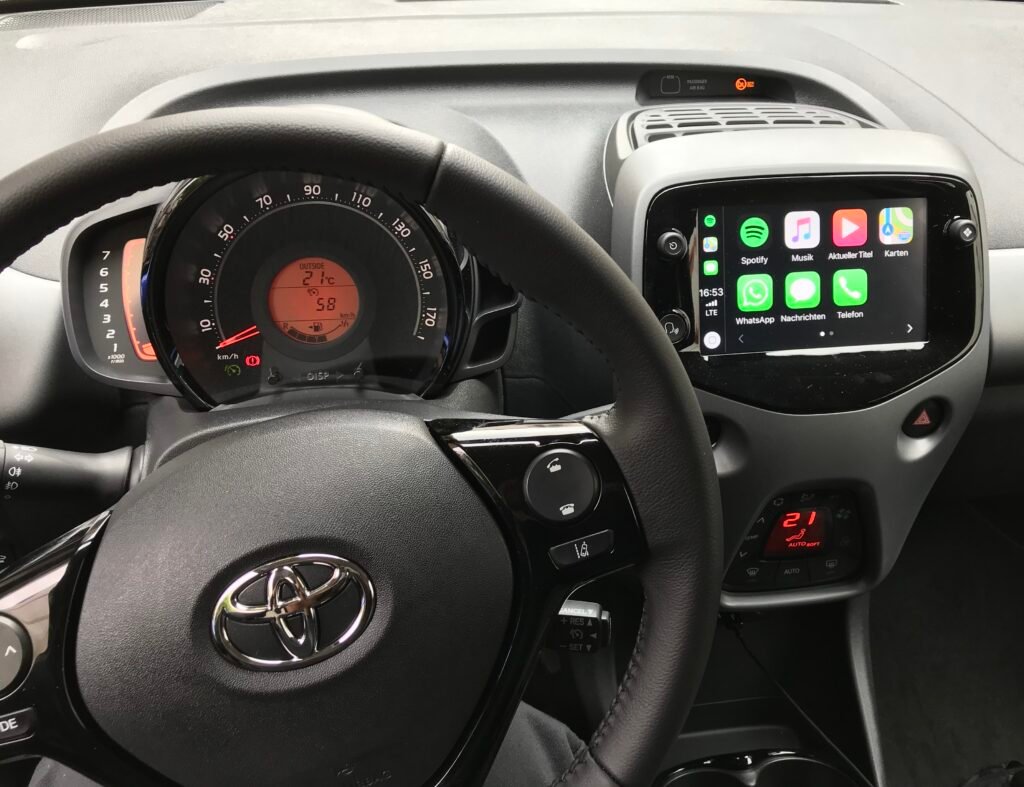
There is a specific kind of frustration that comes from a feature you have been told you own and cannot locate anywhere on the device. CarPlay video is currently the best example in Apple’s lineup.
Apple announced it in 2025: iPhone owners would be able to send video to the car’s screen over AirPlay, watch it while parked, and have the system fall back to audio the moment the car started moving. The iPhone half of that shipped. People updated, went looking for it, and found nothing.
One driver on Reddit put it the way most people experience it. “Did this ever ship? I have a vague memory of there being some excitement about this, and then nothing. I’ve got stock CarPlay in my 2019 Kia Sorento with my phone running iOS 27.0.1 and I can’t get it to work.”
The answer is that it shipped, and his car is never going to run it. The feature does not live on the phone. It lives in a handshake between the phone and the car, and the car has to be built to accept it.
The short version
- The feature is real and it is on your iPhone. AirPlay video to a car display, announced by Apple in 2025 and present in current iOS releases
- Three things have to line up, and only two of them are yours: the iPhone, the video app, and the car’s infotainment system
- The car is the blocker. Apple’s own documentation says support has to be integrated “for CarPlay with AirPlay video to enable this feature in your car”
- An iOS update will not unlock it. No version of iOS can add a capability the head unit was never certified for
- Almost no vehicle on the road qualifies. No mainstream automaker has publicly committed to it, and the only name attached to it so far in reporting is Aston Martin
- Parked only. If the system detects motion, video stops and audio continues
- Most video apps are already fine. If an app supports AirPlay video streaming, developers do not need to change anything
- There is no public compatibility list, which is the real reason nobody can tell whether their car is one of the lucky ones
Three gates, and you only control two
The reason this feels broken is that it is gated three times, and the gate that fails is the one furthest from the user.
The first gate is the phone. If you are on current iOS, you are through it. Nothing to install, nothing to toggle, nothing in Settings that needs turning on.
The second gate is the app. Apple’s guidance to developers is unusually relaxed here: if an app already supports AirPlay video streaming, it needs no changes to work on a CarPlay display. That covers a large share of the video apps people actually have on their phones.
The third gate is the car, and it is a wall. The infotainment system has to be specifically certified by the automaker for CarPlay with AirPlay video. Not CarPlay in general. Not a recent model year. This one capability, signed off by the manufacturer, built into the head unit’s own hardware and software.
Because all three have to pass at once, the practical result is that a perfectly modern setup produces nothing. Latest iPhone, latest iOS, a car with a CarPlay system that works flawlessly for maps and music and calls, and no video option anywhere in the AirPlay menu.
What Apple actually says
Apple has not hidden this, but it has not gone out of its way either. The company’s support material notes that a vehicle needs support integrated “for CarPlay with AirPlay video to enable this feature in your car,” which is a sentence doing a lot of quiet work.
Read it plainly and it tells you the whole story. Apple built the capability and published the requirement. Whether the requirement is ever met is somebody else’s decision, made model by model, by companies whose software update cadence is measured in years rather than weeks.
Owners worked this out before the coverage did. On the same Reddit thread, one reply landed on the correct answer by pure deduction: “It requires an update to your vehicle’s infotainment system, and so far no manufacturers have updated to support it. So it’s in iOS, but not in any cars yet.”
| What you want to do | Who has to say yes | Works today? |
|---|---|---|
| Maps, music, calls, messages | Any CarPlay-equipped car | Yes |
| Play a video on the car screen | The automaker, per vehicle, via certification | Almost never |
| Play video while driving | Nobody. Apple blocks it by design | No |
| Get it via an iOS update | Not possible. The gap is in the car | No |
| Get it via a dealer update | Only if the automaker ships one for your model | Unlikely |
| Buy a car that has it | Requires a public compatibility list, which does not exist | Not yet knowable |
Why the automakers are not rushing
It is tempting to read the silence as laziness. It is more likely economics.
A head unit is not a phone. It is a part with a bill of materials, a validation process, a safety sign-off and a production run that was locked in before the car was built. Adding a certified video path to an existing vehicle means engineering work on a product the manufacturer has already been paid for, which is close to the least attractive proposition in the industry.
There is also the question of what the automakers want CarPlay to be. The most interesting fight in car software right now is over who owns the dashboard, and video is squarely inside that fight. Handing Apple the screen for navigation is one thing. Handing it the screen for entertainment, the part people might one day pay a subscription for, is another.
The precedent is not encouraging. CarPlay Ultra, Apple’s deeper takeover of the instrument cluster, spent a long time available in essentially one very expensive Aston Martin while the rest of the industry watched. Reporting on video support points at the same short list, which tells you something about who is willing to go first and what it costs to be their customer.
How to stop troubleshooting. If video does not appear in your AirPlay menu when parked, there is nothing to fix. You cannot reset it into existence, you cannot sideload it, and reinstalling iOS will not help. Check whether your automaker has published anything about AirPlay video support for your exact model year. If it has not, that is the answer, and the next opportunity is your next car.
The pattern Apple keeps repeating
None of this is unique to CarPlay, which is what makes it worth noticing.
Apple has spent the past two years announcing capabilities that arrive at the user through a gate someone else controls. The new Siri sat on the phone while the version people were promised stayed behind a waitlist, which produced the same conversation: people on the newest software, looking for a feature they had read about, finding the old one instead.
Car features in particular have a habit of looking better in a keynote than in a driveway, and the direction of travel is not always from Cupertino outward. When Android added motion-sickness mitigation, the honest framing was that Apple had shipped the same idea two years earlier and most people had never found that one either.
The common thread is a gap between announcing a capability and anybody being able to use it. For software that lives entirely on the phone, that gap closes in weeks. For anything that has to reach into a car, it closes on the automotive industry’s schedule, and sometimes it does not close at all.
What to watch next
- A published compatibility list. Until Apple or the automakers name specific models, no buyer can make this part of a purchase decision
- The first mainstream commitment. One high-volume brand certifying video support would change the calculus for everyone else
- Whether CarPlay Ultra cars get it first. The vehicles already handing Apple more of the dashboard are the obvious candidates
- Retrofit head units. Aftermarket makers move faster than carmakers and have no brand position to defend on dashboard control
- What happens to the motion lockout. Parked-only is the right call, and it will be tested the moment the feature is real enough to argue about
- Whether Apple says more. The current documentation states a requirement without naming anyone who meets it, which is a strange place to leave a shipped feature
The bottom line
CarPlay video is not vaporware and it is not a bug. It is a finished feature waiting on a dependency that nobody has delivered.
Apple did its part, published the requirement, and moved on. The automakers have not moved, and for cars already sold they have close to no reason to. That leaves millions of drivers holding a phone that supports something their car will never do, with no error message to explain it and no setting to blame.
If you have been hunting for this in your menus, stop. The feature exists, your phone has it, your apps probably support it, and the car in your driveway is the part that said no.
Sources and further reading
- UNILAD Tech: Apple gave millions of drivers a video upgrade but you’ll probably never be able to use it
- MacRumors: CarPlay, everything we know
- Apple Developer: Rev up your CarPlay app (WWDC)
- The Mac Observer: Apple brings video in the car to CarPlay, pending automaker support
- Pocket-lint: CarPlay will let you play videos, but there are rules
- Gadget Review: Apple gave millions of drivers a video upgrade most can’t use yet
About this article: GeekBlog covers U.S. technology news, AI, phones, smartwatches and gaming. Every story is written and checked under our Editorial Policy. Spotted a mistake or have a story tip? Contact our editors.
