

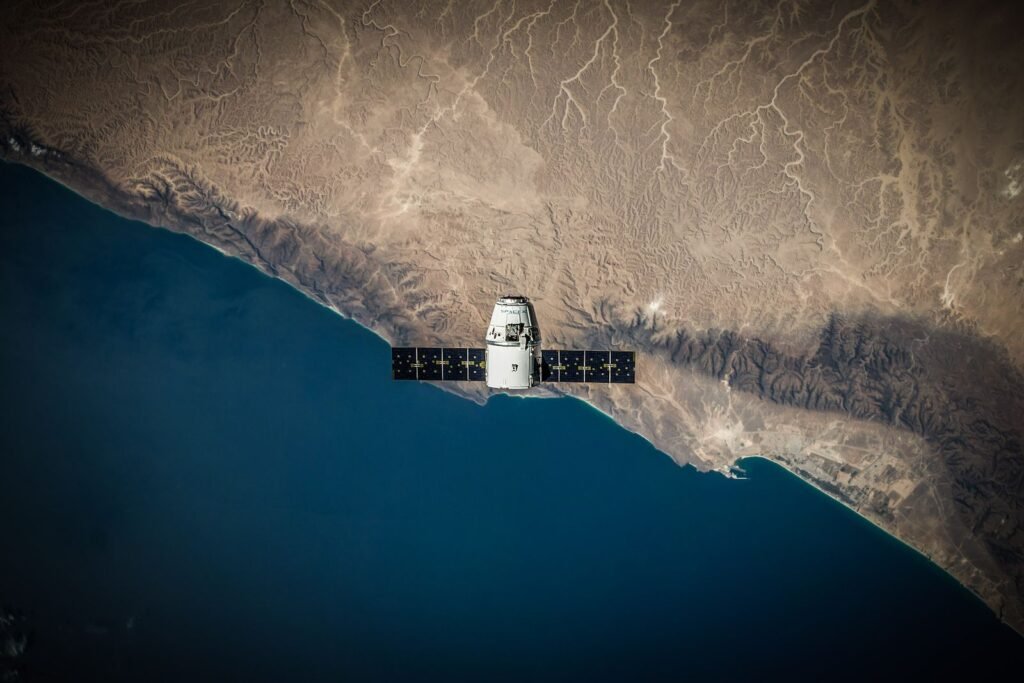
There is a decision buried in NASA’s latest Swift update that deserves more attention than the headline about a telescope falling out of the sky.
The Neil Gehrels Swift Observatory is sinking. A 30 million dollar attempt to save it failed in August. Once that was confirmed, NASA had a choice: leave the spacecraft parked in a low-power configuration and squeeze out a few more months of orbit, or switch its main instrument back on, get real science out of it, and accept that doing so would pull it down faster.
NASA switched it back on. In the agency’s own words, “the return to science has caused Swift to resume its rapid sinking.”
That is not a mistake or a malfunction. It is a calculation, and once you see why they made it, the story stops being about a crash and starts being about what a working telescope is actually worth.
The short version
- Swift launched on November 20, 2004, the first multiwavelength observatory built specifically to chase gamma-ray bursts
- Its orbit was decaying faster than expected, which set a hard deadline on any rescue
- NASA paid about 30 million dollars for LINK, a robotic servicer built by Katalyst Space Technologies in roughly nine months, meant to grab Swift and raise its orbit
- LINK launched in early July 2026 and lost two of its three reaction wheels about three weeks in, which sent it into an uncontrolled spin
- Saving LINK cost LINK the mission. The thrusters used to stop the spin burned the propellant reserved for boosting Swift
- It got within 12 to 15 kilometers of Swift in September, close in absolute terms and not close enough to matter
- Swift is now around 200 miles up, about 325 km. Below 185 miles, roughly 300 km, operations get difficult and science is expected to stop
- NASA expects that threshold in early to mid October, which is to say now
- Reentry risk to people is low. Some hardware may survive, but ocean or uninhabited land is the likely destination
What Swift does that nothing else does
Gamma-ray bursts are the most energetic explosions known, released when massive stars collapse or when compact objects merge. They are also brief. The burst itself can last seconds, and the afterglow fades quickly across other wavelengths.
That brevity is the engineering problem Swift was designed around. It carries three instruments: the Burst Alert Telescope, which watches a wide patch of sky for a burst going off, plus an X-ray telescope and an ultraviolet and optical telescope to study what is left behind. The trick is that when BAT detects something, the spacecraft autonomously turns itself to point the other two instruments at it, fast, without waiting for anyone on the ground to approve.
Twenty-two years of that made Swift the backbone of time-domain high-energy astronomy. When something explodes, Swift is frequently the reason anyone knows where to look. It has fed the alerts that let other observatories catch the fading light of events like a black hole shredding a star and apparently leaving part of it intact, the kind of result that only exists if someone caught the transient early enough.
That is the capability about to disappear, and the honest assessment from astronomers is that the gap will not be filled soon. Instruments get replaced. Rapid-response infrastructure that has been tuned for two decades does not.
How the rescue fell apart
The rescue was ambitious in a way worth stating plainly, because the failure has been reported as if the attempt were foolish.
NASA realized Swift’s orbit was dropping faster than models predicted, which converted a long-term concern into a deadline. Katalyst Space Technologies was given roughly nine months to design, build and launch a spacecraft that could rendezvous with an uncooperative satellite, grab it with robotic arms and lift it. Nine months, for a first-of-its-kind commercial servicing vehicle, is not a normal schedule. It is barely a schedule at all.
LINK, short for Lightweight In-Space Navigation and Kinematics, launched in early July 2026 and deployed its solar arrays successfully. Then the attitude control system went.
| When | What happened |
|---|---|
| November 2004 | Swift launches to hunt gamma-ray bursts across gamma-ray, X-ray, ultraviolet and visible light |
| April 2026 | The Burst Alert Telescope is switched off to conserve power while the solar panels are repositioned |
| Early July 2026 | LINK launches. Solar arrays deploy as planned |
| July 28, 2026 | NASA reports hardware malfunctions. Two of three reaction wheels have failed and LINK is spinning, with intermittent contact |
| Weeks after | Xenon thrusters and new flight software stop the spin. The maneuver drains the propellant budgeted for the boost |
| August 19, 2026 | NASA and Katalyst confirm LINK will not capture or boost Swift |
| September 2026 | LINK runs proximity tests anyway, closing to within 12 to 15 km of Swift. It is set to deorbit |
| October 2026 | Swift sits near 200 miles and is expected to pass the 185 mile science threshold this month |
The cruel detail is the propellant. Reaction wheels hold a spacecraft’s orientation using spinning masses, so losing two of three means losing control authority. The engineers did the right thing, firing the xenon thrusters to arrest the tumble and uploading new software. It worked. It also spent the fuel that was the entire point of the mission. LINK survived as a spacecraft and died as a rescue.
The decision NASA made next
Swift had paused operations ahead of the rescue attempt, with BAT shut down since April to conserve power during the solar panel work. With the boost gone, a spacecraft sitting quietly in a power-saving configuration generates less drag and lasts marginally longer than one actively slewing to chase bursts.
NASA turned BAT back on, restoring Swift’s ability to detect a burst and autonomously point at it.
The trade is straightforward. At these altitudes the atmosphere is thin but not absent, and the drag a spacecraft experiences depends partly on its orientation and attitude activity. A telescope that repeatedly reorients to catch transients presents a changing profile and loses altitude faster. NASA chose weeks of real observations over months of being a quiet piece of hardware waiting to fall, which is the correct call for an instrument with nothing left to preserve it for.
What happens when it comes down
This is the part that generates alarming headlines and deserves a calmer read.
Swift is a substantial satellite, reported at around 3,500 pounds, and the space tracking company LeoLabs has said that given its size, some hardware may survive reentry. The rest of its assessment is the part that matters: “the probability of debris causing significant property damage or physical harm to anyone is very small.” The likely outcome is the ordinary one. “As is the case with most debris that survives re-entry, it will fall into the ocean or on land that’s uninhabited.”
That is not NASA being reassuring about something frightening. It is geometry. Most of the planet is water, most of the land is empty, and uncontrolled reentries have been happening routinely for decades without anyone being hurt. The useful comparison is to how space agencies talk about asteroid odds, where the headline number sounds dramatic and the considered answer is usually that the risk resolves to something close to nothing once the tracking tightens up.
What is not yet clear is exactly when. NASA has given a date for the science threshold, not for reentry. Once a spacecraft drops below roughly 300 km the decay accelerates, but the timing depends on solar activity, atmospheric density and the spacecraft’s attitude, none of which can be pinned down months ahead. Expect the window to narrow as it falls.
Why nobody boosted it sooner. Swift was launched in 2004 without a refueling port, a docking fixture or a grapple point, because nothing existed in 2004 that could have used them. That is true of almost every satellite now in orbit. The entire satellite servicing industry exists to solve a problem that the previous generation of spacecraft was not built to let anyone solve, which is why LINK had to attempt a capture with robotic arms on a target that was never designed to be captured.
The failure that is still worth something
It would be easy to file this as 30 million dollars wasted. The people involved have made a more interesting argument, and it is not purely self-serving.
Katalyst CEO Ghonhee Lee framed it as a first: “in less than a year we went from mission concept to launching and operating the first commercial space robot. This is a foundation we can build on.” He also said the job now is “building a repeatable playbook to inform future rendezvous and proximity operations and satellite servicing.”
NASA administrator Jared Isaacman took the same line, saying the outcome “does not change why this mission was worth attempting” and that the team “moved with extraordinary speed to give Swift a chance to carry out more science while advancing capabilities America will need for satellite servicing in the future.”
Strip out the institutional language and there is a real point. LINK reached orbit, operated, lost most of its attitude control, recovered from an uncontrolled tumble via software uploaded after launch, and then navigated to within 12 to 15 kilometers of a specific uncooperative satellite. For a first attempt on a nine-month build, that is a long way from nothing. Rendezvous and proximity operations are the hard part of servicing, and partial data on the hard part is genuinely useful.
The lesson is also unambiguous: reaction wheel redundancy on a vehicle whose entire purpose is controlled approach is not optional, and a propellant budget that can be wiped out by one contingency maneuver is not a budget. Those are the kinds of findings that only come from flying.
What this costs astronomy
Swift’s loss lands at an awkward moment, because the instruments arriving to replace this generation are built for different jobs.
The new flagships are extraordinary at what they do and none of them is a rapid-response burst chaser. The Roman Space Telescope, built around a spare mirror and launched this year, is a wide-field survey machine. Ground-based transient surveys generate alerts in volumes nobody has fully worked out how to handle. What is thin on the ground is the specific combination Swift provided: a wide-field gamma-ray monitor married to X-ray and ultraviolet instruments on a bus that can reorient itself in about a minute without asking permission.
When that goes, some fraction of bursts will simply be detected late or not localized well enough for anyone else to follow up. That is not a dramatic loss. It is a quiet, cumulative one, and it is the kind that does not show up in headlines until years later when someone notices a gap in the catalog.
What to watch next
- The 185 mile crossing. NASA put it in early to mid October. When Swift passes it, science operations are expected to end
- A reentry window. Expect predictions to get specific only in the final weeks, and to move with solar activity
- What LINK publishes. The proximity operations data from September is the mission’s actual deliverable now, and whether Katalyst shares it broadly will determine how much the 30 million bought
- Whether NASA commissions another servicer. Isaacman’s framing suggests appetite remains. The next target will matter more than the next vehicle
- Grapple fixtures on new satellites. The cheapest fix for all of this is designing the next generation to be serviceable. Watch whether that becomes a procurement requirement
- Who picks up burst alerts. Any announcement about rapid-response gamma-ray coverage after Swift is the thing astronomers are waiting on
The bottom line
Swift is going to come down, it is going to burn up on the way, and the odds of it hurting anyone are very small. That is the news, and it is the least interesting part.
The rescue failed for a mundane reason that happens to be a good lesson: two reaction wheels died, saving the spacecraft cost the fuel that was the mission, and a nine-month build on a hard deadline did not have the margin to absorb it. Nobody involved is pretending otherwise.
The decision that followed is the one worth remembering. NASA had a telescope it could not save and chose to run it hard instead of letting it coast quietly toward the same ending. Twenty-two years after launch, with no way up, the agency decided that observations in hand beat weeks in orbit.
For a spacecraft built to catch things that only last a few seconds, that seems like the right way to go out.
Sources and further reading
- Scientific American: NASA’s rescue mission for the falling Swift space telescope has failed
- UNILAD Tech: NASA issues statement as 22-year-old telescope careens back to Earth
- EarthSky: Mission to save Swift fails, spacecraft will return to Earth
- Via Satellite: Katalyst LINK mission unable to rescue the Swift Observatory
- NASA: Neil Gehrels Swift Observatory mission page
- AccuWeather: Storied NASA observatory weeks away from falling to Earth
About this article: GeekBlog covers U.S. technology news, AI, phones, smartwatches and gaming. Every story is written and checked under our Editorial Policy. Spotted a mistake or have a story tip? Contact our editors.
