

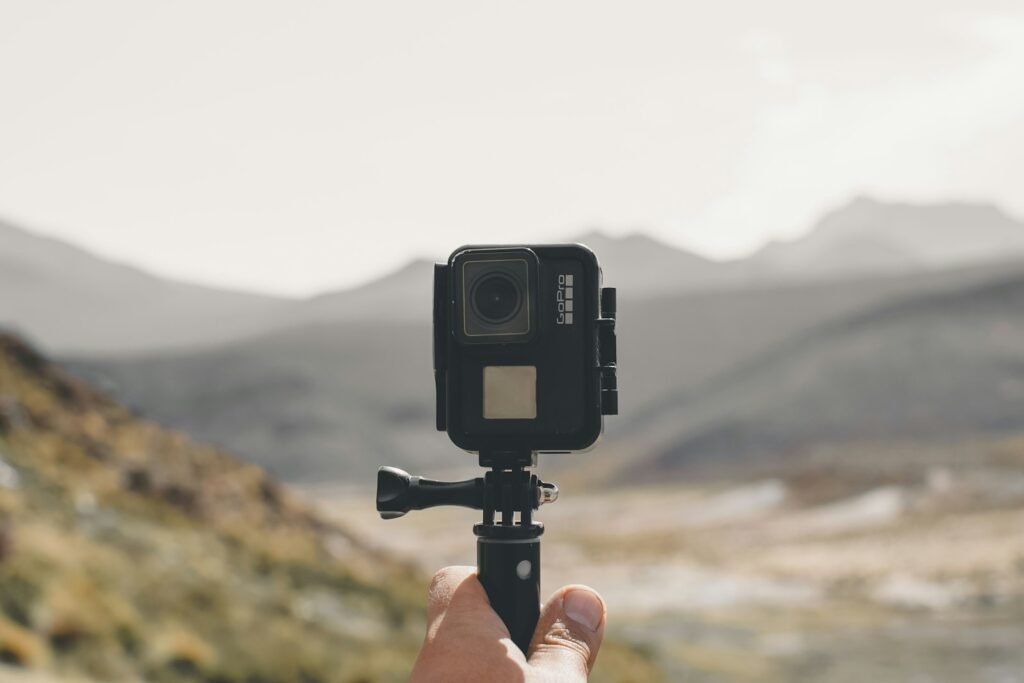
Mark Fischbach, who has spent fifteen years being Markiplier on YouTube, quietly became the largest individual shareholder of GoPro. Not an investment fund, not the founder, an entertainer with a camera hobby and a lot of disposable income from a film he made.
On September 1, GoPro agreed to sell itself for $285 million to an optical photonics company that wants to build hardware for AI data centers and defense customers. Fischbach’s stake converts to roughly $15 million. He went on stream and made it very clear that this is not the outcome he wanted.
The short version
- The stake: about 13.5 million GoPro Class A shares, roughly 8.5 percent of that share class, bought at around $0.60
- The deal: Starman Optical is buying GoPro for $285 million, paying $1.14 a share in cash
- The payday: roughly $15.39 million gross, before taxes and adjustments
- The problem: the buyer is pivoting GoPro toward AI data center optics, defense and national security work
- The accusation: reports of a large purchase shortly before the announcement triggered insider trading claims, which Fischbach denies flatly
How a YouTuber ended up owning 8.5 percent of a public company
GoPro spent the last several years as a case study in what happens when a hardware company defines a category and then watches phones eat it. Its market capitalization fell roughly 98 percent from its peak. The stock traded under a dollar. Debt piled up.
Fischbach’s stated reasoning was simple and, by his account, not especially strategic. He thought the company was undervalued, he liked the cameras, and he wanted GoPro to survive. He described it as something he was “cooking in the background” while working on other things, funded largely by the success of his feature film Iron Lung.
Buying up 13.5 million shares of a sub dollar stock is not an exotic maneuver. What made it notable is where it landed him. At roughly 8.5 percent of the Class A shares, he was the largest individual holder who was not an institution or connected to GoPro itself. Crossing the 5 percent threshold in a registered share class normally triggers a beneficial ownership filing with the SEC, which is how a position like this stops being private.
The deal that changed the company he invested in
Starman Optical is not buying an action camera brand because it wants to sell action cameras.
| Deal term | Detail |
|---|---|
| Announced | September 1, 2026 |
| Buyer | Starman Optical, a private optical photonics company |
| Cash to shareholders | $285 million, or $1.14 per share |
| GoPro debt repaid at closing | Roughly $92 million |
| Retained ownership | Existing holders keep about 10 percent of the combined company |
| Strategic direction | US made optical transceivers for AI data centers, plus defense, government, robotics and aerospace |
| Expected close | End of 2026, subject to regulatory approval and a shareholder vote |
GoPro founder Nicholas Woodman framed it as becoming “a leading American imaging and optical solutions company, addressing important areas of national security related to cameras, optics and AI infrastructure.” Investors liked it immediately. The stock jumped about 40 percent on the announcement and was up roughly 116 percent over five days.
Why he is not celebrating
Fischbach’s public reaction was not a victory lap. He said he was genuinely sad about it, and his objection is specific: he invested in a camera company, and the buyer is not really in the camera business.
“I don’t even remember the real name of it but it has something to do with defense, and AI data centers,” he said in a video responding to the news. “I invested because I like this camera, I invested because I believe that the camera is going to be good for people.” He added that if he had known where the company was heading, “I wouldn’t even be remotely close to this.”
There is something clarifying about that. He is describing the difference between buying a stock and backing a thing, and discovering the hard way that owning 8.5 percent of a struggling public company buys you no say in what it becomes. GoPro’s board took a deal that repays its debt and gives it a future in a sector investors are currently paying enormous premiums for. That the sector is AI infrastructure rather than adventure cameras is precisely the point of the deal.
It is a pattern showing up everywhere right now. Companies with real engineering assets and no growth story keep getting absorbed into the AI buildout, and the acquirer’s roadmap replaces the original one. We saw a much larger version of the same dynamic when Nvidia bought the platform most AI developers depend on, and the immediate question was who the acquired company would really be working for afterward.
The insider trading accusation
This is the part that turned a finance curiosity into a scandal cycle, and it deserves to be stated carefully.
Reports circulated that Fischbach had put roughly $9 million into GoPro shortly before the merger was announced. Given that the announcement sent the stock up sharply, a large purchase in the days beforehand looks, on its face, like exactly the sort of timing regulators exist to examine. Accusations followed quickly. Fellow creator Ludwig summed up the mood with “it doesn’t add up to me.”
Fischbach addressed it directly on a livestream. He denied having any advance knowledge of the merger, said he had been accumulating the position over months rather than days, and called the timing a coincidence. “I did not pump. I did not dump,” he said.
What is actually established, and what is not
- Established: he held a large stake, the merger was announced on September 1, and the shares rose sharply
- Established: he reviewed a GoPro product on his channel and labeled it as sponsored, without separately disclosing that he held stock in the company
- Contested: whether any purchase was made unusually close to the announcement, and what he knew when
- Not established: any finding, charge or regulatory action. No agency has announced an investigation
The disclosure question is the more interesting one, and it is separate from the legal question. Insider trading requires acting on material non public information obtained through a duty of trust. Reviewing a product on your channel while quietly owning 8.5 percent of the manufacturer is not that. It is a conflict of interest, and the sponsorship label does not cover it, because a sponsorship and an equity position are different relationships that create different incentives.
Creators have been colliding with this boundary for a while now, usually in smaller ways. The audience treats a recommendation as a personal opinion, the law treats it as commercial speech, and the gap between those two readings is where nearly every creator controversy lives. It came up in a very different form when a YouTuber used his platform to get a family compensated and ended up in court himself, and the underlying tension was the same one: influence that behaves like journalism, without any of the disclosure rules journalism carries.
What actually happens next
The merger needs regulatory clearance and a shareholder vote, and is expected to close by the end of 2026. Until then nobody gets paid, including Fischbach.
He has said he opposes the deal, which raises a genuinely interesting possibility. An 8.5 percent holder of a share class is not powerless in a shareholder vote, particularly in a company where retail ownership is heavy and turnout is unpredictable. Voting against a merger that would hand him $15 million would be an unusual thing to do. It would also be entirely consistent with everything he has said publicly about why he bought the shares in the first place.
The likelier outcome is that the deal passes, he takes the money, and GoPro becomes an optics supplier with a famous logo. Whether he ends up glad about that is a question only he can answer, and he has been unusually direct about the answer being no.
The honest read
Strip out the drama and this is a story about the limits of buying in. Fischbach did the thing people always say they want to do, which is put real money behind a product he actually believed in, at a moment when almost nobody else would. He was right about the value and wrong about what the value would be used for.
The insider trading accusations are, so far, an inference drawn from timing, and inference is not evidence. The disclosure criticism is more durable, because it does not depend on what he knew. It depends on what his audience did not, and that is a standard creators are going to keep running into as the money involved gets larger. Fifteen million dollars is the kind of number that turns a hobby position into a governance question, and there is no version of the creator economy that has figured out that part yet. The platforms themselves keep rewriting the rules of what creators owe their audiences, and disclosure of financial stakes is a long way down that list.
