

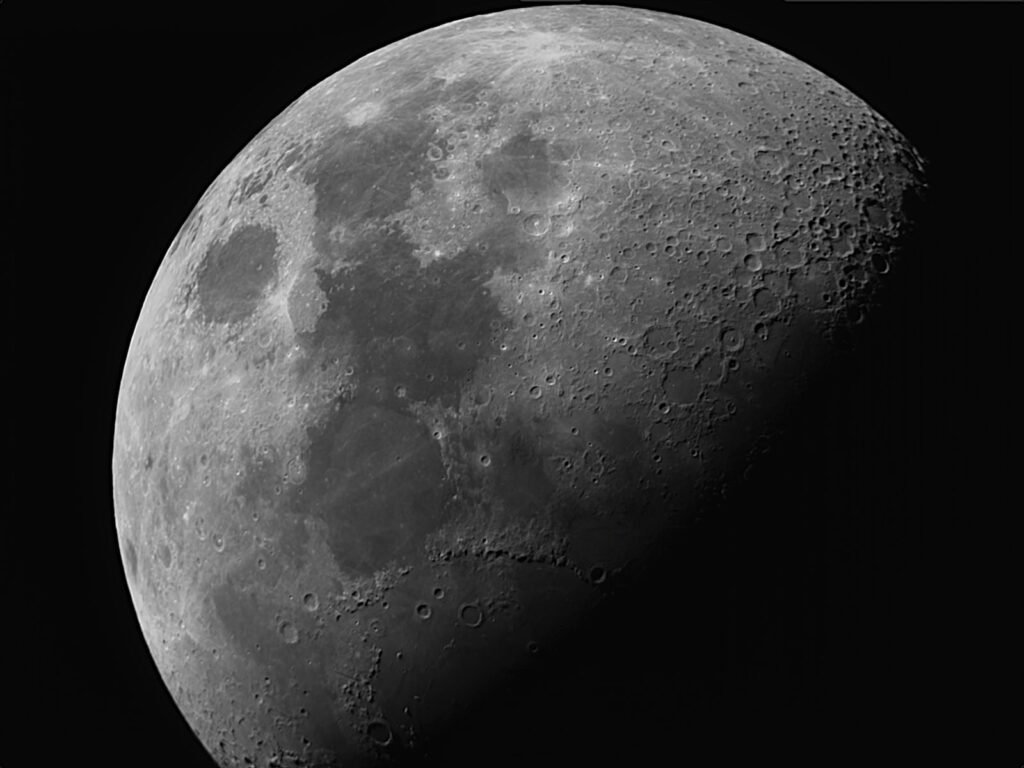
The Moon has no atmosphere, no weather and no ocean to swallow the evidence. Everything that has ever hit it is still written on the surface, which is why lunar scientists treat it as a kind of open ledger of the inner solar system. The problem with a ledger that large is that somebody has to read it.
In 2024, something roughly the size of a six-story building came in fast and punched a hole in the eastern edge of the Moon’s near side. It was the largest fresh impact anyone has ever caught on the lunar surface. Nobody on Earth saw it happen. The spacecraft that photographed the aftermath had the pictures on file for over a year before a human being looked closely enough to notice.
The short version
- NASA’s Lunar Reconnaissance Orbiter recorded a new crater on the Moon measuring about 222 meters across, roughly 728 feet
- It is named McGetchin, after Thomas McGetchin, a former director of the Lunar and Planetary Institute in Houston
- The impact happened between April 11 and May 22, 2024, narrowed down by comparing before and after images
- The object was an asteroid or comet fragment estimated at the size of a three to six story building
- It is about three times wider than the previous largest fresh crater found during the mission
- Researchers put an event this size at roughly once per century
- Nobody detected the flash from Earth. It was found later, in stored orbital imagery
- NASA’s next job is calculating whether debris from impacts like this threatens a planned crewed lunar base
How you miss a once-in-a-century event
The Lunar Reconnaissance Orbiter has been circling the Moon since 2009. In that time its camera system has returned an amount of imagery that no team could ever review frame by frame, which is the ordinary condition of modern planetary science. The data arrives faster than anyone can look at it.
The standard technique is comparison. You take an old image of a patch of ground, line it up against a new one, and let software flag the pixels that changed. Fresh craters announce themselves in a specific way: a bright spot where the impact has thrown up material that has not yet been darkened by space weathering, usually ringed by a darker halo where the blast scoured the surface.
Robert Wagner, an image-processing specialist who works with the orbiter’s camera data, was running through flagged changes when one of them stopped him.
“I just stopped, dropped everything, and started looking into what that spot was,” Wagner said.
The spot was not subtle once you knew to look. The issue was that it had been sitting in the archive since 2024, one bright smudge among an enormous number of images, waiting for the right pair of eyes on the right afternoon.
How big is 222 meters, really
Crater measurements are hard to feel. The number lands better next to things you have stood in or walked across.
The crater is wider than the Colosseum’s long axis and it is a hole, not a building. It runs about 43 meters deep, with a rim standing roughly 8 meters above the surrounding ground. The disturbance did not stop at the rim either. Material flung out by the impact scoured the surface for more than 66 miles in places.
The numbers behind the find
| Measure | Value |
|---|---|
| Crater width | About 222 meters (728 feet) |
| Depth | About 43 meters |
| Rim height above surroundings | Close to 8 meters |
| Impact window | April 11 to May 22, 2024 |
| Estimated impactor size | A three to six story building |
| Reach of surface disturbance | More than 66 miles |
| Estimated frequency | Roughly once a century |
| New craters found by the mission | More than 1,000, plus about 100,000 other surface changes |
Figures from NASA’s Lunar Reconnaissance Orbiter team. The impact window comes from comparing dated before and after imagery of the same terrain.
The Moon gets hit constantly. That is the boring part.
The headline number is the size, but the context underneath it is arguably more interesting. Small impacts on the Moon are not rare events. They are the background hum of the place.
The orbiter’s camera can resolve craters down to about 30 feet across, which corresponds to an incoming rock roughly the size of a monster truck tire. At that threshold, NASA estimates the Moon picks up around 140 new craters every year. Below it, the surface is being sandblasted continuously by objects too small to leave a mark anyone can see from orbit.
Earth gets hit at a comparable rate. The difference is that our atmosphere turns nearly all of it into a light show at altitude. The Moon has nothing to slow anything down, so every rock arrives at full speed and every arrival leaves a permanent scar. It is the same reason that the asteroid 2024 YR4 was tracked so carefully once its odds of striking the Moon were calculated: a lunar impact is not a planetary emergency, but it is a genuinely useful natural experiment, and one you would very much like to see coming.
Why nobody saw the flash
Impact flashes on the Moon are monitored, but the coverage has holes in it. A flash is only visible from Earth if it lands on the near side, during lunar night on that patch of ground, while a telescope happens to be pointed there, in clear weather, with nobody’s schedule conflicting. Miss any one of those conditions and the event simply does not get recorded.
For the largest new crater ever found on the Moon, all of those conditions apparently failed at once.
The part that matters for astronauts
Here is where a piece of trivia turns into an engineering input.
Both NASA and China are planning long-duration crewed presence on the lunar surface. A permanent base is not a capsule that sits there for three days. It is pressurized habitat, power generation, landing pads and stored consumables, parked in one spot for years at a time.
A direct hit on a habitat by an object like this one is extraordinarily unlikely, and nobody is seriously designing around that scenario. The real concern is the secondary debris. When something strikes the Moon at those speeds, it does not just excavate a hole. It launches material outward at velocity, and on an airless body that ejecta travels a very long way before it comes down. The 66 mile figure is not a rounding error, it is the design problem.
So the next step for the team is exactly the unglamorous one you would hope for: calculating the risk that ejected crater material could reach a planned lunar base, and what that implies for where you put one and how you shield it. A base sited near a statistically busy patch of ground, or in the debris path of a plausible impact, is a different proposition from one that is not.
This is the quiet value of a mission that has been flying for over 17 years. A spacecraft that has watched the same surface for that long is not just taking pictures, it is building a baseline. Without imagery of this ground from before April 2024, the crater would be indistinguishable from the millions of others, and the impact would be undatable. Long-baseline observation is the thing that converts a photograph into evidence, which is the same logic behind putting an enormously wide field of view in orbit and surveying the same sky repeatedly.
What to watch next
- The ejecta risk numbers. This is the output that actually affects mission planning. Everything else is context
- Whether the detection pipeline gets faster. A year and a half between impact and discovery is a long lag. The bottleneck is human review of an archive that keeps growing
- Whether anyone recovers a flash record. Now that the window is narrowed to six weeks in 2024, amateur and professional monitoring archives can be searched for something that was recorded and never flagged
- Where Artemis site selection lands. Impact risk is one variable among many, including sunlight, terrain and water ice, but it is now a variable with a fresh data point attached
The Moon did not do anything unusual in the spring of 2024. It did the thing it has been doing for four and a half billion years, at the upper end of the normal range. What was unusual is that we had a camera in orbit with a photograph of that exact patch of ground from before it happened, and a catalog good enough to date the event to a six week window.
The record for largest fresh lunar crater will be broken eventually. The interesting question is whether the next one waits a year and a half to be noticed.
Sources and further reading
- NASA Science: Moon orbiter spots new once in a century crater
- Lunar Reconnaissance Orbiter Camera: McGetchin crater images
- Space.com: NASA spacecraft finds giant new crater on the Moon
About this article: GeekBlog covers U.S. technology news, AI, phones, smartwatches and gaming. Every story is written and checked under our Editorial Policy. Spotted a mistake or have a story tip? Contact our editors.
