

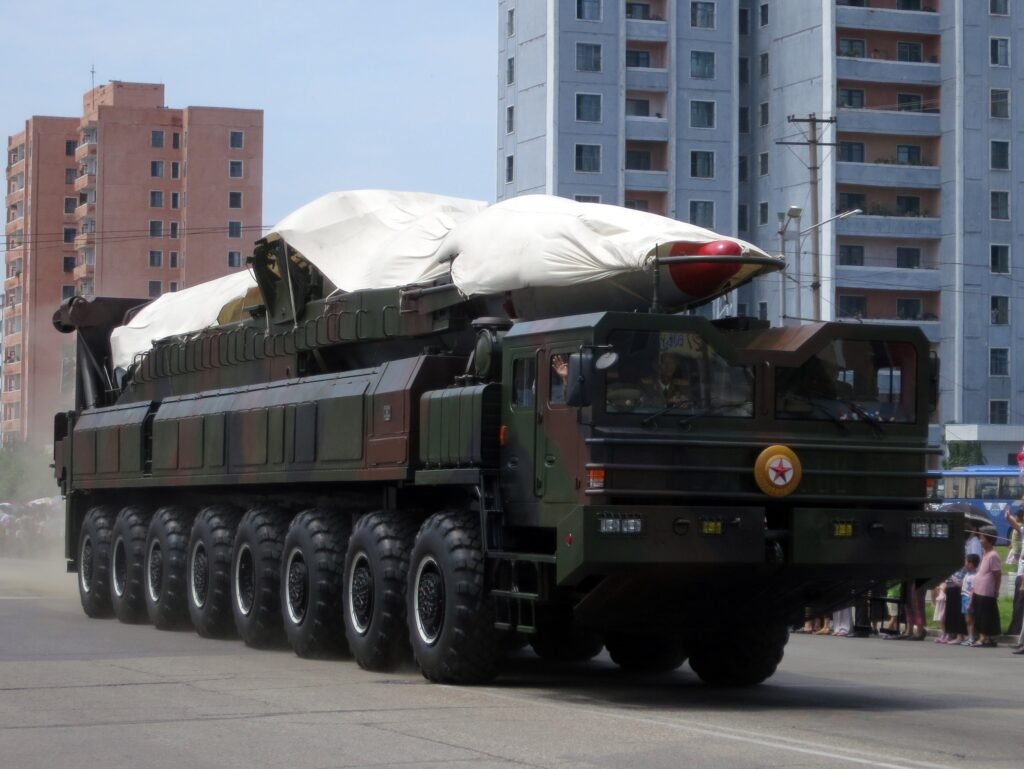
On October 4, North Korea fired something off its east coast. That part is not in dispute. South Korea tracked it, Japan tracked it, and both governments published numbers within hours.
What happened next is the interesting part. Kim Yo Jong, sister of Kim Jong Un and the regime’s usual voice for this kind of announcement, told state media that the missile was an intermediate-range strategic weapon with artificial intelligence in its control system, capable of changing its flight path at low altitude and running at least four different flight modes. Then she offered evidence that the allies had failed to track it.
Her evidence was that South Korea said the missile flew more than 700 kilometers and Japan said 680.
The short version
- What launched: one missile, from the Wonsan area toward the East Sea, on October 4, 2026, with Kim Jong Un reportedly present
- What Seoul measured: a flight of more than 700 kilometers, per the Joint Chiefs of Staff
- What Tokyo measured: roughly 680 kilometers, landing outside Japan’s exclusive economic zone
- What Pyongyang claims: an intermediate-range strategic missile with AI in the control loop, four or more flight modes, and the ability to alter trajectory at low altitude
- The quote: “Whenever we applied the wavelike trajectory mode to missiles, the enemy failed to track the targets from their first skip points. There is no way to avoid this attack”
- What the US said: Pacific Command assessed the launch as posing no immediate threat to American personnel, territory or allies
- What is independently verifiable: the launch, the rough range, and nothing about the AI
The 20-kilometer argument does not hold up
Start with the claim that is checkable, because it is the one Pyongyang chose to lead with.
Kim Yo Jong’s argument is that two allied militaries publishing different range figures proves they lost the missile. In reality, allied militaries publish slightly different figures for essentially every North Korean launch, and have done so for years, for reasons that have nothing to do with AI.
Range estimates come from different sensors in different places doing different jobs. South Korea’s assets sit close to the launch point and watch the boost phase. Japan’s are further away and are primarily concerned with whether something is going to land in Japanese waters. One reports flight distance along the ground track, another may report it slightly differently, and both are producing a fast public figure from a partial track rather than a final reconstructed trajectory. A spread of three percent between those two numbers is unremarkable.
Put differently: 680 and “more than 700” are the same answer. If the allies had genuinely lost the missile, the signature would be an absence of a figure, or a wildly inconsistent one, not a 20-kilometer gap on a 700-kilometer flight.
What a “wavelike trajectory” actually is
This is where the story gets more substantive, because the maneuver being described is real and it does complicate missile defense. It just is not new, and it is not obviously about AI.
A classical ballistic missile flies an arc. It burns, it coasts up through a high apogee, and it falls. From a defender’s point of view that is close to ideal: once you have a few seconds of track, the rest of the path is physics, and you can compute an intercept point before the warhead gets anywhere near the target.
A depressed, maneuvering trajectory breaks that. The missile stays much lower, pulls up and pushes down, and in some profiles skips along the upper atmosphere the way a stone skips on water. Each pull-up throws away the defender’s extrapolated impact point and forces a fresh solution. The phrase “first skip points” in Kim Yo Jong’s statement is a direct reference to that profile.
North Korea has been demonstrating pull-up and depressed-trajectory behaviour on its shorter-range systems since around 2019, and it showed off solid-fuel intermediate-range missiles in 2024. There was a hypersonic system test on September 20 of this year. The aerodynamics on display here are a continuation, not a leap.
So the genuinely new assertion is narrower than the headline: not that the missile maneuvers, but that software with some autonomy decides how and when it maneuvers. That is a claim about a guidance computer nobody outside Pyongyang has seen.
Claim by claim
It helps to separate what was observed from what was asserted, because the two have been reported together.
| The claim | Who says it | Status |
|---|---|---|
| A missile was launched from Wonsan toward the East Sea on October 4 | South Korea’s Joint Chiefs of Staff and Japan’s Defense Ministry | Confirmed |
| It flew roughly 680 to 700 kilometers and landed outside Japan’s EEZ | Both allied militaries, with minor variation | Confirmed |
| Kim Jong Un oversaw the test personally | KCNA, via Kim Yo Jong | State media only |
| It is an intermediate-range “strategic” missile | KCNA. A 700 km flight is well short of intermediate range, which usually implies a lofted or shortened test profile | Unresolved |
| AI in the control system enables four or more flight modes | KCNA only. No technical detail released | Unverifiable |
| Allied sensors lost the missile | KCNA, citing the gap between the two published range figures | Not supported |
| No other country can match the technology for years | KCNA, attributed to Kim Jong Un | Rhetorical |
Why “AI” is a useful word for Pyongyang right now. North Korea’s missile announcements have always been written for three audiences at once: a domestic one, an adversary one, and a negotiating one. In 2026, “artificial intelligence” buys more attention and more alarm than “improved terminal guidance,” which is what the same capability would have been called five years ago. The label is free. Whether there is a learning system in the loop, or a conventional autopilot with several preprogrammed profiles, produces identical flight behaviour from the outside.
The response, which was deliberately low key
South Korea raised its surveillance posture and said it would share intelligence with Washington and Tokyo. US Pacific Command said the launch “does not pose an immediate threat to American personnel or territory or to our allies.”
That second statement is standard language, and it is also the correct read. A 700-kilometer flight into the East Sea threatens nobody. The point of the test was the data and the message, not the distance.
It arrives against a wider pattern. Kim Jong Un has spent September and October demonstrating activity: live-fire drills, a new warship commissioning, the hypersonic test. Nuclear diplomacy with Washington has been dormant since talks collapsed in 2019, and North Korea has moved closer to Russia, supplying troops and munitions for the war in Ukraine. Each of those facts raises the value of a launch that looks technologically ambitious.
Everyone is reaching for the same word
The thing that makes this more than a Pyongyang story is that it is not only Pyongyang reaching for AI as a description of future weapons. Bloomberg has reported that NATO has drafted a plan, referred to internally as “Theory of Victory,” built around low-cost drones, AI-enabled targeting and systems run by minimal human crews. Supreme Allied Commander Europe General Alexus Grynkewich is expected to present it on October 12.
The United States has gone further in reorganising around the idea. The Pentagon is cutting a fifth of its general officer positions to stand up a command focused on autonomous warfare, which is a bet about the next decade expressed as a personnel decision.
Which raises the uncomfortable question underneath all of this. Autonomy in weapons is being sold on the promise of speed, and speed is exactly what removes the window in which a human notices a mistake. That is not theoretical. A chatbot-written intelligence summary recently put US aircraft in the air over a ship that was not where the report said it was. Nobody was hurt, and the sequence from bad output to military action took hours rather than minutes.
The governance conversation has not kept pace. AI executives briefed the UN Security Council this year, which was a first, and produced no binding constraint on anything resembling the system North Korea says it just flew.
What to watch next
- Imagery. KCNA usually publishes photographs. Airframe shape, fins and nozzle geometry will tell analysts far more about what flew than any adjective in the statement
- Whether Seoul or Tokyo revise their numbers. Final reconstructed trajectories typically differ from the first-hour figures, and a revision would say something about how clean the track really was
- A second launch on the same profile. One flight proves a flight. Repeatability across varied conditions is what separates a demonstration from a deployed capability
- Range credibility. If this is genuinely an intermediate-range system, a full-range or lofted test eventually has to happen, and that one is much harder to characterise as routine
- October 12. NATO’s plan presentation will show whether the alliance’s version of AI-enabled targeting is a doctrine or a procurement slogan
- Russian involvement. The main unanswered question in North Korean missile progress since 2024 is how much technical help is flowing back from Moscow in exchange for troops and shells
The bottom line
A missile flew about 700 kilometers into the sea, two allied militaries tracked it and published nearly identical figures, and North Korea announced that the small difference between those figures proved the tracking had failed. That specific argument is weak, and it is the only part of the claim offered as evidence.
The maneuvering profile Pyongyang describes is real, it is a genuine problem for missile defense, and it has been developing in plain sight for several years. The word “AI” attached to it is the one piece that cannot be checked from the outside, and it is doing a lot of work in the headlines.
The right posture is neither dismissal nor alarm. Treat the flight as evidence, treat the adjective as advertising, and wait for the photographs.
Sources and further reading
- North Korea says test of intermediate-range strategic missile included use of AI
- North Korea tests AI-enabled ballistic missile that can “change flight orbit”
- Further reporting on the AI-assisted intermediate-range missile test
- Background on the Hwasong-11 family and its maneuvering profiles
- Grynkewich on autonomous drones and mass in European security
- UNILAD Tech: North Korea fires “strategic” AI-powered missiles in new test
About this article: GeekBlog covers U.S. technology news, AI, phones, smartwatches and gaming. Every story is written and checked under our Editorial Policy. Spotted a mistake or have a story tip? Contact our editors.
