

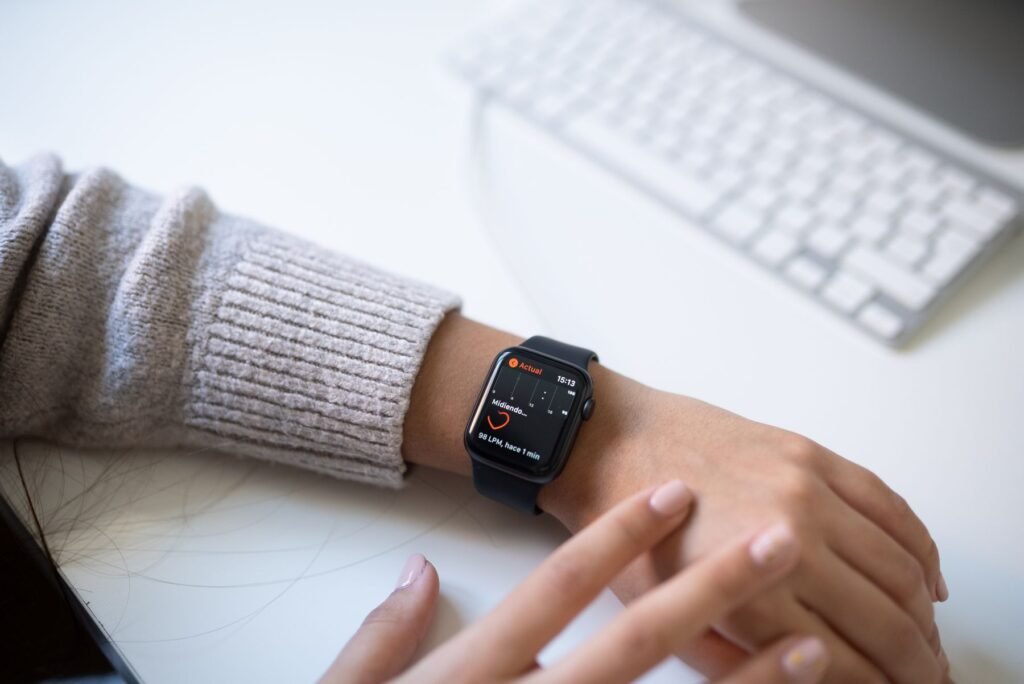
Most people look at their heart rate for the same two reasons: they are exercising, or they are stressed. Both are the moments a wrist sensor is least equipped to measure accurately. The number it gets right is the one nobody bothers checking, which is what your heart is doing when you are lying completely still.
Mallika Marshall, MD, who sits on staff at Harvard Medical School and writes for Harvard Health Publishing, has been making the case that resting heart rate deserves far more attention than it gets. She is not wrong, and the reason is partly technical. Your watch is genuinely good at this specific job.
The short version
- Typical range: 60 to 100 beats per minute, with most healthy adults sitting between 55 and 85
- Trained endurance athletes: frequently in the 40s, and that is normal for them
- The flag: consistently above 90 bpm at rest is worth mentioning to a doctor
- The other flag: an unusually low rate paired with weakness, lightheadedness or breathlessness
- Why your watch can do this: optical sensors are most accurate at rest and degrade as you move
- The real signal: your own trend over weeks, not a single reading against a chart
There is no such thing as a good number
Marshall’s first point is the one that deflates most of the internet’s advice on this. There is technically no universal “good” resting heart rate, because it depends on age, general health, fitness, medication and a pile of variables you do not control.
The textbook range is 60 to 100 beats per minute. In practice most healthy adults land somewhere between 55 and 85. People who do a lot of cardiovascular training can sit in the 40s and be in excellent shape, because a stronger heart moves more blood per beat and therefore needs fewer beats.
Meanwhile stress, anxiety, medication, hormones, illness, dehydration, a late night and a heavy meal can all push the figure up temporarily without meaning anything is wrong with your heart at all. This is why a one-off reading is nearly useless and a two month trend is not.
What the ranges tend to indicate
| Resting rate | Where it usually sits | What to do about it |
|---|---|---|
| Under 50 bpm | Common in trained endurance athletes | Fine on its own. Not fine with dizziness or breathlessness. |
| 55 to 85 bpm | Where most healthy adults live | Nothing. Watch the direction it moves over time. |
| Consistently above 90 bpm | Still inside the textbook “normal” band | Mention it at your next appointment. Marshall says a doctor should know. |
| Rising 5 to 10 bpm over weeks | Often stress, illness, poor sleep or deconditioning | The single most useful pattern your tracker can show you |
Marshall’s phrasing on the low end is worth quoting directly, because the caveat matters more than the number. “A heart rate that is slow for the average person is worrisome, and should prompt a call to your doctor’s office,” she says, “especially if you feel weak, lightheaded, or short of breath.” On the high end: “a resting heart rate that is consistently above 90 beats per minute is also something your doctor should be aware of. Although that’s within the normal range and may not necessarily indicate a serious problem, it could be a sign of something amiss.”
The research that makes this more than trivia
Harvard Health has pointed to research finding that a higher resting heart rate tracks with a higher risk of premature death. In that work, a resting rate between 81 and 90 was associated with roughly double the chance of death, and above 90 with roughly triple.
Two caveats belong right next to that, and most coverage drops them. First, association is not causation. A high resting rate can be a marker of poor fitness, chronic stress or underlying illness rather than the cause of anything. Second, these are population level statistics. They describe risk across large groups, not a prediction about you.
What they do justify is paying attention. A number you can read in two seconds on your wrist, that correlates with long term outcomes and that responds to things you can change, is a rare thing in consumer health tech.
Why the watch is trustworthy here and shaky elsewhere
Almost every fitness watch and band measures heart rate the same way, using photoplethysmography. A green LED shines into your wrist, a sensor reads how much light comes back, and software infers pulse from the rhythm of blood flowing underneath. A smaller set of devices also include an electrical ECG sensor, which reads the heart’s own electrical signal and is the more precise instrument.
Validation studies keep landing on the same conclusion. Optical wrist sensors perform well at rest and during low intensity activity, and their accuracy falls off as intensity rises. Movement is the enemy: your skin deforms under the band, the sensor loses contact, blood flow patterns change, and the algorithm starts guessing. In cardiac patient testing, some wrist devices, including the Apple Watch, tracked closely with ECG, while others systematically underestimated the true rate.
Skin tone, tattoos, band fit, vascular aging and cold hands all affect signal quality too. Nobody advertises this, and it is worth knowing before you treat a mid-workout figure as gospel.
Put those two facts together and the conclusion is neat. The measurement your watch is best at is the one taken while you sleep or sit still, which is exactly the measurement that carries the long term health signal.
Maximum and target rates, by age
Resting rate is one half of the picture. The other is the ceiling, which falls steadily as you get older. Marshall notes a 40 year old’s maximum sits around 180 bpm, dropping toward 150 for someone at 70. The standard estimate behind those figures is simply 220 minus your age, and the training zone most guidance uses runs from 50 to 85 percent of that ceiling.
| Age | Estimated maximum | Target range (50 to 85%) |
|---|---|---|
| 30 | 190 bpm | 95 to 162 bpm |
| 40 | 180 bpm | 90 to 153 bpm |
| 50 | 170 bpm | 85 to 145 bpm |
| 60 | 160 bpm | 80 to 136 bpm |
| 70 | 150 bpm | 75 to 128 bpm |
These are estimates, not measurements. Real maximum heart rates vary widely between individuals of the same age, which is why anyone training seriously gets tested rather than relying on arithmetic. For everyone else the table is a rough sanity check, not a target to chase.
How to get a reading worth trusting
- Use the sleep number. Most trackers calculate resting heart rate from your lowest sustained overnight period. That is the cleanest signal your device produces, and it needs the watch worn to bed. Our roundup of the best sleep trackers covers which devices actually do this well.
- Wear the band properly. Snug, a finger width above the wrist bone, not sliding around. A loose band is the single most common cause of nonsense readings.
- Compare yourself to yourself. A 12 bpm gap between two brands on the same wrist is common. The direction your own number moves is the part that means something.
- Look at weeks, not days. One bad night, one hangover or one stressful afternoon will move it. A sustained climb over a month is the pattern to take seriously.
- Do not spend a fortune to start. Resting heart rate is the least demanding measurement in the entire category, and plenty of cheap smartwatches handle it perfectly well.
This is a consumer gadget, not a diagnostic device
None of this is medical advice, and no wrist tracker is cleared to diagnose anything. What a watch is good for is noticing that something changed. If your resting rate has climbed and stayed there, or you feel faint, breathless or your chest is doing something unfamiliar, the correct next step is a doctor, not a forum thread.
The genuinely useful takeaway
Wearable makers spend their marketing budget on the numbers that photograph well: recovery scores, readiness percentages, sleep grades, stress indexes. Most of those are proprietary composites built on top of a handful of raw signals, and none of them are validated the way a pulse is.
Resting heart rate is different. It is simple, it is measured under the conditions the hardware handles best, it has decades of clinical literature behind it, and it responds within weeks to sleep, training, alcohol and stress. If you only ever look at one figure on your watch, that is the one.
Check it tomorrow morning. Then check it again in a month, and pay attention to which way it moved.
About this article: GeekBlog covers U.S. technology news, AI, phones, smartwatches and gaming. Every story is written and checked under our Editorial Policy. Spotted a mistake or have a story tip? Contact our editors.
