

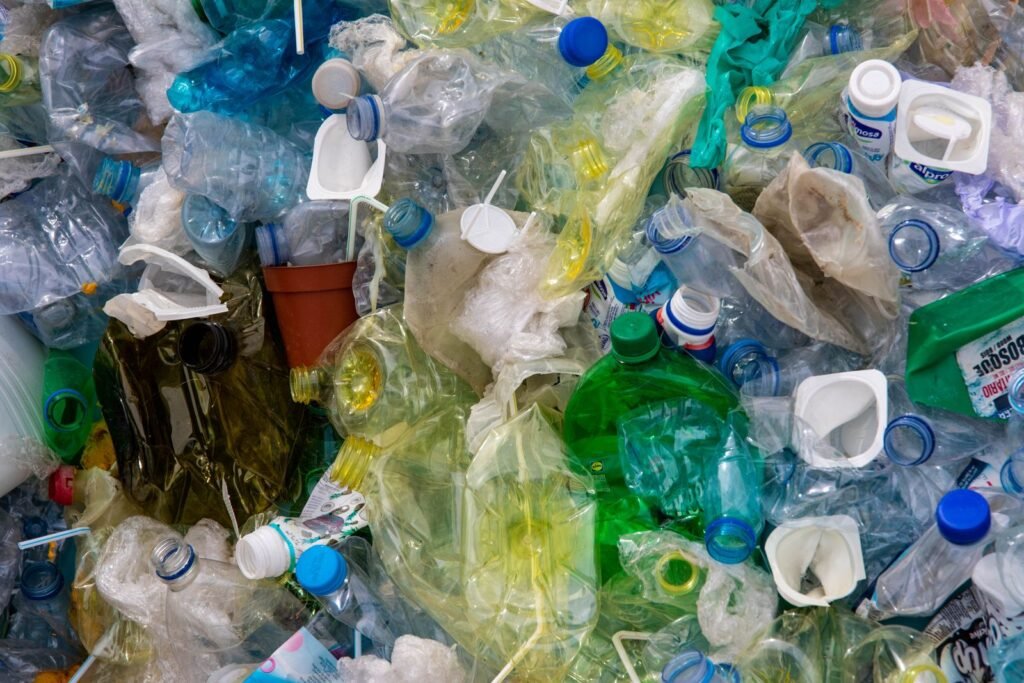
There is a cookie sitting in a lab at Southern Illinois University Carbondale that used to be a plastic bottle. It is protein rich, it smells of vanilla, it came out of a 3D printer, and according to the people who made it, it contains no plastic at all. Nobody has eaten one, because nobody has been given permission to.
That last detail is the one most of the coverage has skipped past, and it is worth holding onto. This is a real result presented at a real chemistry conference, and it is also very early. The team has smelled their cookies. They have not tasted them.
The short version
- What it is: µBites, pronounced microbites, a 3D printed protein snack built from PET plastic and crop waste
- Who made it: a team led by Dr Lahiru Jayakody at Southern Illinois University Carbondale, funded through NASA’s Deep Space Food Challenge
- How: waste is chemically broken down, engineered yeasts eat the fragments and produce proteins, fats, flavor and vitamins, and the result is printed and microwaved
- Status: aroma testing done and scoring well. Human taste testing is awaiting approval
- Cost: roughly $60 per kilogram, which sounds absurd until you price the alternative for a Mars crew
How you get from a bottle to a biscuit
The process has three stages, and none of them involves grinding up plastic and baking it into food. That distinction matters, so it is worth walking through properly.
Stage one is demolition. The team takes PET plastic, corn stalks and leaves left over after harvest, and other biomass, and runs it through something called oxidative hydrothermal dissolution. Water and oxygen at high temperature and pressure tear the long polymer chains and tough plant fibers into small molecules that a microbe can actually metabolize. At the end of this you have a chemical soup, not plastic fragments.
Stage two is the interesting part. Engineered yeasts eat that soup and build food molecules out of it. The team used more than one organism for more than one job. A modified baker’s yeast, Saccharomyces cerevisiae, converts plant derived ferulic acid into vanillin, which is where the vanilla smell comes from. A separate adapted strain, Rhodosporidium toruloides, takes ethylene glycol derived from the PET and produces beta carotene, the precursor your body turns into vitamin A.
Stage three is assembly. The resulting proteins, fats and acids get blended with starch, fiber and sweetener, extruded through a 3D printer into a shape that reads as food, and microwaved.
Why anyone would want this
Jayakody’s explanation of how the project started is the cleanest summary of the logic anyone has offered. “My lab works on developing technologies for plastic upcycling,” he said. “We thought, why not look into food? Plastic is carbon and food is carbon.”
That is chemically true and emotionally very hard to accept, which is why this story is doing numbers this week. But the intended use case is not your lunch. It is a spacecraft.
“When an astronaut goes to Mars, they have to survive in extreme conditions,” Jayakody said. “The round-trip is three years. You have to use everything you can.”
The math that makes $60 a kilogram look cheap
NASA has historically budgeted around 1.8 kilograms of food and packaging per crew member per day. Run that out for a four person crew on a three year round trip and you get a number that explains why anyone is engineering yeast to eat garbage.
Against that, $60 per kilogram of production cost is not the objection it looks like. The relevant comparison is not the supermarket. It is the cost of lifting eight tonnes of shelf stable meals out of Earth’s gravity well and keeping them palatable for three years. The team also expects the number to fall as the yeast strains get more efficient and the process scales, which is the standard trajectory for anything grown in a bioreactor.
What the researchers have actually tested
| Question | Where it stands |
|---|---|
| Does it smell like food? | Yes. It scored highly on aroma with test participants |
| Would people eat it? | Most participants said yes, in a resource limited situation. That is a meaningful qualifier |
| Does it taste like food? | Unknown. No human has eaten one |
| Is it safe? | Not yet demonstrated in humans. Approval for human testing is pending |
| Does it contain plastic? | The researchers say no. The polymer is broken into molecules before anything eats it |
| Could it sustain someone long term? | Open question. It is framed as a protein rich supplement, not a complete diet |
Jayakody was direct about the gap: “We haven’t eaten them yet because we’re awaiting approval for testing in humans.” That is the correct order of operations and it is also the honest ceiling on what anyone can claim today.
The Earth argument, which is not as dramatic but may matter more
Space missions pay for the research. The plausible near term users are on the ground: submarines, remote research stations, disaster zones where supply lines have been cut, and any situation where you have waste, water and power but no functioning food logistics.
The wider framing that keeps appearing in coverage is food insecurity, and it deserves care. The FAO’s recent assessments have put the number of people facing moderate or severe food insecurity in the region of 2.3 billion, close to 29 percent of the world. That is a real and enormous number. It is also not a problem that a 3D printed vanilla cookie solves, because global hunger is overwhelmingly a distribution, income and conflict problem rather than a calorie synthesis problem.
Where technology like this could genuinely help is at the sharp edge, in the places where distribution has already failed. That is a smaller claim, and a more defensible one.
The upcycling angle is the underrated one
Strip away the space mission and what you have is a plastic recycling method that produces something more valuable than recycled plastic. Conventional PET recycling degrades the polymer a little more each cycle until it is fit only for fiber or landfill. Breaking it down to molecules and rebuilding it as a different class of material entirely sidesteps that decay.
That is the same instinct behind a lot of the more interesting environmental engineering right now, which is to stop treating waste as a disposal problem and start treating it as feedstock. Florida has been doing a low tech version of exactly this by putting restaurant oyster shells back into the Gulf to rebuild reefs, and the seafloor has responded. Different scale, same logic.
It also arrives against a background where the food system itself is under pressure from a warming climate, which is the actual context for a lot of the alarm in this coverage. Our breakdown of what the hothouse Earth research does and does not say is a useful corrective if the headlines have been getting to you.
How much to believe right now
A reasonable position
- Believe: the chemistry works, the yeasts do what the team says they do, and the result smells like vanilla
- Do not yet believe: that it is safe, palatable, nutritionally complete or affordable at scale
- Watch for: the first human trial results, and whether the $60 per kilogram figure moves
A NASA logo does a lot of heavy lifting in a headline, and it is worth being a little disciplined about that. This is a legitimate university project with legitimate NASA challenge funding, which is a very different thing from a NASA mission decision, and the gap between those two gets flattened constantly. We wrote about a spectacular recent example when an entirely fictional NASA program convinced a lot of people that gravity was going to switch off.
µBites is real, and the underlying idea is genuinely clever. It is also a cookie that no human has ever been permitted to eat. Both things are true at once, and the second one will probably change first.
