

Featured image source: Pexels (free to use)
For most of this year, the story about Flock Safety followed a familiar shape. A surveillance company grows fast, privacy advocates object, a few progressive city councils vote it out, and the company issues a statement about community trust.
That story stopped working in the first week of September, because the people switching off the cameras this time are Ron DeSantis and Greg Abbott.
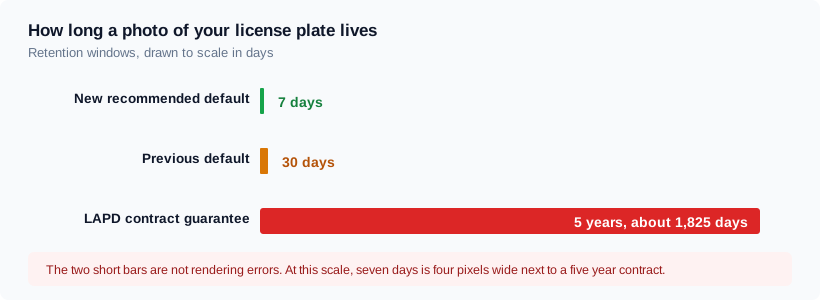
Florida’s Department of Transportation issued a memo ordering license plate readers removed from state highway rights-of-way, citing “concerning reports of misuse, data privacy concerns, and surveillance schemes.” Agencies have 30 days, with a deadline of September 30. In Texas, Governor Abbott ordered state agencies to halt funding for the systems. The Dallas Police Department responded by announcing it is shutting down more than 300 cameras.
What happened this week
- Florida: FDOT ordered plate readers off state highways within 30 days. At least three more Florida counties then ended their own programs.
- Texas: Abbott froze state funding. Dallas PD is switching off 300-plus cameras. Pflugerville’s council voted unanimously to end its contract and its 28 readers.
- Wisconsin: at least a dozen law enforcement agencies suspended use.
- The running total: at least 56 cities and towns have deactivated, rejected or canceled Flock contracts in 2026, per a tally by the advocacy group DeFlock.
Why the politics flipped
Automated license plate readers were supposed to be the rare surveillance technology with bipartisan cover. They catch stolen cars and find missing people, they do not listen to you, and the pitch to a city council is concrete in a way that most privacy debates are not.
What broke that consensus was not an argument about principle. It was a run of specific, documented incidents that were impossible to characterize as hypothetical.
Officers used the network to track people they knew personally. Roughly 50 documented cases of misuse accumulated over the year, including a Florida officer who ran his wife’s plate 717 times while the system’s own justification field accepted whatever he typed into it. Several officers around the country resigned or were arrested.
Then there was the security side. Earlier this year a batch of cameras was found streaming to the open internet, which the company attributed to bad SIM cards. And a University of Washington report found that Border Patrol had effectively back door access to the networks of at least 10 police departments in that state that had not explicitly authorized federal searches of their data. The police chief in Eatonville told local reporters his department had no idea its six cameras were being queried that way.
That last detail is the one that moved conservative officials. A local sheriff who signs up for a tool to catch car thieves and later discovers a federal agency has been running searches against his data without his knowledge is not having a privacy debate. He is having a control debate, and that is an argument that lands across the political spectrum.
The reforms came first, and did not stop it
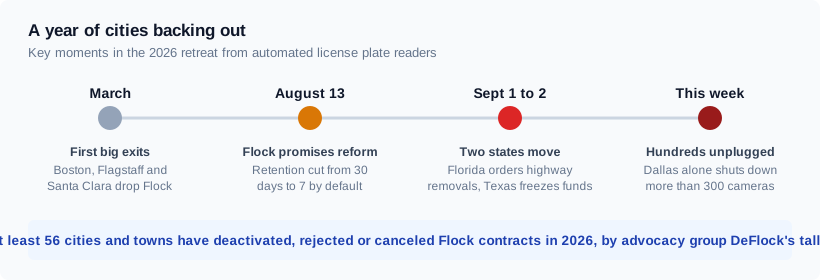
The remarkable part of the timing is that Flock had already moved. On August 13, the company announced it was cutting default data retention from 30 days to seven, adding mandatory misuse safeguards, and introducing an Evidence Mode that lets detectives preserve specific records for active investigations. Most of the changes become mandatory for law enforcement customers on January 1, 2027.
The company backed the seven-day figure with its own usage data, saying more than 90 percent of partial plate searches happen within a week of the data being logged. On the merits, that is a reasonable defense of a shorter window.
It arrived about three weeks before two governors decided the question was no longer about retention windows.
The retention promise has a large asterisk
Here is the detail that undercuts the reform announcement, and it is not a small one.
Existing customers keep their current retention periods unless they choose to opt into the new seven-day standard. That is a meaningful carve-out, because some existing contracts are nothing like seven days. The LAPD’s agreement guarantees five years of retention.
There is also an unresolved argument about who owns any of this. Flock says the data belongs to its customers, meaning police departments, homeowners associations and private businesses. Privacy researchers point out that the contracts have allowed the company to retain certain data to train its models, and a number of departments have been renegotiating specifically to bar that. Senator Ron Wyden has written to the FTC about the company.
Where the cameras are actually coming down
| Where | What was decided | Scale |
|---|---|---|
| Florida, statewide | FDOT memo removing readers from state highway rights-of-way | 30 day deadline, September 30 |
| Dallas, Texas | Shutdown following the state funding freeze | More than 300 cameras |
| Pflugerville, Texas | Council voted unanimously to end the agreement | 28 readers, system access disabled |
| Hood County, Texas | Commissioners ended the relationship | 3 cameras disconnected and covered |
| Wisconsin | Agencies suspended use pending review | At least a dozen departments |
The Hood County detail is oddly evocative. Three cameras, disconnected and physically covered until someone can come and take them down. That is a county government that does not want to wait for a removal appointment.
The case on the other side
It is worth being fair about what gets lost, because the police objections are not purely institutional defensiveness.
Lucas County Sheriff Mike Navarre made the most concrete version of the argument when the retention change was announced: some crimes are not discovered for weeks. A burglary at a vacation property, a fraud that surfaces during an audit, a missing person case that starts as something else. A seven-day window is useless for any investigation that begins on day 20.
The tradeoff nobody has solved
- Short retention protects the innocent majority. Almost everyone photographed by these cameras is not connected to any crime.
- Long retention helps the slow cases. Investigations that start late need data that was collected early.
- Audit logs only work if someone reads them. The Florida officer typed a justification 717 times and the system accepted it every time.
- Access control is the real failure point. Retention length does not matter much if agencies outside the contract can query the network anyway.
The uncomfortable conclusion is that the retention debate, which is where Flock chose to make its concession, may be the least important of these. A seven-day window with unaudited access and undisclosed federal querying is not obviously safer than a 30-day window with neither.
What this means for the company
Flock has been one of the more celebrated venture-backed companies in public safety, and its growth model depends on a steady stream of municipal contracts that renew quietly. A year in which more than 50 jurisdictions cancel, and two large states intervene at the executive level, attacks that model directly.
It also creates a template. Cities that were undecided now have cover from an unexpected direction, and the mapping work that made the network legible in the first place is still out there. Someone mapped every Flock camera in America earlier this year, and that map turned an invisible system into a list of specific poles in specific neighborhoods that residents could point at during a council meeting.
Bottom line
The reforms Flock announced in August were real and, taken alone, defensible. They also addressed the part of the problem the company could fix with a settings change, while the incidents driving the backlash were about who could reach the data and whether anyone was watching them do it.
Two governors from the party least likely to be described as privacy activists have now decided that is not a settings problem. Whatever happens to the September 30 deadline in Florida, that political fact is the one the industry will be reacting to for the rest of the year.
