


Featured image: Riot Games, via riotgames.com
Riot Games does not usually publish numbers this specific. But on September 17, the studio’s head of anti-cheat, Phillip Koskinas, posted a blog update confirming that Vanguard’s “Anti-Boost” system has actioned exactly 296,416 League of Legends and VALORANT accounts for rank manipulation since late 2025, and that Riot is not close to done. The post reads less like a corporate disclosure and more like a stand-up bit, but underneath the jokes is one of the more detailed looks any major publisher has given into how it actually catches players who buy, sell, or borrow their way up the ranked ladder.
The timing turned out to be awkward for a handful of well-known names. Within a day of the announcement, variety streamer Trainwrecks said on stream that his own League of Legends rank had been reverted, and he pinned the cause on queuing with fellow streamers Tyler1, Trick2g, and Yassuo. “We’re playing on stream, we’re just playing to play,” he told his audience, a defense that has not stopped the clip from circulating widely since.
The short version
- What happened: Riot confirmed 296,416 League of Legends and VALORANT accounts have been penalized for rank manipulation since late 2025
- The tool: Vanguard’s Anti-Boost system, which flags accounts gaining rank from a higher-skilled player logging in on their behalf
- Timeline: Launched privately on League in September 2025, expanded to VALORANT this past July after nearly a year of testing
- The catch: Riot says enforcement is not even at full strength yet, with stricter rank removal coming in the months ahead
- Who got caught up in it: Streamer Trainwrecks had his League rank reverted days after the announcement, sparking pushback from parts of the community
What Riot actually means by rank manipulation
Riot’s blog post leans on three specific terms, and understanding them explains most of how the system works. A “booster” is a higher-rated player who logs into someone else’s account and plays well above that account’s usual level. The account receiving that treatment is the “boostee.” A “hitchhiker” is a separate, lower-rated player who repeatedly parties with a booster or a purchased account, riding along to a rank they would not reach on their own.
Vanguard’s Anti-Boost tool, first tested privately on League of Legends starting in September 2025, was built to spot the pattern those three roles create. When an account’s skill profile suddenly jumps, when it is logged into from unfamiliar hardware, and when its match history shows it repeatedly grouped with much higher-rated players, the system flags it for review. After roughly a year of refinement on League, Riot brought the same detection layer to VALORANT this past July, effectively doubling its reach across the company’s two biggest competitive titles.
The punishments scale with how many times you get caught
Riot was unusually specific about what actually happens once Vanguard flags an account. The penalties are not one-size-fits-all. They escalate based on the role a given account played and whether it is a repeat offense.
| Role in the manipulation | What Riot does about it |
|---|---|
| Boosted account (boostee) | Rank and rewards gained during the boost are stripped, and the account is suspended for three days minimum, longer for each additional offense |
| Booster’s own main account | Escalating suspensions, separate from whatever penalty hits the account they boosted |
| Purchased or ownerless account (smurf) | Permanent ban, no rank rollback involved since Riot treats these accounts as having no legitimate standing to protect |
| Hitchhiker (partied with a smurf or booster) | Loses whatever rank was gained during those games, even if they claim they did not know |
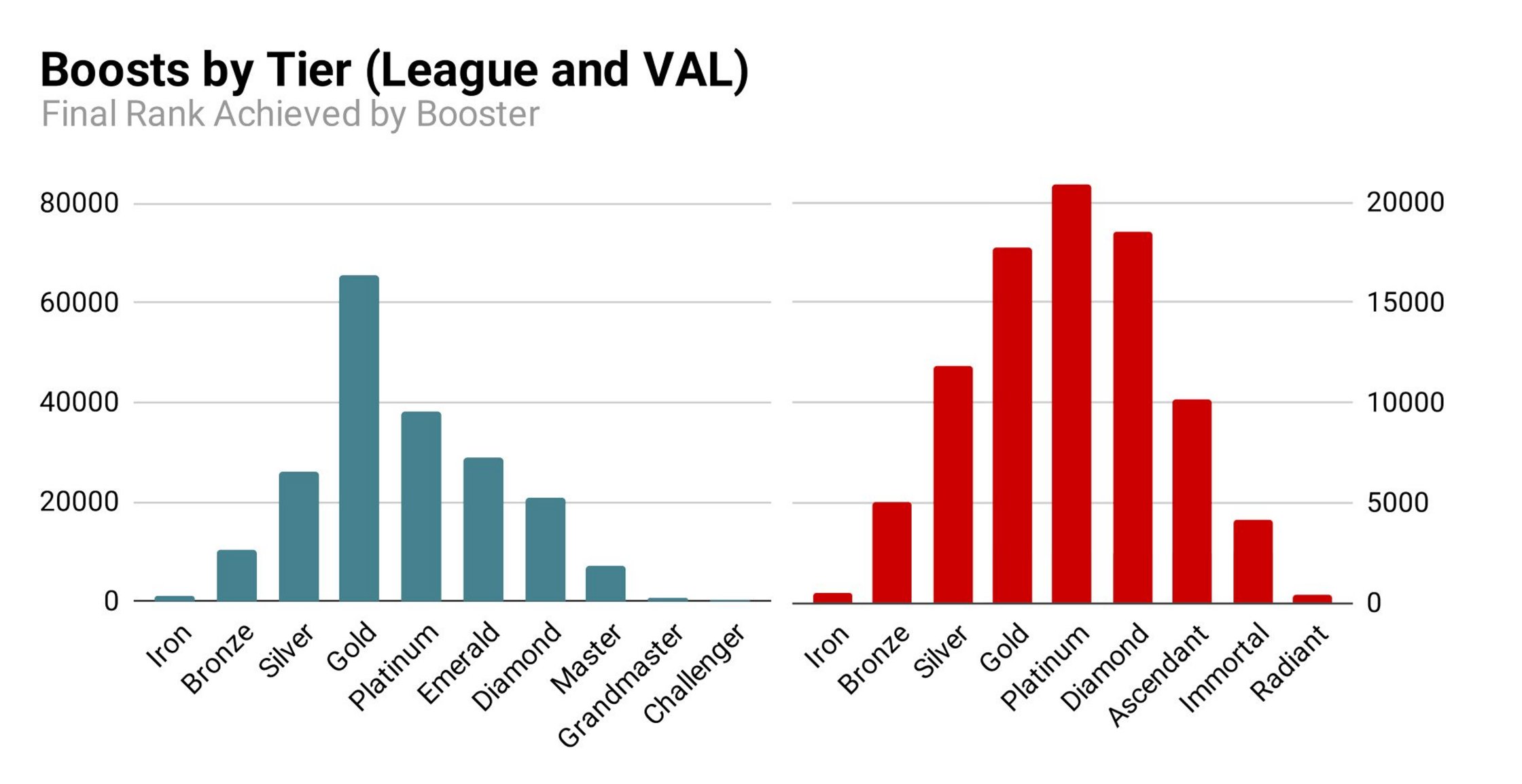
That chart carries one of the more telling details in the whole post. League of Legends shows a clear spike in boosting activity right at the Gold tier, and Riot says that is because a rank-exclusive skin reward starts unlocking at that threshold. Give players a cosmetic tied to a specific rank, and a slice of them will pay someone else to get there rather than climb on their own.
Not every second account is a crime
The part of Riot’s post that reads least like a punchline is its breakdown of who actually owns a second account. Across both games, around 9 percent of daily active ranked players are on an account other than their primary one on any given day, a figure that includes shared, borrowed, and stolen accounts alongside completely legitimate alts. Of that slice, Riot says roughly half are what it calls “benevolent alternates,” accounts created, leveled, and played by one person with no intent to cheat.
Riot’s list of legitimate reasons to have an alt
Practicing a new champion or agent away from your main’s rank, keeping a dedicated five-stack account for a set group of friends, staying anonymous if you are a public figure who draws unwanted attention in-game, running a strict one-trick account for a single role, and simply wanting to climb the ladder a second time for the challenge all made Riot’s own list of accounts it has no interest in punishing, provided they are not shared or used to hitchhike.
The line Riot draws is ownership and intent. An account you built yourself and never share is treated as clean, even if you never touch your main again. An account you bought, rented out, or used to drag a friend up the ladder is not, and that distinction is doing most of the work in a 296,416-account enforcement wave that Riot insists is not a blanket purge of anyone with more than one account.
What actually trips the ban
Riot’s post lists the specific behaviors that will get an account suspended and its rank stripped. Stripped of the jokes, the list comes down to five patterns:
- Paying or arranging for a booster to log into your account and play it for you
- Buying or borrowing a lower-rated account specifically to queue against weaker opponents
- Handing a friend or teammate an account you do not own so they can rank it up
- Repeatedly queuing with a booster or a purchased account as a hitchhiker
- Deliberately losing games to derank an account, typically so it can be resold or used to boost someone else later
None of that is new territory for anti-cheat teams generally, but Riot’s willingness to publish exact figures alongside it, down to the last digit, is unusual for a studio this size.
The community reaction has not been entirely on Riot’s side
Enforcement announcements like this one tend to land differently depending on who ends up in the blast radius, and this one caught a few high-profile streamers almost immediately. Trainwrecks was the most visible case, attributing his reverted rank to queuing sessions with Tyler1, Trick2g, and Yassuo rather than any deliberate boosting arrangement. Part of the pushback echoes a gap that has shown up elsewhere in gaming this year, where an official verdict and what the actual audience believes can diverge sharply, whether that verdict comes from a review score or, in this case, an automated system deciding a group of friends playing together looks statistically identical to boosting.
Riot’s system does not appear to distinguish intent from pattern. If four friends of wildly different skill levels queue together often enough, Vanguard can flag it the same way it would flag an actual paid boosting arrangement, and the account with the least standing in that group is the one that loses rank. That is precisely the scenario several streamers say happened to them, and it is a real tension in a detection system built on statistical pattern matching rather than direct evidence of a transaction.
Riot says this is just getting started
The most pointed line in Riot’s post is also the least jokey one: enforcement is not at full power yet, and the studio plans to get stricter about rank removal in the coming months. Alongside tighter detection, Riot is accelerating multi-factor authentication requirements for ranked play and pushing TPM 2.0 hardware verification, aimed at making it harder to operate the account farms that fuel the boosting economy in the first place rather than just banning the accounts after the fact.
It is part of a broader pattern of platforms tightening rules around what players are actually allowed to do with their own accounts and their own time this year. Microsoft framed its own overhaul of Xbox policy as the biggest reset in the platform’s history, and Riot’s enforcement wave carries a similar undertone: the rules players assumed were loosely enforced are getting a lot less loose, and the systems doing the enforcing are getting harder to argue with.
Bottom line
Riot rarely hands out a number as specific as 296,416, and doing so alongside charts, tier breakdowns, and a genuine defense of legitimate alt accounts makes this one of the more transparent anti-cheat disclosures a major studio has published. The tradeoff is a detection system confident enough to strip rank from streamers who say they were just playing with friends, which is exactly the kind of edge case that was always going to surface once a ban wave got this large. Riot has been clear that the current total is a floor, not a ceiling. Anyone still queuing on a borrowed account, or regularly carrying a much lower-rated friend, is playing against a system that is explicitly built to notice.
About this article: GeekBlog covers U.S. technology news, AI, phones, smartwatches and gaming. Every story is written and checked under our Editorial Policy. Spotted a mistake or have a story tip? Contact our editors.
