

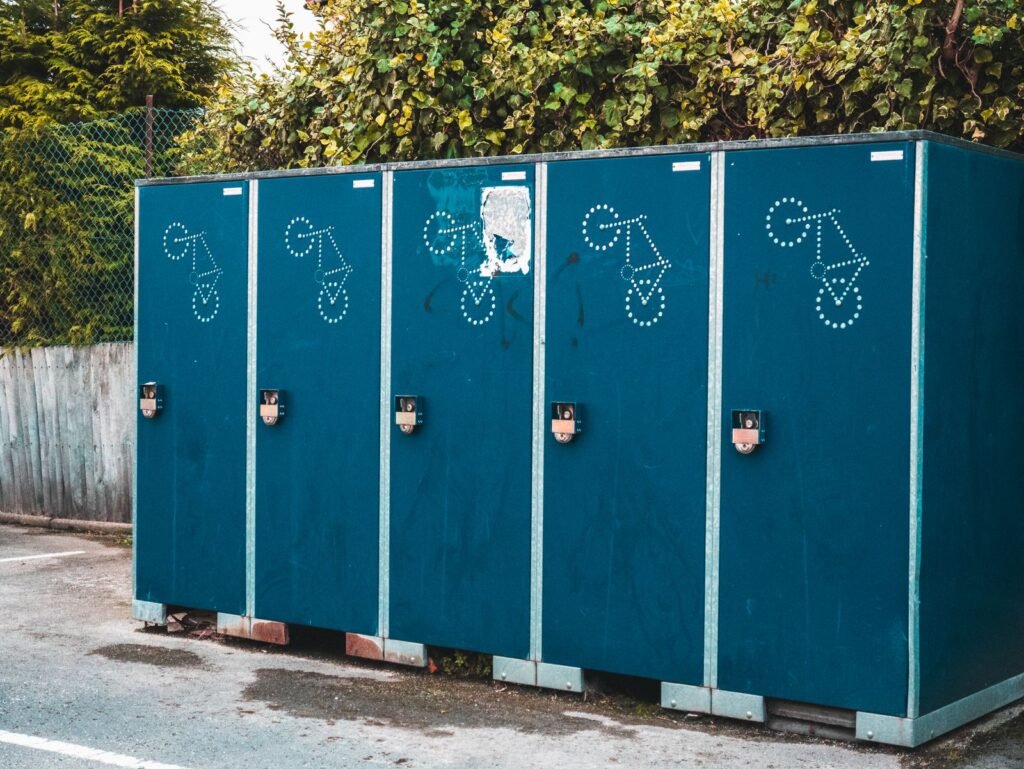
There is a sentence New Yorkers are going to start hearing on the street, and it is not one anybody has had to think about before.
“Attention: Your use time has expired. The door is opening now.”
That announcement belongs to a new generation of public restroom arriving across the five boroughs. Seventeen of them, under a one year pilot costing about $4 million, operated by a company called Throne Labs. They are free. They have running water and a real flushing toilet. They are cleaned on a schedule driven by user ratings. Several are already open in Brooklyn and Queens.
They also run a clock on you, and when it hits ten minutes the door slides open whether you are ready or not.
The short version
- 17 modular restrooms across all five boroughs, under a one year pilot worth roughly $4 million
- Operated by Throne Labs, which already runs units in Washington DC, Los Angeles, the San Francisco Bay Area and Ann Arbor
- Entry is by QR code, app, text message or a physical tap card handed out through community partners
- Every visit is capped at 10 minutes, with audio warnings along the way
- They need no sewer or water hookup, which is the entire reason the city can afford to place them quickly
- Homeless advocates say the phone requirement excludes the people who need a bathroom most
- New York ranks 93rd out of the 100 largest US cities for public restrooms per resident
How the clock actually works
The ten minute limit is not a sudden ejection. It is a sequence, and the design intent behind it is pretty clearly to give you enough warning that the ending is never a surprise.
There is also a protocol for the person who simply does not leave. Throne says it will send someone out, and if a situation escalates beyond that, police can be called. In practice the company is betting that the flashing lights and the open door resolve almost every case long before anybody is dispatched.
Four ways in, and why the fourth one matters
You cannot just walk into one of these. Access is gated, and there are four routes through the gate.
| Method | What you need | The catch |
|---|---|---|
| Scan a QR code | A smartphone camera | Needs a working phone and usually a signal |
| The Throne app | iOS or Android install | Account setup before you are desperate |
| Text a number | Any phone that sends SMS | Lowest bar of the three, still a phone |
| Tap card | A physical card, free | Distributed through community partners, so you have to find one first |
The tap card is the city’s answer to the obvious objection, and it is a real answer rather than a token one. It is also the part of the system that will decide whether this pilot is judged a success, because a card that exists in a policy document and a card that is actually in somebody’s pocket are two different things.
Why New York is doing this at all
It is easy to read the timer as the story and miss the reason the city is in this position. New York has a genuinely bad public bathroom problem, and the numbers are not close.
Mayor Zohran Mamdani framed it in the plainest terms available. “Too many New Yorkers know what it’s like to have nowhere to go while they’re on the go,” he said, describing the pilot as being about whether people “can count on a clean, safe, accessible bathroom when they need one.”
The city has a longer term plan on top of this, aiming to add dozens of new restrooms and renovate dozens more over the next five years. That plan involves construction. This one involves delivery trucks, which is the whole point.
What a Throne unit actually is
The reason seventeen of these can go up quickly, and the reason they cost what they cost, comes down to one engineering decision: they are not plumbed into anything.
Each unit carries its own water tank and pump, its own waste holding tank, and solar panels on the roof. No sewer connection, no water main, no electrical hookup, no digging up a street and no multi year capital project. A unit can be dropped onto a sidewalk or a parking lot and switched on. Inside there is a flushing toilet, a running water sink, touchless entry and flush, wheelchair accessibility, ventilation and climate control, and free period product dispensers.
The company behind them started in Washington DC in 2020, founded by Fletcher Wilson, who has spoken about living with irritable bowel syndrome and the specific problem of a city where you cannot count on a bathroom. Throne now runs units in DC, Los Angeles, the Bay Area and Ann Arbor, including a 64 unit contract with LA Metro that runs into the lead up to the 2028 Olympics.
The cleaning model is the part that tends to surprise people. Maintenance is driven by real time ratings from the people who just used the unit, which means the same connectivity that creates the access complaint is also what keeps the things from turning into the public toilets everyone remembers.
The objection that is not about the timer
Most of the noise online has been about the ten minutes. The serious criticism is about the door, and specifically about who can open it.
The Free to Pee Coalition, led by VOCAL-NY and the Coalition for the Homeless, supports adding clean public bathrooms and still went on record with a warning. “We are concerned that it raises several access issues for homeless New Yorkers,” the group said. “Many may not have a smartphone or be able to easily obtain a physical tap card to open these restrooms. Modular bathrooms alone will not change the current imbalance in bathroom access.”
That is the argument worth taking seriously, because it points at a real tension rather than a hypothetical one. Gated entry is what makes these units stay clean and usable. It is also what puts a small barrier between a person and a toilet, and the people for whom a small barrier becomes a large one are the people the city keeps issuing public urination summonses to.
New York has form for making a big technology decision and discovering the edge cases afterward. The city switched off generative AI for 600,000 students earlier this month for broadly similar reasons: the tool worked, the policy around who it worked for did not.
The quieter question: what does the unit know?
Nobody has raised this loudly yet, and it is worth flagging before somebody does.
A restroom you unlock with your phone is a restroom that has a record of the unlock. Time, location, and an identifier tied to a phone number or an app account. That is not surveillance in the sense people usually mean, and there is no indication Throne is doing anything unusual with it. It is simply a new category of log that did not exist when a public bathroom was a door with a handle.
The lesson from the past year is that these logs matter less for what the operator intends and more for what the data turns out to be good for later. That was the uncomfortable finding when researchers pulled apart a roadside camera and looked at what it was actually recording. A retention policy for bathroom entry logs is the kind of thing that costs nothing to publish now and is very awkward to explain in eighteen months.
What to watch over the next year
- How many tap cards actually reach people. This is the number that answers the main criticism, and the city should be publishing it
- Whether the ten minute limit survives contact with reality. Ten minutes is generous for most visits and tight for some. Watch for an accessibility exception
- Cleanliness ratings over time. The whole pitch is that responsive cleaning beats scheduled cleaning. A year is long enough to find out
- Whether 17 becomes 170. The pilot exists to prove a unit economics case. If it works, the delivery truck model scales in a way construction never has
- What happens in winter. Solar powered, off grid and climate controlled is an easier promise in September than in February
The word getting thrown around for these things is dystopian, and it is doing a lot of work for a device whose main sin is telling you when your time is up. A city with one public toilet for every 8,697 residents is the dystopian part. What arrived this week is an attempt to fix that with hardware that can be delivered on a flatbed instead of built over four years.
Whether it works will not be settled by the timer. It will be settled by whether the person who needs one of these at two in the morning, with no phone and no card, can get through the door at all.
Sources and further reading
- NYC Mayor's Office: 17 new public bathrooms across New York City
- NBC New York: new public bathrooms auto open the door after 10 minutes
- Gothamist: NYC deploys automated toilets with a 10 minute limit
About this article: GeekBlog covers U.S. technology news, AI, phones, smartwatches and gaming. Every story is written and checked under our Editorial Policy. Spotted a mistake or have a story tip? Contact our editors.
