

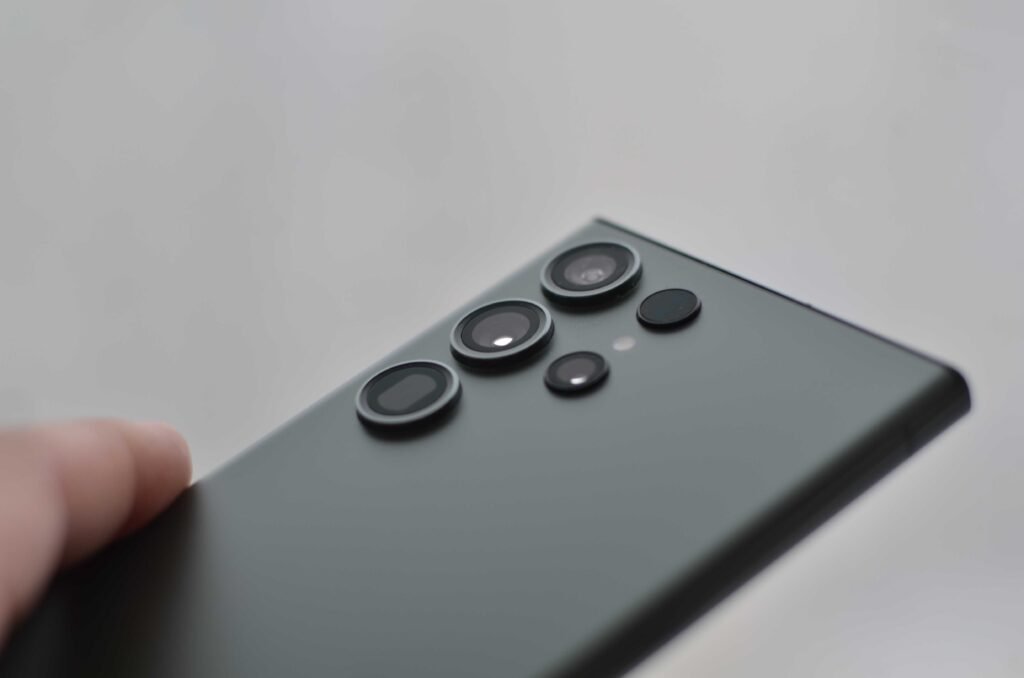
Four rear cameras have been the Ultra signature since the Galaxy S20 Ultra, and the spec sheet has been the point as much as the pictures. Ultra buyers pay a four figure sum partly for the reassurance that nothing was left out. So when a leaker with a strong record says the next one drops to three, the instinct is to call it a cut and move on.
That instinct is understandable and, on this particular change, mostly wrong. Ice Universe, posting on X, says it is now settled that the Galaxy S27 Ultra will not carry a 3x telephoto camera, leaving the rear array to jump straight from the 1x main sensor to the 5x periscope. Leaked renders had already shown three openings rather than four, so the claim fits what else is circulating.
The interesting part is what happens when you stop reading the spec sheet and start doing the arithmetic on the lenses involved. The 3x module Samsung is reportedly deleting is the weakest optic on the phone, and the thing replacing it gathers considerably more light. There is a real problem buried in this story. It is just not the one the headline points at.
What the leaks actually claim
Several separate threads have converged over the past two months, and they do not all carry the same weight. Worth separating them before drawing conclusions.
| Claim | Detail | Confidence |
|---|---|---|
| Three rear cameras | Main, ultrawide, 5x periscope. No 3x module. | Multiple leakers agree |
| Main sensor | 200MP ISOCELL HP6, a Galaxy tuned variant of the HPC, around 1/1.3 inch | Widely reported |
| Periscope | 50MP 5x, sensor size and aperture unchanged from the S26 Ultra | Reported, not confirmed |
| 3x replacement | In sensor crop from the HP6, marketed as optical quality 3x | Reported |
| LOFIC highlight handling | Overflow capacitor tech to stop blown highlights in high contrast scenes | Early leak, less certain |
| Galaxy S27 Pro keeps a 3x | Same main and ultrawide, but a 12MP 3x instead of the 5x periscope | Reported |
| Anything from Samsung | Nothing. No announcement, no acknowledgement. | Zero |
The last row deserves more weight than it usually gets. A phone launching in early 2027 is still a year from certification, and camera modules get swapped late. Ice Universe has been right about Samsung hardware often enough to take seriously and wrong often enough that nobody should buy or skip a phone on this.
Where the hole in the zoom range actually sits
Samsung’s main camera sits at roughly a 24mm equivalent field of view. That makes 3x about 72mm, which is the classic portrait length, and 5x about 120mm, which is a short telephoto. Removing the 3x means the phone has no dedicated glass anywhere between a wide angle and a 120mm lens.
A gap on a diagram is not automatically a gap in image quality, though, and this is where most coverage of the story stops one step too early.
The arithmetic nobody ran
Take the 200MP HP6 at roughly 1/1.3 inch. Cropping to a 3x field of view keeps one ninth of the sensor area, which is one third of the width and one third of the height. One ninth of 200 million pixels is about 22 million, and one ninth of the area of a 1/1.3 inch sensor works out to a slice of roughly 1/3.9 inch.
Now put that next to the module it replaces. The 3x telephoto Samsung has carried across several Ultra generations is a 10MP unit on a sensor around 1/3.5 inch, behind a lens of about f/2.4. The main camera’s lens on the S26 Ultra opens to f/1.4.
| At a 3x field of view | Dedicated 3x module | Crop from the 200MP main |
|---|---|---|
| Usable resolution | 10MP | About 22MP |
| Sensor area in play | Around 1/3.5 inch | Around 1/3.9 inch |
| Lens aperture | f/2.4 | f/1.4 |
| Light per unit of sensor | Baseline | Roughly 2.9x more |
| Minimum focus distance | Close, good for tele macro | Whatever the main lens allows |
| Separate stabilized path | Yes | No, shares the main |
Add the area difference and the aperture difference together and the crop is collecting somewhere in the region of two and a half times more light than the dedicated module at the same framing, off more than twice the pixel count. Samsung is not cheapening the 3x experience. It is deleting a bad lens and letting a good one do the job.
The perspective myth, cleared up
A comment that appears under every story like this one is that cropping cannot replace a real telephoto because you lose the compression a longer lens gives you. It sounds right and it is not.
Perspective is set by where you stand, not by the lens on the front of the camera. Shoot a face from two meters with a 24mm lens, crop to the same framing a 72mm lens would have given you from that same spot, and the relationship between the nose and the ears is identical. The flattering look people associate with portrait lenses comes from stepping back, and a crop lets you stand exactly where the 72mm shooter stood.
What a crop does not replicate is background blur, because blur depends on the physical size of the opening letting light in. Here the numbers still favor Samsung: an f/1.4 lens cropped to 3x has a larger effective opening than an f/2.4 lens covering that framing natively, which means the crop should produce slightly more genuine background separation, not less. Anyone who has compared an Ultra’s 3x shots against the same frame cropped from 1x has probably noticed the 3x module was never the one winning.
What you actually give up
Three real losses survive the arithmetic, and they are worth naming precisely because the general panic is misplaced.
The first is close focus. Samsung’s 3x module focuses far closer than the main camera can at an equivalent framing, which is what makes the tele macro shots of flowers, food and small objects work at all. Delete the module and that trick either disappears or gets handed to the ultrawide, which is a different look entirely.
The second is video. Recording at 3x from a crop means no optical stabilization tuned for that focal length and no clean handoff between lenses mid take. In practice, footage between 1x and 5x becomes a digital zoom that the stabilization system has to work harder to hold steady.
The third is resolution at the top of the range. A phone that crops to reach 3x has nothing left to crop when you ask for 4x, which is exactly the zoom level where a 1x to 5x gap hurts most. That is a fairly narrow complaint, but it is the one that stands up.
The part that should actually worry you
Here is the buried story. Reports say the 5x periscope carries over from the S26 Ultra with no change to sensor size or aperture. Which means the S27 Ultra’s long zoom, the camera you will be relying on for everything past 5x now that the middle of the range is a crop, is the same hardware as last year.
That matters more as the rest of the industry moves. Oppo now puts 200MP sensors behind all three of its flagship’s rear lenses, and Motorola shipped a 200MP periscope on a phone sold in the United States. A 50MP periscope on a sensor around 1/2.5 inch was competitive when it arrived. Two generations later, with nothing added, it is the weakest link on a phone that expects you to reach for it more often than before.
Samsung’s stated compensation is image processing rather than glass. The HP6 is described as a Galaxy tuned version of the ISOCELL HPC, built on a pixel architecture that holds more charge per photosite before clipping, which should mean better highlight retention and cleaner shadows. LOFIC, if it makes the cut, routes overflow electrons into a dedicated capacitor rather than discarding them, which is genuinely useful in scenes with a bright sky above a dark subject. Both are real improvements. Neither of them puts more light through the periscope.
The Galaxy S27 Pro keeps a 3x, which is the funniest detail here
Samsung is reportedly fielding four mainline flagships in 2027 for the first time, adding a Pro between the Plus and the Ultra. Leaks put the Pro at a 6.47 inch screen with the same 200MP main and 50MP ultrawide as the Ultra, and a 12MP 3x telephoto instead of the 5x periscope.
| Rumored model | Dedicated telephoto | Best for |
|---|---|---|
| Galaxy S27 Ultra | 50MP 5x periscope only | Long reach, stage and wildlife distances |
| Galaxy S27 Pro | 12MP 3x | Portraits, tele macro, everyday framing |
| Galaxy S27 and S27 Plus | Not yet detailed | Unknown |
Read that table again. If the leaks hold, the phone that keeps a dedicated portrait length lens is the cheaper one, and the flagship is the model where 3x is a crop. It is a coherent product decision, since an Ultra buyer probably values 10x reach over 3x convenience, but it does mean the best portrait camera in the 2027 Galaxy lineup might not be in the Ultra.
What it costs, and when
The Galaxy S27 series is expected in the usual January or February window, with the Ultra widely tipped to land somewhere between $1,299 and $1,399 in the United States. Early configuration leaks are not encouraging on the memory side either, with 12GB of RAM expected to remain standard on most variants and 16GB reserved for the 1TB model, a consequence of the memory pricing squeeze that has already pushed flagship costs up across the industry.
Removing a camera module does save money. A telephoto assembly with its own sensor, lens stack, actuator and stabilizer is not free, and deleting one across tens of millions of units is a meaningful line item. It is entirely possible that cost was the reason and the improved optics are a convenient justification. Both things can be true at once, and the resulting photos do not care about the motive.
Frequently asked questions
Is the Galaxy S27 Ultra losing a camera confirmed?
No. It comes from leaker Ice Universe and matches leaked renders showing three rear openings, but Samsung has said nothing. The phone is not expected until early 2027, and camera hardware has changed later than this in past cycles.
Will 3x photos look worse than on the Galaxy S26 Ultra?
In good light, probably not, and possibly better. A 3x crop from a 200MP f/1.4 sensor delivers roughly 22MP from a sensor patch comparable in size to the old 10MP module, with substantially more light reaching it. In low light the picture is less clear, because cropping reduces the room the phone has to bin pixels for noise control.
What about 2x and 4x?
Both are crops either way, since neither the S26 Ultra nor the rumored S27 Ultra has glass at those lengths. The 2x crop is excellent because it keeps a quarter of a 200MP sensor, around 50MP. The 4x crop is the weak point, since it sits beyond what the main can comfortably deliver and short of where the periscope takes over.
Does a crop really give the same perspective as a telephoto lens?
Yes, provided you shoot from the same place. Perspective depends on the camera’s distance from the subject, not on focal length. What a crop does not reproduce is a longer lens’s optical characteristics, and on this specific comparison the main camera’s wider aperture works in the crop’s favor.
Which S27 model gets a dedicated 3x lens?
According to leaks, the new Galaxy S27 Pro, which is tipped to pair the same 200MP main and 50MP ultrawide as the Ultra with a 12MP 3x telephoto and a 6.47 inch display. The Ultra keeps the 5x periscope instead.
Is the 5x periscope being upgraded?
Reports say no. Sensor size and aperture are described as carried over from the Galaxy S26 Ultra, which is the part of this story that deserves more attention than the missing 3x module.
The bottom line
Losing a camera from an Ultra feels like a downgrade because four cameras have been the point of an Ultra for six years. On the numbers, this particular deletion removes the least capable optic on the phone and hands its job to a sensor and lens combination that collects more light and resolves more detail. The complaints that will survive contact with real photos are narrower than the ones being made now: close focus at medium zoom, video between 1x and 5x, and night shots at 3x where there is no resolution left to trade for cleanliness.
The change worth watching is the one nobody is shouting about. Samsung is asking the 5x periscope to carry more of the zoom range than it ever has, using hardware that has not been touched in two generations, while rivals put 200MP sensors behind their long lenses. Three cameras is not the problem. Three cameras where one of them is standing still might be.
Sources and further reading
- TechRadar: The Samsung Galaxy S27 Ultra is tipped to ditch its predecessor’s 3x telephoto camera
- Android Authority: Samsung might kill one of the Galaxy S27 Ultra’s rear cameras
- GSMArena: Samsung Galaxy S27 Ultra’s new telephoto camera detailed
- Android Authority: Galaxy S27 Ultra camera leak reveals major processing upgrades
- TechRadar: Samsung could launch a smaller Galaxy S27 Pro next year
