

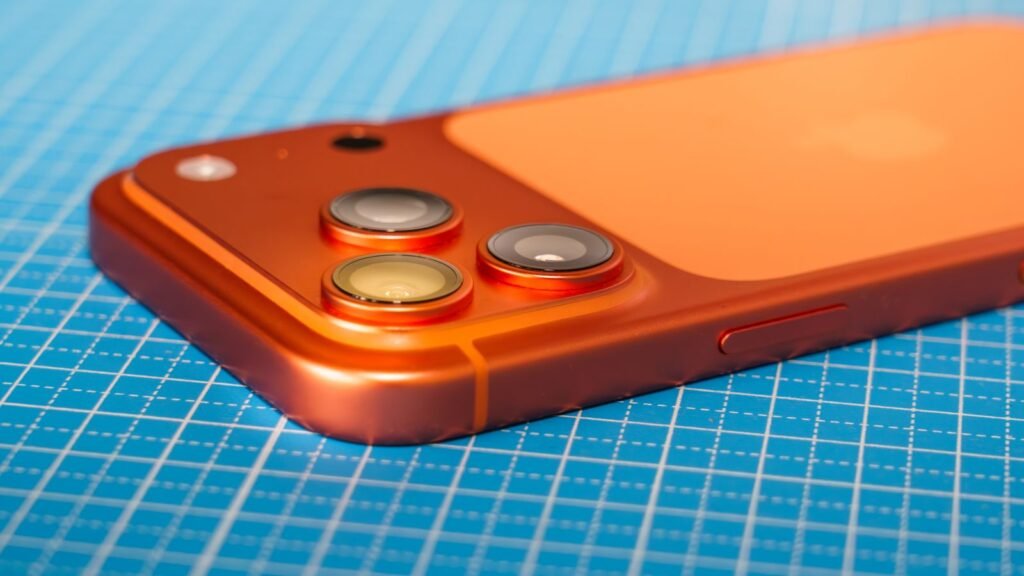
The iPhone 17 Pro camera is a three lens system in which every rear camera is 48 megapixels for the first time: a 48MP main camera at 24mm and f/1.78, a 48MP ultra wide at 13mm and f/2.2, and a new 48MP telephoto at 100mm (4x) and f/2.8. Apple counts it as the equivalent of eight lenses from 13mm to 200mm, with up to 8x optical quality zoom and 40x digital. The iPhone 17 Pro Max has exactly the same cameras, so everything here applies to both.
Quick answer
iPhone 17 Pro and 17 Pro Max: 48MP Fusion main (24mm, f/1.78, sensor shift stabilization), 48MP Fusion ultra wide (13mm, f/2.2, 120 degrees), 48MP Fusion telephoto (100mm, 4x, f/2.8, tetraprism), 12MP optical quality 2x and 8x crops, and an 18MP Center Stage front camera. Video goes up to 4K at 120 fps in Dolby Vision, with ProRes RAW, Apple Log 2 and genlock. DXOMARK scored it 168. The newer iPhone 18 Pro changes only the main camera’s aperture; the other lenses are identical.
The iPhone 17 Pro was the biggest camera update Apple had made in years when it launched in September 2025, mainly because of the telephoto. It is still one of the best phone cameras you can buy a year later, and now that the iPhone 18 Pro is out, it is also the camera most people will be comparing against. Here is what is inside it, what each lens is actually good at, how it performed in testing, and whether the 18 Pro is worth the move.
iPhone 17 Pro camera at a glance
Sources: Apple iPhone 17 Pro technical specifications, DXOMARK camera test.
iPhone 17 Pro camera specs
Apple calls the system the 48MP Pro Fusion camera. “Fusion” is Apple’s name for a 48MP quad pixel sensor that can either shoot full resolution or crop the center of the frame for a 12MP image at a longer focal length, which is how one lens produces two zoom levels.
| Camera | Resolution | Focal length | Aperture | Sensor size |
|---|---|---|---|---|
| Main (Fusion) | 48MP | 24mm (1x) | f/1.78 | Type 1/1.28 |
| 2x crop from main | 12MP | 48mm | f/1.78 | Center of main sensor |
| Ultra wide (Fusion) | 48MP | 13mm (0.5x), 120 degrees | f/2.2 | Type 1/2.55 |
| Telephoto (Fusion) | 48MP | 100mm (4x), tetraprism | f/2.8 | Type 1/2.55 |
| 8x crop from telephoto | 12MP | 200mm | f/2.8 | Center of telephoto sensor |
| Front (Center Stage) | 18MP | Wide, square sensor | f/1.9 | Autofocus |
The zoom range Apple quotes is 2x optical zoom out and 8x optical quality zoom in, a 16x optical quality range end to end, plus digital zoom up to 40x. In the camera app that shows up as quick buttons for 0.5x, 1x, 2x, 4x and 8x. The main camera also offers 28mm and 35mm framings, and with macro added on, that is how Apple arrives at eight lenses.
What each lens is actually good at
The 48MP main camera
This is the camera that does most of the work, and it has the largest sensor by a wide margin, about three times the area of the other two. It has second generation sensor shift optical image stabilization and Focus Pixels across the whole sensor. In good light it shoots 24MP images by default, combining detail from the full 48MP readout with the cleaner 12MP binned data, and you can switch to full 48MP in HEIF Max or ProRAW when you want to crop later.
Its one limitation is built in: the aperture is fixed at f/1.78. Background blur in Portrait mode is computed, not optical, and very close subjects with complicated edges, like hair or glasses frames, can still trip up the depth map.
The 48MP ultra wide
The ultra wide also handles macro photography. Get close to a subject and the camera switches to it automatically, and at 48MP the macro shots hold more detail than older 12MP ultra wides could. It has a smaller sensor than the main camera, so in dim rooms it is the first lens to show noise, and DXOMARK scored it lower than the main and telephoto cameras for that reason.
The 48MP 4x telephoto
This is the headline change from the iPhone 16 Pro. The older phone had a 12MP 5x telephoto at 120mm. Apple swapped it for a 48MP sensor at 100mm, with a sensor it says is 56 percent larger, and the higher resolution is what makes the 8x crop possible. In practice 4x is the more natural portrait length, and having a clean 8x at 200mm covers concerts, wildlife at a distance and sports from the stands far better than any digital zoom.
Worth knowing
The zoom levels between the fixed buttons, for example 3x or 6x, are digital crops blended from two cameras. DXOMARK specifically noted lower texture at those intermediate zoom settings. For the sharpest results, stay on 0.5x, 1x, 2x, 4x or 8x and crop afterwards if you need to.
iPhone 17 Pro video features
Video is where the 17 Pro pulled furthest ahead of other phones. DXOMARK gave it a video score of 172, higher than its photo score of 166, and singled out exposure, dynamic range and smooth transitions between lenses while zooming.
- 4K Dolby Vision at up to 120 fps on the rear cameras, for slow motion at full resolution.
- ProRes RAW recording, a first for iPhone, giving editors the same kind of raw video file used on cinema cameras.
- Apple Log 2, a flatter color profile for grading in editing software.
- Genlock, which lets several cameras sync their frames exactly in multi camera productions.
- Dual Capture, recording from the front and rear cameras at the same time at up to 4K 30 fps.
The front camera is new as well. The 18MP Center Stage sensor is square, so you can take a landscape selfie while holding the phone upright, and it can widen the frame automatically when more people join the shot.
How the iPhone 17 Pro camera scored in testing
DXOMARK gave the iPhone 17 Pro an overall camera score of 168, placing it sixth in its global ranking at the time of testing. The breakdown shows exactly where the strengths and weaknesses are:
DXOMARK sub scores, iPhone 17 Pro
Source: DXOMARK. Bars scaled to the highest sub score.
The pattern is clear. The main camera is outstanding for both photo and video, natural looking background blur is a strength, and the further you move from the main lens the more the results drop. DXOMARK’s listed weaknesses were slight noise indoors and in low light, occasional focus and white balance wobbles on moving subjects in video, and softer texture at in between zoom levels.
iPhone 17 Pro vs iPhone 17 Pro Max camera
There is no difference. Both use the same three rear cameras, the same front camera and the same video features. The Pro Max gives you a bigger 6.9 inch screen to frame and review shots, and a larger battery that lasts longer on a long shoot, but the photos and videos themselves are identical.
iPhone 17 Pro vs the rest of the iPhone 17 lineup
| Model | Rear cameras | Telephoto | Pro video (ProRes RAW, Log 2) |
|---|---|---|---|
| iPhone 17 Pro, 17 Pro Max | 48MP main, 48MP ultra wide, 48MP telephoto | 4x and 8x | Yes |
| iPhone 17 | 48MP main, 48MP ultra wide | No, 2x crop only | No |
| iPhone Air | 48MP main only | No, 2x crop only | No |
All three share the 18MP Center Stage front camera. If you mostly shoot people and places at arm’s length, the iPhone 17 covers that well. The Pro earns its price with the telephoto, the extra low light headroom of its main sensor and the professional video formats. For a wider view of how every model stacks up, see our ranking of every iPhone camera from best to worst.
iPhone 17 Pro vs iPhone 18 Pro camera: should you upgrade?
The iPhone 18 Pro kept almost everything. The ultra wide, the telephoto, the 2x and 8x crops, the front camera and the core video formats are all the same. The one hardware change is the main camera, which gained a variable aperture with six moving blades.
| Camera | iPhone 17 Pro | iPhone 18 Pro |
|---|---|---|
| Main | 48MP, 24mm, fixed f/1.78 | 48MP, 24mm, variable f/1.48 to f/4 |
| Ultra wide | 48MP, 13mm, f/2.2 | Same |
| Telephoto | 48MP, 100mm (4x), f/2.8 | Same |
| Front | 18MP Center Stage, f/1.9 | Same |
| Manual aperture and shutter in Camera Control | No | Yes |
| Starting price at launch | $1,099 | $1,199 |
At its widest setting, f/1.48, the 18 Pro’s main camera gathers roughly half a stop more light than the 17 Pro, and at f/4 it can keep a group of people or a landscape sharp from front to back optically. That is a real improvement for low light and for genuine optical depth of field. It is also the only one. DPReview’s verdict was that if the variable aperture does not matter to you, the upgrade from a 17 Pro is hard to recommend, and we agree.
Our take
Already own a 17 Pro: keep it unless you shoot a lot in dim light or want real optical background blur. Coming from an iPhone 15 Pro or older: a discounted 17 Pro gets you the full 48MP system and the 4x telephoto for less money, and the 18 Pro is worth the extra only if the variable aperture is the feature you want.
Best settings for the iPhone 17 Pro camera
- Turn on 48MP capture. In Settings, Camera, Formats, choose HEIF Max for full resolution photos at a manageable file size, or enable ProRAW if you edit in Lightroom.
- Pick your default main lens. The camera settings let you make 28mm or 35mm the default framing instead of 24mm, which suits street and portrait shooting.
- Keep Macro Control on. It shows a small flower icon when the camera switches to the ultra wide for close ups, so you can turn the switch off when you do not want it.
- Use the fixed zoom buttons. 0.5x, 1x, 2x, 4x and 8x give the cleanest results.
- Shoot Apple Log 2 only if you will grade it. Log footage looks flat and gray straight out of the camera. For everyday video, standard Dolby Vision HDR looks better with no editing.
Frequently asked questions
What are the iPhone 17 Pro camera specs?
Three 48MP rear cameras: a main camera at 24mm and f/1.78, an ultra wide at 13mm and f/2.2, and a 4x telephoto at 100mm and f/2.8. It also offers 12MP optical quality crops at 2x and 8x, digital zoom to 40x, and an 18MP Center Stage front camera.
Is the iPhone 17 Pro Max camera better than the iPhone 17 Pro?
No. The two phones have identical camera hardware and software. The Pro Max has a larger screen and battery, which help on long shoots, but the images are the same.
How much zoom does the iPhone 17 Pro have?
4x optical from the telephoto lens, 8x optical quality from a crop of the 48MP telephoto sensor, and up to 40x digital zoom. Apple describes the full range as 16x optical quality, from 0.5x to 8x.
Is the iPhone 17 Pro camera better than the iPhone 16 Pro?
Yes, mainly at the telephoto end. The 17 Pro replaced the 16 Pro’s 12MP 5x telephoto with a 48MP 4x telephoto that Apple says has a 56 percent larger sensor, which adds the 8x option and sharper zoomed shots. It also added ProRes RAW, genlock and a new 18MP front camera.
Does the iPhone 18 Pro have a better camera than the iPhone 17 Pro?
Only the main camera changed. The 18 Pro adds a variable aperture from f/1.48 to f/4, which helps in low light and gives real optical depth of field. The ultra wide, telephoto and front cameras are the same.
What is the iPhone 17 Pro DXOMARK camera score?
168 overall, with 166 for photo and 172 for video. Its strongest sub score was 186 for main camera video, and its weakest was 123 for telephoto video.
The bottom line
The iPhone 17 Pro camera is the system that made every rear lens 48MP and gave the iPhone a usable 8x zoom, and a year later it remains a top tier phone camera, especially for video. Its main sensor is excellent, the ultra wide and telephoto are good but clearly a step behind, and the in between zoom levels are its weakest point. If you already own one, the iPhone 18 Pro offers one meaningful camera upgrade, the variable aperture, and nothing else. For most people, that is not enough reason to switch. For more on picking a model by camera, see which iPhone has the best camera.
Sources and further reading
- Apple: iPhone 17 Pro technical specifications
- DXOMARK: Apple iPhone 17 Pro camera test
- DPReview: iPhone Pro camera upgrade guide, every Pro since the 12
About this article: GeekBlog covers U.S. technology news, AI, phones, smartwatches and gaming. Every story is written and checked under our Editorial Policy. Spotted a mistake or have a story tip? Contact our editors.
