

There is an awkward detail sitting under T-Mobile’s latest jab at SpaceX. The carrier’s own satellite texting service, T-Satellite, runs on Starlink. So when chief executive Srini Gopalan told investors last week that satellite is “an inferior version” of what T-Mobile already sells, he was describing a technology his company rents, markets and bundles into its most expensive plans.
That is not a contradiction so much as a boundary line. T-Mobile is happy to use Starlink as a backstop for dead zones. What it will not do is hand SpaceX the keys to its towers so Starlink Mobile can become a fourth national carrier. And with AT&T and Verizon saying much the same thing in the same week, SpaceX now has a clear answer from all three: build it yourself.
What Gopalan actually said
The comments came during the question and answer part of the call, when analysts pushed on the obvious topic of the month. Gopalan made three separate points, and they are worth pulling apart because they target different parts of the SpaceX pitch.
First, on the technology. “Satellite is an inferior version of FWA with even more constraints in terms of things like what is the size of the beam,” he said. Fixed wireless access is the 5G home internet product T-Mobile has turned into one of its fastest growing businesses. A router in your living room talks to a nearby cell site instead of a fiber line.
Second, on the market. Gopalan said “two-thirds of our FWA customers come from dense urban areas,” and that T-Mobile sees “huge growth opportunities in those areas still, all under the fallow capacity model. So we don’t really see a synergistic opportunity with satellite providers.” Translation: T-Mobile’s home internet business is not a rural product waiting to be replaced by satellites. It mostly fills unused capacity in cities.
Third, on the deal SpaceX wanted. “I see no room for an MVNO with SpaceX, either on the consumer side or on the physical and Edge AI side.” An MVNO, or mobile virtual network operator, is a company that sells phone service on someone else’s network. Mint, Visible and Xfinity Mobile all work this way. It would have been the fastest route for Starlink Mobile to reach millions of phones in cities, and it is now closed at T-Mobile.
Why “the size of the beam” matters
Gopalan’s beam comment is the most technical part of his argument, and also the most defensible. A satellite in low Earth orbit covers the ground with beams that span a large area. Everyone inside one beam shares the same pool of capacity. A cell site, by contrast, splits its coverage into small sectors, and a city may have a site every few blocks. The more people you squeeze into an area, the bigger the advantage of the tower.
That is why satellite service is excellent where there is no tower at all and struggles where there are many people. It is also why Verizon CEO Dan Schulman, speaking on his own earnings call on October 26, said Starlink “just can’t compete with a terrestrial network in suburban and urban areas, where like 98% of our revenues are.” He added a bolder claim: “We’re somewhere between 100 to 1000 times more efficient than they are.” That range comes from a rival CEO with obvious interests, so treat it as a talking point rather than a measurement. The direction of the argument, though, is standard radio physics.
All three big carriers have now said no
T-Mobile is not alone, and the timing is telling. In the space of eight days, the chief executives of all three national carriers used their earnings calls to downplay SpaceX’s mobile ambitions.
| Carrier | CEO and date | What they said |
|---|---|---|
| AT&T | John Stankey, October 21 | “It’s not something that gets done overnight. It takes a lot of years and a huge level of investment to get to the kind of performance levels that customers have become accustomed to in scaled networks.” |
| Verizon | Dan Schulman, October 26 | “There is no magic wand. There’s no secret sauce. There’s no shortcut.” He put the all-in cost of a competitive network at $300 billion to $500 billion over six to seven years. |
| T-Mobile | Srini Gopalan, October 28 | Satellite is “an inferior version of FWA” and there is “no room for an MVNO with SpaceX.” |
Schulman also offered the line that best sums up the incumbents’ posture: “It’s very hard to throw a punch against something that doesn’t exist. But once they come into the market, we will be ferociously competitive.” A Verizon spokesperson had earlier told Reuters that spectrum without a network to use it is “just empty airwaves.”
Elon Musk replied on X that the buildout “will take 2 or 3 years.” He did not address Schulman’s cost estimate.
Why the carriers are talking so much about something that “doesn’t exist”
If Starlink Mobile were truly no threat, the carriers would not need to keep saying so. The reason they do is visible in their share prices. SpaceX had a busy October, and Wall Street reacted to almost every step.
October 9 was Verizon’s worst trading day since 2002. The selloff followed SpaceX’s agreement to buy Grain Management’s nationwide 800MHz licenses, the low band spectrum that gets a signal through walls. We broke down what that 14MHz of spectrum can and cannot do for Starlink Mobile at the time. The short version: it fills a real gap, but it is roughly a quarter of the low band each big carrier already owns.
There is a twist here that makes T-Mobile’s position even more pointed. Grain bought those exact 800MHz licenses from T-Mobile in August, for $2.9 billion in cash plus Grain’s 600MHz holdings. Barely two months later they are headed to SpaceX, which the Wall Street Journal valued at around $8 billion.
Plan B: SpaceX goes looking for towers
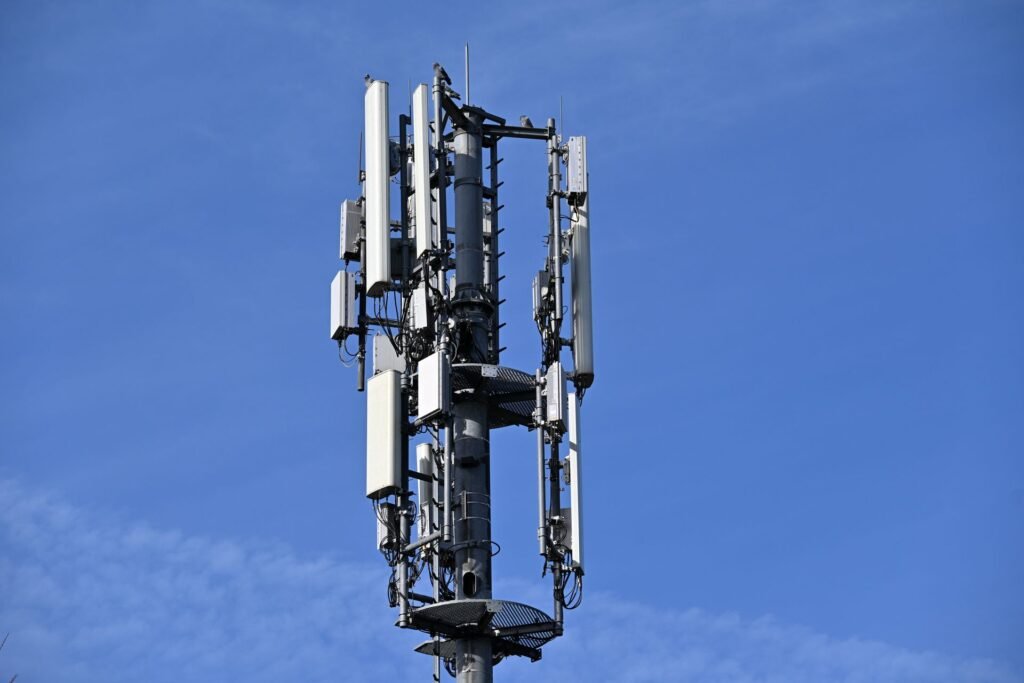
Without an MVNO deal, SpaceX has to do what Gopalan’s argument implies it must: put radios on the ground. On SpaceX’s October 20 earnings call, president Gwynne Shotwell said the company would “basically leverage the real estate from Starlink installs and other towers.” Two days later Bloomberg reported that SpaceX was in talks with major tower companies, reportedly including Crown Castle, for access to at least 80,000 US cell sites.
That number is not small. Here is how it compares to the existing market and what it might cost just to rent the space.
SpaceX’s argument is that it does not need a traditional network. Its pitch pairs satellites with a lighter ground layer, including small base stations attached to existing Starlink dishes, and it says that structure costs far less than tens of thousands of conventional macro sites. Whether that holds up in a dense downtown is the open question, and it is exactly the question Gopalan’s beam comment is aimed at.
The fight has moved to the FCC
The quieter battle is regulatory. On October 29, the day after T-Mobile’s call, the FCC voted to open a proposal to update its rules for satellite-to-phone service, which it calls “supplemental coverage from space.” The draft would make an additional 482MHz of spectrum available for that use. A yes vote only starts public comment. Chairman Brendan Carr has pitched it as a way to eliminate cellphone dead zones.
The carriers, through their trade group CTIA, want three things: keep satellites off the 2.5GHz and 3.45GHz bands that carry much of their 5G traffic, keep carriers in control of any satellite use of their licensed airwaves, and hold satellite providers to the same service and consumer protection standards as regular carriers. In a letter filed before the vote, CTIA warned that “the Commission’s buildout decisions have real consequences for consumers.”
The carriers are not anti-satellite, to be clear. In early October, AT&T, Verizon and T-Mobile formally launched a joint venture to pool spectrum so more satellite companies can reach their customers. They want satellites as a supplier. They do not want one as a competitor. If that sounds familiar, Europe’s largest operators are attempting a similar move, as we covered in our look at the joint satellite bid from Vodafone, Orange and others.
What this means for your phone
For now, very little changes, and that is the honest headline for consumers.
- T-Satellite is not going anywhere. Gopalan rejected an MVNO, not the existing partnership. T-Satellite, which launched in July 2025, remains included on T-Mobile’s top plans and costs $10 a month for everyone else, including AT&T and Verizon customers with an unlocked, eSIM-capable phone. If you want to try that route, here is how to put Starlink texting on a Verizon or AT&T phone.
- There is no Starlink Mobile plan to buy. SpaceX has not published pricing or a coverage map. Its own US service has already slipped once: in August the target was the end of 2027, and in September CFO Bret Johnsen moved it to the first half of 2028.
- Exclusivity is loosening. Satellite analyst Tim Farrar said in June that T-Mobile’s exclusive US deal with Starlink was due to expire in July. That frees SpaceX to offer direct-to-cell service through other partners, which could matter more to you in the next two years than a standalone Starlink carrier.
- Prices are the long-term stake. The US has had three national carriers since T-Mobile bought Sprint in 2020. Bureau of Labor Statistics data show wireless service prices jumped 5.9% in August 2026, the category’s largest one-month rise on record, after increases at AT&T and T-Mobile. A credible fourth network is the kind of pressure that has pushed prices down before.
Frequently asked questions
Is T-Mobile ending its Starlink partnership?
No. Gopalan ruled out letting SpaceX run a Starlink-branded phone service on T-Mobile’s network. The existing T-Satellite service, which uses Starlink satellites to cover dead zones, continues.
What is FWA, and why compare it to satellite?
FWA stands for fixed wireless access. It is home internet delivered over a carrier’s 5G network to a router in your home. Gopalan compared it to satellite because both are alternatives to cable and fiber, and he argues FWA is better in most places because a cell site serves fewer people per slice of capacity than a satellite beam.
Did Verizon and AT&T also reject SpaceX?
Yes. All three national carriers have publicly dismissed a Starlink Mobile wholesale deal or the idea that satellite can compete in cities. Verizon’s CEO estimated a competitive network would cost $300 billion to $500 billion, while AT&T’s CEO said it would take “a lot of years.”
When could Starlink Mobile launch as its own carrier?
SpaceX is targeting early 2028 for service on its own airwaves. That depends on FCC approval of the Grain spectrum deal, the launch of next-generation satellites and some form of ground network, possibly through the 80,000 tower sites it is reportedly negotiating for.
Can I already use Starlink on my phone?
Yes, for texting and some apps in areas with no cell coverage. In the US, T-Mobile’s T-Satellite offers it, and it is available as a $10 monthly add-on even for customers of other carriers with a compatible phone.
Sources and further reading
- TechRadar: T-Mobile CEO calls Starlink’s satellite technology “inferior”
- Yahoo Finance: SpaceX’s telecom ambitions will take years and cost hundreds of billions, CEOs say
- Yahoo Finance: AT&T, Verizon and T-Mobile warn FCC as SpaceX plots a phone network for 2028
- Benzinga: T-Mobile US Q3 2026 earnings call transcript
- Forbes: AT&T, Verizon and T-Mobile stocks slump as SpaceX announces Starlink Mobile deal
- New Space Economy: FCC proposes expanded supplemental coverage from space rules
About this article: GeekBlog covers U.S. technology news, AI, phones, smartwatches and gaming. Every story is written and checked under our Editorial Policy. Spotted a mistake or have a story tip? Contact our editors.
