

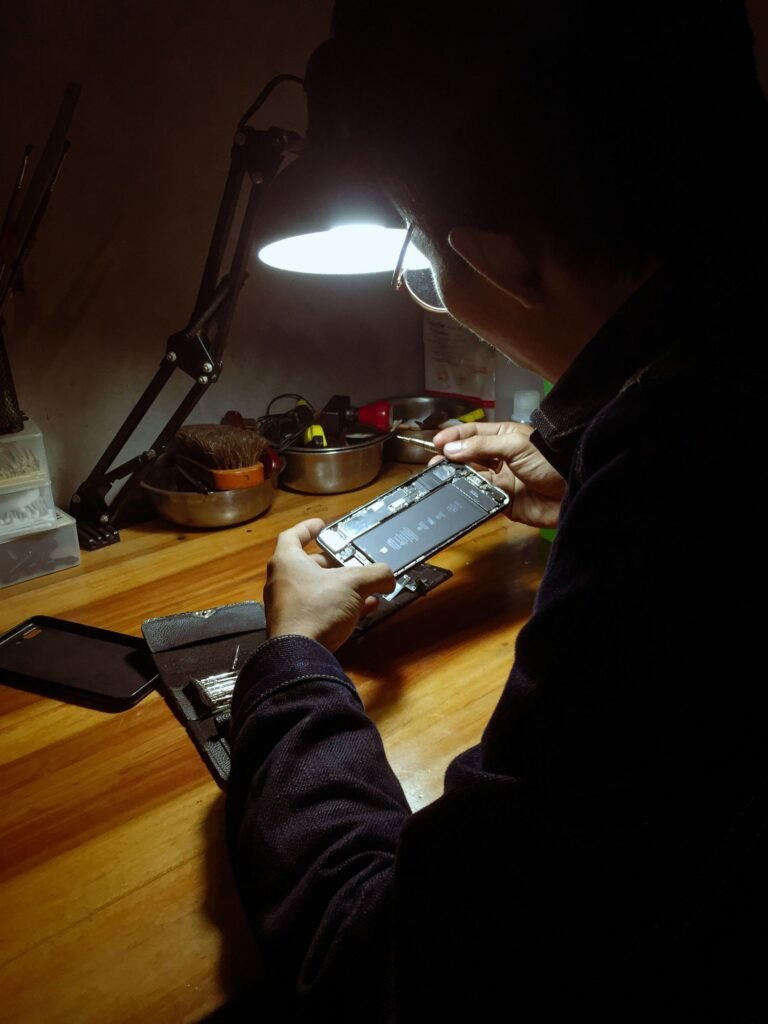
Sixteen months ago, the European Union started treating smartphones a bit like refrigerators. Since June 20, 2025, every phone and tablet sold in the EU has needed an energy label, a repairability grade from A to E, spare parts on the shelf for seven years and a free repair manual online. It was the most ambitious repair law any major market had passed for phones.
So, did it work? The first real audits are in, and the answer is a frustrating “partly.” Parts and manuals from the big brands are easier to find than ever. But a September investigation found that 80% of smartphone models in the EU’s own product database fail the information rules, a repair grade can be awarded by the very company being graded, and the most common repair of all, a cracked screen, can still cost close to a third of the phone’s original price.
What the rules actually require
The regulation is less radical than its reputation. It does not force Apple to make the iPhone a Fairphone, and it does not require any phone to score well. It mostly sets minimum standards for parts, information and longevity, then asks manufacturers to disclose how they did on a label.
| Requirement | What the law says | How it is going |
|---|---|---|
| Spare parts | Screens, batteries, cameras, ports and other critical parts available for at least 7 years after a model leaves the EU market | Improved, per BEUC’s market check |
| Delivery time | Within 5 working days for the first 5 years, then 10 days for the last 2 | No public audit yet |
| Repair information | Repair instructions and indicative parts prices on a free website, linked in the EU database | About 80% of registered models non-compliant |
| Software updates | Security updates for at least 5 years after a model’s end of sale | Too early to test |
| Battery durability | Minimum standards, with endurance shown on the label | Shown on labels that are often missing in stores |
| Repairability grade | A to E score on the energy label, self-declared by the manufacturer | Some non-compliant brands still claim class A |
Two details are easy to miss. First, the full list of parts goes to professional repairers. Ordinary buyers are guaranteed a much shorter list, roughly the battery, back cover, SIM tray and charger. Second, a last-minute “corrective act” in spring 2025 removed displays from the list of parts a layperson must be able to replace with basic tools. iFixit summed up the result bluntly: you can buy a replacement screen, but the law does not require that you can install it yourself.
The good news: big brands opened up
The most encouraging finding comes from BEUC, the European Consumer Organisation. In June 2026, it ran a market check with consumer groups in Austria, Denmark, France, Slovenia, Spain and the Netherlands, comparing smartphones, which are covered by the rules, with battery-powered vacuum cleaners, which are not.
The difference was obvious. Smartphone repair instructions were “generally comprehensive and enable consumers and professionals to carry out most repairs,” BEUC found. Vacuum cleaner manuals typically stopped at basic troubleshooting. “Our research shows that European laws are making the repair of smartphones easier for consumers,” said BEUC director general Agustín Reyna. “These rules clearly work.”
iFixit’s EU policy lead Thomas Opsomer, usually one of the rules’ harshest critics, agrees on this point. “We have seen dramatic improvements in the availability of instructions for self-repair from the leading manufacturers, who were previously quite reluctant to share those,” he told TechRadar. There has also been movement on parts pairing, the software locks that can disable a genuine replacement part unless the manufacturer blesses it. Manufacturers such as Apple must now let users and independent shops restore full function to replacement parts, which Opsomer called “a significant barrier” removed.
The bad news: 4 out of 5 listings fail
Every phone sold in the EU must be registered in the European Product Registry for Energy Labelling, known as EPREL, with links to where buyers can find repair instructions and parts prices. In September, iFixit and Right to Repair Europe checked those links for 2,334 smartphone models placed on the market over the past year. They called the results “abysmal.”
Some examples are almost comic. Acer lists an “indicative price” for a tablet battery of anywhere between €14 and €128. A rugged Oukitel phone and a no-name tablet both claim a class A repair score, built on a perfect mark for repair information, while leaving the information fields empty or pointing to Temu.
Context matters, though. “We found 80% of models on the market to be non-compliant, which is not the same as 80% of units sold,” Opsomer stressed. The failures cluster among cheap, lesser-known brands that flood online marketplaces with dozens of models. Apple, Samsung and Google mostly have working links, even if, as the report notes, it takes “some more clicking and selecting” to reach an actual price. The uncomfortable side effect is that budget buyers, the people who can least afford a new phone, get the weakest protection.
Phones still open the hard way
Better manuals do not change what is inside the phone. Opsomer says the regulation “did not really change the current mainstream smartphone design, which is one that requires heating to release the screen adhesive in order to get access to the inside of the phone for any type of repair.” That is a daunting step for most people.
iFixit’s recent iPhone 18 Pro teardown illustrates the point. Apple added a screwed-in battery tray and modular cameras, real progress, yet getting to the battery still means removing the glued display. iFixit damaged the plastic display frame on three of the four units it opened, though it cautioned more testing is needed. Apple’s foldable tells a similar story: as we found in iFixit’s iPhone Duo teardown, it earned a record score for a foldable while its inner screen still costs $999 to replace.
The real problem is price
This is where the rules have the biggest blind spot. The EU’s A to E grade looks at disassembly, tools, parts availability and information. It does not look at what parts cost. France’s older repair index did, and the EU replaced it.
BEUC found the most expensive smartphone display in its check cost more than €400, around 30% of the phone’s original price. Research in the Commission’s own impact assessment suggests people are typically willing to spend about 20% of a product’s price on repairs. That gap is where repair dies. Samsung’s Irish price list puts an out-of-warranty Galaxy S26 Ultra screen repair at a more reasonable €267, which includes a new battery, while Fairphone sells a Fairphone 6 display for €89.95 and a battery for €39.95, both designed to be swapped at home.
“The economics of repair are key,” Opsomer says. When a phone breaks, owners weigh the repair bill against what the old phone still feels worth, and that value is “lowered by incessant messaging extolling the virtues of the latest and greatest model.” The EU’s separate Right to Repair Directive, in force since July 31, 2026, requires spare parts at a “reasonable” price, but it sets no formula or cap for what reasonable means.
Why this matters if you live in the US
Phones are global products, and very few companies build a separate model for one region. “The regulation clearly influenced products sold outside Europe,” IDC analyst Francisco Jeronimo told TechRadar. Apple’s 2022 promise of seven years of iPhone parts arrived, as iFixit put it, “thanks almost certainly” to the coming EU rules. The longer software support you now see on many Android phones points the same way, even if brands do not always keep those promises. Sony recently stopped the Xperia 10 VI one Android upgrade short of what it originally promised.
There are also signs that repair is becoming a selling point in its own right. Fairphone, whose phones scored a perfect 10 from iFixit, has started selling in America, and we looked at what $649 buys you in a phone built to be fixed. Beyond phones, iFixit gave Lenovo’s ThinkPad T14 Gen 7 a provisional 10 out of 10, and Apple’s MacBook Neo scored 6 out of 10, the best MacBook score in about 14 years.
Still, Jeronimo cautions against calling it a revolution. “We see a shift towards repairability in smartphones and laptops, but not to the extent that I would call it a broader industry shift.” His firm’s research shows people now keep phones for about 3.5 to 4.5 years, but repairability is not why. In IDC’s 2025 survey, battery life, connectivity, price and build quality ranked highest when people chose a phone.
- Check the manufacturer’s self-repair or parts store first. Apple, Samsung and Google now publish official prices for screens and batteries.
- Compare the repair quote with your phone’s trade-in value. If the repair costs more than about a fifth of what a replacement would cost, it is worth pausing.
- Batteries are the cheapest, most effective fix. A fresh battery can add years to a phone with a healthy screen.
- If you are buying in Europe, look for the full energy label, not just the small icon. The repairability grade is only on the full version.
What happens next
The consumer groups want three fixes. First, put parts prices into the repairability score, as France did. Second, require manufacturers to publish the full calculation behind their self-declared grade, so anyone can check it. Third, give consumers and repairers an EU-wide way to report non-compliance. BEUC also wants the same rules extended to laptops, printers, vacuum cleaners and e-bikes.
Money could help too. Under the Right to Repair Directive, each EU country must adopt at least one measure that encourages repair, such as repair vouchers. Member states have until July 2029 to report what they did. “Among these options, financial incentives would be by far the most effective,” Opsomer says.
Frequently asked questions
Do the EU repair rules apply to phones sold in the US?
No, the rules only apply to devices sold in the EU. But because most manufacturers sell the same hardware worldwide, parts availability, repair manuals and longer software support often carry over to US models.
What is the EU repairability score?
It is a grade from A (best) to E (worst) printed on the energy label of every phone and tablet sold in the EU since June 20, 2025. Manufacturers calculate it themselves based on disassembly, tools, parts availability, software updates and repair information. It does not include parts prices.
Can I replace my own phone screen under the new rules?
Not necessarily. A late amendment removed displays from the list of parts that must be replaceable by a non-professional with basic tools. Screens must be sold to professional repairers for seven years, but the phone does not have to be designed for a DIY screen swap.
Which brands are failing the rules?
The iFixit and Right to Repair Europe audit found most problems among cheaper, lesser-known brands sold heavily online. Major brands like Apple and Samsung generally publish the required information, though finding actual prices can take several clicks.
How long must spare parts be available?
At least seven years after a model stops being sold in the EU, with delivery to professional repairers within five working days for the first five years and ten working days after that.
Sources and further reading
- TechRadar: One year after new EU repairability rules came into force, are smartphones getting easier to repair?
- Right to Repair Europe: One year into EU Ecodesign rules, 80% of smartphones lack required repair information
- BEUC: Smartphones now easier to repair thanks to EU regulation
- iFixit: Ecodesign for smartphones, two steps forward, one step back
- European Commission: Smartphones and tablets energy label and ecodesign
- Euronews: Spare parts and services price Europeans out of fixing their gadgets
About this article: GeekBlog covers U.S. technology news, AI, phones, smartwatches and gaming. Every story is written and checked under our Editorial Policy. Spotted a mistake or have a story tip? Contact our editors.
