

Most durability videos end with a verdict on the phone. Zack Nelson’s latest one ends with a question about where the phone came from.
On October 29, the JerryRigEverything channel put the Trump Mobile T1 through its usual routine: razor blade, Mohs picks, lighter, bend test, teardown. The gold handset handled the abuse better than plenty of people expected. Then Nelson pulled the motherboard out of a 2024 HTC U24 Pro, dropped it into the T1, and powered it on. It worked. He did the same thing the other way around. That worked too.
That swap is about as blunt as hardware evidence gets. Here is what the new video adds to iFixit’s earlier teardown, what Trump Mobile actually changed, and what it means if you own one or are thinking about buying one at the new $749 price.
What the durability test showed
On the physical side, the T1 is a perfectly ordinary modern phone, and that is meant as a compliment. Here is how it fared in Nelson’s tests, based on the video and coverage from Android Authority and other outlets.
The scratch result is exactly what you would expect from a phone with modern cover glass. Level 6 marks with deeper grooves at level 7 is the same story you see on most handsets, including far more expensive ones. The frame did not snap or crease when Nelson bent it from the front and the back, and a unit that had already been dunked in water still had clean, white liquid damage indicators inside. For context, the HTC U24 Pro carries an IP67 rating, and since the T1 shares its chassis, it is no surprise the seals held.
The weak spots are cosmetic. The gold back is plastic, and its finish comes off under a blade. And the stars and stripes printed on the back of a phone sold as “proudly American” has 11 stripes rather than 13, a mistake reviewers had already spotted in early hands-on photos.
The motherboard swap that settles it
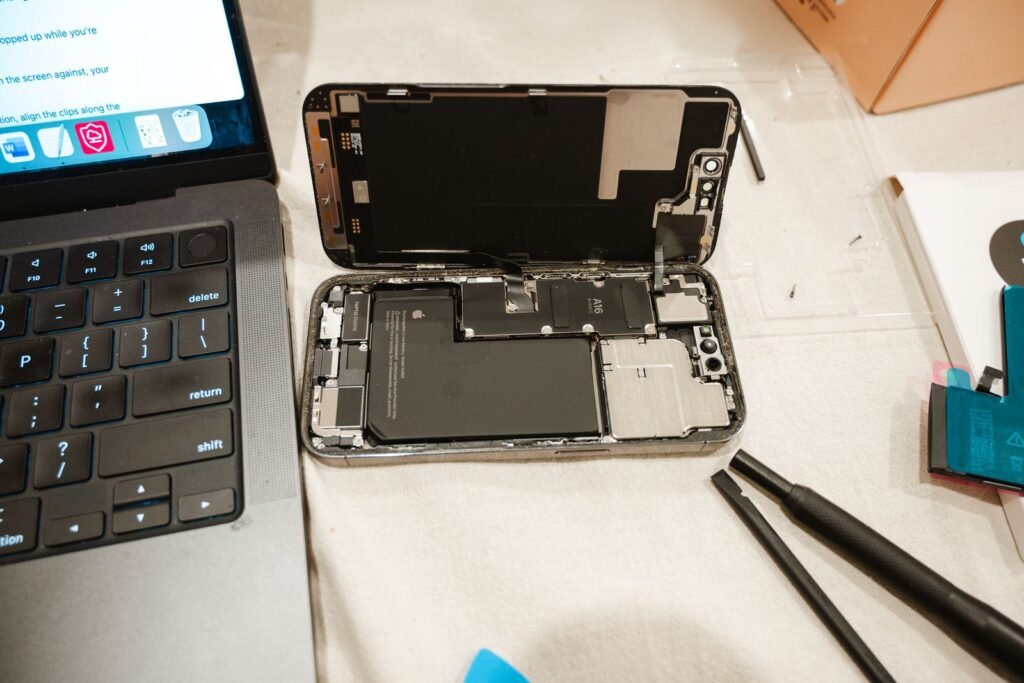
The big moment in the video is not a durability test at all. Nelson opened both phones side by side and found the same screws in the same places, the same motherboard layout, the same battery placement, and even the same model number printed on the daughterboard. Outside, the T1 matches the HTC’s dimensions, button placement, 3.5mm headphone jack and microSD slot.
Then he swapped the boards. The HTC board ran the T1, and the T1 board ran the HTC. iFixit had already done a one-way version of this in June, putting the HTC’s board into the T1, at which point the gold phone happily booted with an HTC logo. Nelson’s two-way swap removes any lingering doubt that the T1 might be a loose cousin of the U24 Pro rather than the same device.
What Trump Mobile actually changed
To be fair to Trump Mobile, the T1 is not a pure relabel. iFixit’s teardown, which included a Lumafield CT scan and a microscope comparison of the two displays, found a handful of real differences. Most of them are small.
| Trump Mobile T1 | HTC U24 Pro (2024) | |
|---|---|---|
| Chip | Snapdragon 7 Gen 3 | Snapdragon 7 Gen 3 |
| Memory and storage | 12GB / 512GB, Micron package | 12GB / 256GB or 512GB, SK Hynix package |
| Display | 6.78-inch 120Hz OLED, Diamond Pixel layout | 6.8-inch 120Hz OLED, identical panel under the microscope |
| Battery | 19.35 Wh (about 5,000mAh), cell made in the Philippines | 17.23 Wh (4,600mAh) |
| Wired charging | 30W, 30W charger in the box | 60W, 60W charger in the box |
| Back and camera housing | Gold plastic back, redesigned camera surround, flash moved via a longer flex cable | HTC design |
| Speaker grille | Different hole pattern, same speakers | Original pattern |
| iFixit repair score | 3/10 (provisional) | 3/10 |
The battery is the only change that matters day to day. The T1’s cell is rated at 19.35 Wh against 17.23 Wh in the HTC, roughly 12% more capacity in a pack of similar size. iFixit traced it to a company called Newlix Mfg Inc in the Philippines, which was registered in 2025, around the time the T1 was announced. The tradeoff is charging: the T1 tops out at 30W, half of what the U24 Pro supports, and ships with a slower charger to match.
Everything else is cosmetic. The flash did not really move. iFixit found the spring contacts in the same place and a lengthened flex cable reaching the new position. The speaker grille has a different pattern of holes over identical speakers. iFixit’s teardown put it bluntly: the T1 is a good price for an equivalent 512GB U24 Pro, and “the only things you give up are the 60W fast charging and your dignity.”
“Made in USA” became “Proudly American”
The reason a teardown of a midrange phone keeps making headlines is the marketing. Trump Mobile originally pitched the T1 as made in the United States. That language later shifted to “Proudly Assembled in the USA,” then to “Made with American Values” and “Proudly American.”
The company’s claim is that a team in Florida assembles the phone from around ten major components. iFixit thinks that is technically plausible for parts like the mainboard, battery, camera modules, speakers, USB-C port and haptic motor, with the chassis and curved display likely arriving as one pre-assembled unit. But it also points out that the design, the tooling, and the vast majority of components come from the same Chinese supply chain that built the HTC. The Verge traced the factory to Guangdong. HTC has stayed silent, and iFixit’s guess is that HTC never owned the design in the first place: since selling much of its phone team to Google in 2017, HTC has relied on outside manufacturers that can sell similar designs to other brands.
If you want a phone whose electronics are actually made in America, iFixit points to the Purism Liberty Phone, at around $2,000. That gap tells you how hard domestic phone manufacturing really is.
The price went up, and the specs did not
The T1 finally began shipping to preorder customers in May 2026, months after its original August 2025 target. Buyers who put down a $100 deposit locked in the $499 launch price. Around September 10, Trump Mobile quietly raised it to $749 with no announcement and no hardware change. Coverage at the time tied the hike to the memory shortage that has pushed up prices across the industry, which we covered in our explainer on why memory prices soared this year. Company executives had previously said the $499 figure was introductory.
The volume picture is murky too. A website flaw uncovered in May exposed order data that pointed to about 30,000 orders from roughly 10,000 unique customers, far below the 590,000 or so preorders the company had talked up. Trump Mobile has never published sales figures. And this month a group calling itself BYOD posted what it says is data on 3,615 more customers, which we covered in our report on the Trump Mobile leak.
Should you buy one?
Judge the T1 as a phone and it is fine. The Snapdragon 7 Gen 3 is a capable midrange chip, 12GB of RAM and 512GB of storage are generous, and the build survives real abuse. The problem is the context around it.
- At $749, it is a 2024 midrange phone at a 2026 flagship-adjacent price. Midrange Pixels and Galaxy A models with newer chips and long update promises cost less.
- Software support is the big unknown. iFixit’s 3/10 score leans heavily on the lack of service manuals, official spare parts and any guaranteed update window. White-label ODM phones have a poor track record here, and the U24 Pro itself shipped with Android 14.
- Charging is slower than the phone it is based on. You get a bigger battery, but you wait longer to fill it.
- Repairs depend on HTC-compatible parts. Ironically, that could be the T1’s saving grace: since the internals match, U24 Pro parts are a realistic fallback for a screen or board.
If repairability and longevity are why you are shopping, look at phones built around them. The Fairphone Gen 6 Plus, for example, launched in the US with a perfect repair score for $649, about $100 less than the T1.
About this article: GeekBlog covers U.S. technology news, AI, phones, smartwatches and gaming. Every story is written and checked under our Editorial Policy. Spotted a mistake or have a story tip? Contact our editors.
