


A lot of families land on this question the same way. A parent gets an Apple Watch or a medical alert watch recommended after a fall, a scare with their heart, or just a long stretch of living alone, and then someone checks the price. The next thought is a reasonable one: surely Medicare helps with that.
The honest answer is mostly no, with a few useful exceptions. Original Medicare does not pay for a smartwatch, and the exceptions live in private Medicare Advantage plans, in Medicaid programs, and in the medical care that happens after a watch flags something. This guide walks through each one so you know where to look before you spend a dollar.
Quick answer
Original Medicare (Parts A and B) does not cover smartwatches or fitness trackers. They are classed as consumer electronics, not medically necessary equipment. Some Medicare Advantage plans offer wellness allowances, over the counter (OTC) credits or emergency response benefits that can lower the cost, and some Medicaid programs fund medical alert devices. Medicare Part B can still cover the heart monitoring and doctor visits that follow if a watch flags a problem.
What Original Medicare Does and Does Not Cover
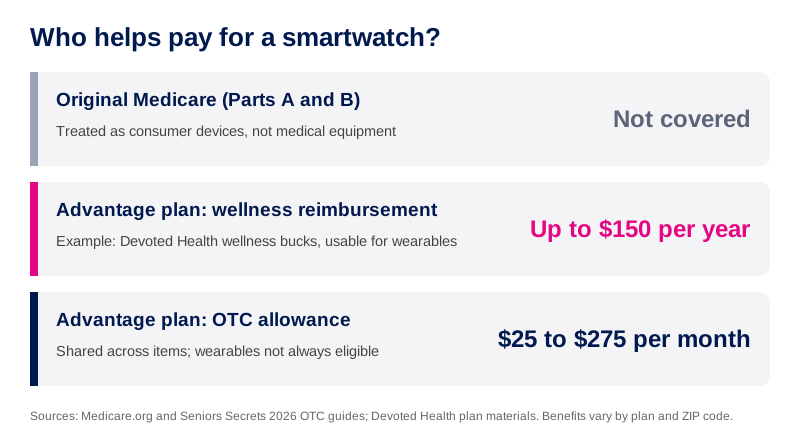
Original Medicare pays for items that are medically necessary and prescribed by a doctor, such as a wheelchair, a walker or an oxygen concentrator. A smartwatch does not fit that definition. Even when the watch has fall detection, an ECG app or an SOS button, Medicare treats it the same way it treats a fitness tracker: useful, but a personal purchase.
The same applies to medical alert systems. Neither Original Medicare nor a standard Medigap plan reimburses a monthly monitoring plan or the pendant itself. If you want the full picture of what monitored devices cost and where the fees come from, our breakdown of what medical alert watches really cost in 2026 lays out the numbers side by side.
Sources: CMS 2026 Medicare Parts A and B premiums and deductibles; Medicare.org and Seniors Secrets 2026 OTC allowance guides.
Where Help Can Actually Come From
There are four realistic routes to getting some of the cost covered. None of them is automatic, and each depends on the exact plan or state you live in.
| Route | What it can cover | Catch |
|---|---|---|
| Original Medicare + Medigap | Nothing toward the watch or a monitoring plan | Smartwatches are not durable medical equipment |
| Medicare Advantage OTC or wellness allowance | Some plans let you spend credits on fitness trackers or wearables | Eligible items vary by plan, and the allowance is shared with other products |
| Advantage emergency response benefit | A medical alert device or part of the monthly monitoring cost | Usually limited to approved vendors, not an Apple Watch |
| Medicaid home and community based waivers | Personal emergency response services in many states | Income and care need rules, and the benefit differs by state |
Medicare Advantage allowances
Medicare Advantage (Part C) plans are run by private insurers, and many add extras that Original Medicare lacks. Two of those extras matter here. The first is an OTC allowance, which commonly ranges from $25 to $275 a month depending on the plan and where you live. The second is a wellness or fitness reimbursement.
Real examples exist. Devoted Health has advertised up to $150 a year in “wellness bucks” that can go toward classes, programs or wearable devices like an Apple Watch. Humana members with an OTC benefit can buy a Fitbit through CenterWell Pharmacy using their spending account card. These are plan specific perks, not national rules, so a neighbor’s plan may allow something yours does not.
Emergency response benefits
Separate from the OTC credit, some Advantage plans include a personal emergency response system (PERS) benefit. Plans from insurers such as SCAN and Independent Health publish this benefit on their sites. It usually covers a pendant or wrist device from a contracted vendor, which is not the same thing as a mainstream smartwatch, but for a senior who mainly needs a reliable SOS button it can mean paying nothing at all.
Medicaid
Under Medicaid, medical alert systems are called personal emergency response services. Many states include them in home and community based services (HCBS) waivers, which are designed to help people stay at home instead of moving into a facility. Eligibility and coverage vary by state, so your state Medicaid office or local Area Agency on Aging is the right place to ask.
Worth Asking Your Plan About
- ✓ OTC or wellness allowance rules
- ✓ A PERS or “emergency response” benefit
- ✓ Fitness reimbursement for wearables
- ✓ Approved vendors and device lists
Do Not Assume
- ✕ That Original Medicare will reimburse the watch
- ✕ That an Apple Watch qualifies as a “medical alert”
- ~ That last year’s benefits still apply
- ~ That every Advantage plan has the same extras
When a Smartwatch Flags Something, Medicare Can Still Help
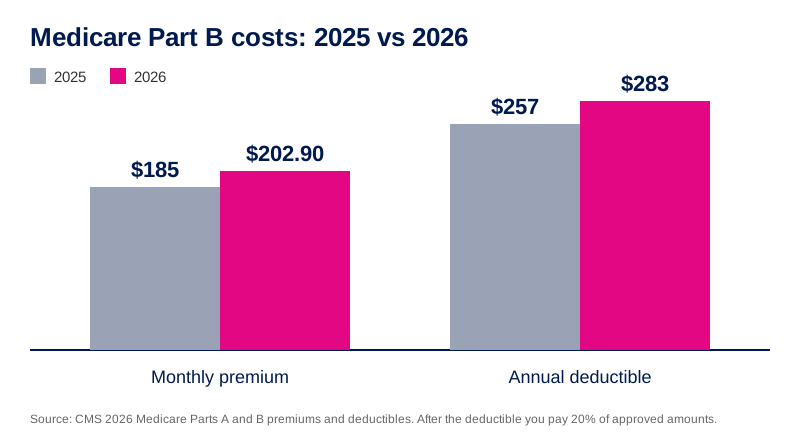
This is the part many people miss. Medicare will not buy the watch, but it can pay for what happens next. If a watch flags an irregular rhythm such as atrial fibrillation, a doctor can order proper testing, and that testing is a medical service. Heart monitors that are medically necessary, including event monitors that are typically worn for about 30 days, are covered under Part B. After you meet the $283 deductible, Medicare pays 80% of the approved amount and you pay the remaining 20%.
So a smartwatch can work as an early warning, with Medicare covering the diagnosis. The watch is not a diagnostic tool, and a flagged reading is a reason to call a doctor, not a diagnosis on its own. For how well a wrist sensor can actually spot problems, our guide to how smartwatch fall detection works for seniors explains where the technology is strong and where it misses.
Check the details before you buy
Allowances are often use it or lose it, and they can reset every month, quarter or year. Some plans only reimburse after purchase, others only work through a specific catalog. Confirm eligibility in writing or in your plan’s Evidence of Coverage before you pay, because a refused claim is hard to reverse once the box is open.
How to Check Your Own Plan in Four Steps
- Find your Evidence of Coverage. It is on your plan’s website or in the mailed packet, and it lists every extra benefit.
- Search for the right terms. Look for “over the counter,” “OTC,” “wellness,” “wearable,” “personal emergency response” and “PERS.”
- Call member services. Ask directly whether a smartwatch, fitness tracker or medical alert device is eligible, and get the answer by email or a reference number.
- Compare with going it alone. If the plan limits you to a narrow catalog, a no subscription watch bought on your own may still be the better deal. Our list of the best smartwatches with no subscription shows which ones avoid monthly fees entirely.
Frequently Asked Questions
Does Medicare cover an Apple Watch?
Original Medicare does not. An Apple Watch is a consumer device, not durable medical equipment. A few Medicare Advantage plans offer wellness or OTC credits that can be put toward one, but this depends on the specific plan.
Does Medicare cover medical alert systems?
Original Medicare and Medigap do not. Some Medicare Advantage plans include a personal emergency response benefit, and some state Medicaid waivers pay for one. Ask your plan which vendors are approved.
Will Medicare pay for a heart monitor if my smartwatch shows AFib?
If your doctor decides monitoring is medically necessary, Part B can cover it. After the deductible you typically pay 20% of the approved amount. The watch alert itself is not a diagnosis, so the first step is a doctor visit.
Can I use my OTC allowance on a smartwatch?
Only if your plan lists wearables as eligible items. Many OTC catalogs focus on health and pharmacy products, so check the catalog or call member services before ordering.
Is there any smartwatch that is free with Medicare?
Not as a standard benefit. Occasionally a Medicare Advantage plan runs a promotion, but those change every year. Treat any “free smartwatch” offer with caution and confirm it with the insurer directly.
Final Verdict
The Bottom Line
Original Medicare will not pay for a smartwatch in 2026, so plan to buy it yourself. If you have a Medicare Advantage plan, check for an OTC allowance, a wellness reimbursement or an emergency response benefit, because that is where real savings hide. If money is tight and living alone is the concern, ask your state Medicaid office about personal emergency response services. And if a watch ever flags a heart problem, Part B can cover the testing that follows.
Sources: CMS 2026 Part B fact sheet, KFF Medicare Advantage 2026 benefits, Medicare.gov ECG coverage. Benefits change each plan year; confirm details with your plan.
Featured image: Marcus Aurelius on Pexels.
