

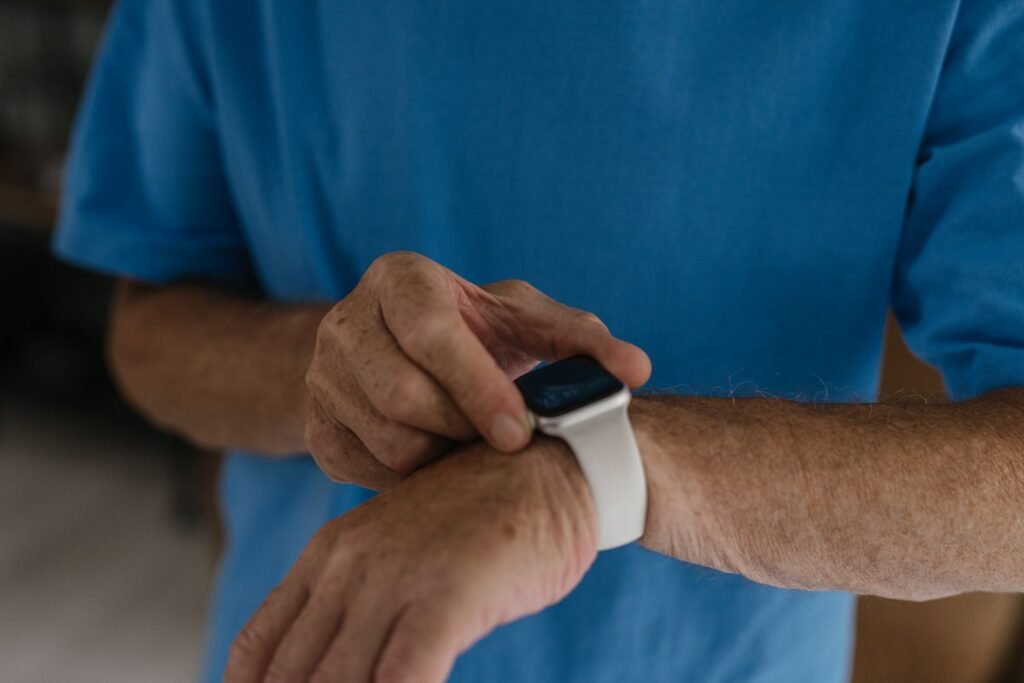
If you or someone you love has Parkinson’s, a smartwatch can feel like a long shot. Most reviews talk about step counts and sleep scores, not whether the watch can tell a resting tremor from someone waving hello. The good news is that one platform has gone much further than the rest, and it has the regulatory paperwork to prove it.
The short version: a regular consumer smartwatch cannot diagnose Parkinson’s, and none of them should be treated as a medical device on their own. But an Apple Watch paired with an FDA-cleared app can quietly log tremor and involuntary movement all day, and that log is something a neurologist can actually use. This guide covers what that looks like in real life, what it costs, how to make the touchscreen workable with shaky hands, and which clinical wearables exist if a standard watch is not enough.
Quick answer
The best smartwatch for Parkinson’s tracking is an Apple Watch Series 4 or newer running an FDA-cleared app such as StrivePD (Rune Labs) or Parky (H2O Therapeutics). Both use Apple’s Movement Disorder API to record resting tremor and dyskinesia in the background. The StrivePD app is free to download, and you only pay for the watch itself. Android and Garmin watches can still help with reminders, activity and fall alerts, but we could not find an equivalent FDA-cleared tremor tracking option for them.
Why Parkinson’s Is a Different Smartwatch Question
Parkinson’s symptoms swing during the day. A medication dose wears off, tremor creeps back, and then a few hours later it eases again. A clinic visit captures maybe 20 minutes of that. A watch worn on the wrist for 14 hours a day captures the rest, which is exactly why researchers got interested in wearables years ago.
Apple added a Movement Disorder API to its ResearchKit framework back in 2018. It measures two things: resting tremor in the 3 to 7 Hz range that is typical of Parkinson’s, and dyskinesia, the involuntary, fidgety movement that can show up as a side effect of long term levodopa treatment. The watch runs the analysis passively while you go about your day, so there is nothing to start or stop.
The Evidence Behind the Apple Watch Approach
This is not just a marketing claim. The algorithm behind the API is called MM4PD, and it was built using data from a pilot study of 118 people with Parkinson’s, whose watch data were matched against the gold standard clinical exam, the MDS-UPDRS Part III. Two results stand out.
Sources: Apple MM4PD validation study as reported in Frontiers in Neurology (2024); MobiHealthNews and MedTech Dive coverage of the FDA clearances.
A correlation of 0.80 is strong, but it is not perfect, and the ON/OFF result describes tracking changes in symptoms over time rather than replacing an exam. That is how the cleared apps are positioned too: as a record to bring to your appointment, not a verdict.
The Apps That Do the Actual Tracking
The watch hardware only collects the motion data. The two FDA-cleared apps are what turn it into something readable.
| App | Made by | What it tracks | Extras |
|---|---|---|---|
| StrivePD | Rune Labs | Tremor, dyskinesia, activity, sleep, gait, falls | Free to download, optional paid tier, iPhone and Watch apps |
| Parky | H2O Therapeutics | Tremor, dyskinesia, physical activity, medication intake | Medication reminders and a cueing feature to help with freezing of gait |
Both apps need an Apple Watch Series 4 or later, which also covers the Apple Watch SE and Ultra lines. Developers also have to get a special entitlement from Apple to use the API at all, which is one reason you will not find random fitness apps offering tremor graphs.
Making the Watch Usable With a Tremor
Here is the practical part that most guides skip. A watch that tracks tremor is useless if the tremor makes the touchscreen impossible to operate. A few settings and choices make a real difference.
- Turn on Touch Accommodations. On Apple Watch it lives under Accessibility settings. Hold Duration makes the screen ignore light, fluttery touches until a finger stays down for the time you choose, and Ignore Repeat treats rapid repeat taps as a single tap.
- Choose a band with no clasp. The Magnetic Link band closes with magnets in one motion, so there is no buckle to pinch. That matters if grip strength or fine finger control is already affected.
- Lean on voice. Siri can set timers, reminders and alarms, which avoids a lot of tapping.
- Keep the layout simple. Fewer complications on the watch face means fewer small targets to hit.
If simplicity is the top priority, our roundup of easy-to-use smartwatches for seniors covers which models have the least confusing interfaces, and most of that advice applies here too.
Clinical Wearables: When a Consumer Watch Is Not Enough
Doctors do prescribe dedicated devices, and the UK’s NICE has conditionally recommended five of them for remote monitoring: Kinesia 360, KinesiaU, PDMonitor, the Personal KinetiGraph (PKG) and STAT-ON. They collect more specialised data, and several use multiple body sensors rather than a single watch. They also cost far more.
To be fair about the comparison, those clinical systems are generally prescribed and paid for by health services, and PDMonitor also has an outright purchase price of £12,000. A watch you buy yourself will not match the depth of data from a multi sensor kit. What it offers is something you can start using this week, with no referral.
How the Options Compare
| Option | Tracks tremor? | Tracks dyskinesia? | Cost | Best for |
|---|---|---|---|---|
| Apple Watch + StrivePD or Parky | Yes, cleared | Yes, cleared | Watch price (SE 3 starts at $249), app free to download | Self-directed tracking and sharing with a doctor |
| KinesiaU | Yes | Yes | About £64 a month in NICE figures | Clinician-led remote monitoring |
| Personal KinetiGraph (PKG) | Yes | Yes | Prescribed | Medication timing decisions, with event markers and reminders |
| Android or Garmin watch | No cleared option found | No cleared option found | Varies | Reminders, activity, sleep and general health |
Clinical device prices come from UK NICE figures and will differ in the US. Apple Watch pricing is approximate and varies by model and retailer.
Pros and Cons of Using a Smartwatch for Parkinson’s
What works well
- ✓ Passive, all day tremor and dyskinesia logging
- ✓ FDA-cleared apps, backed by clinical validation
- ✓ Medication reminders and fall detection in one device
- ✓ Accessibility settings built for motor difficulties
What to watch out for
- ✕ Tracking is Apple Watch only, so it needs an iPhone
- ✕ It records one wrist, so symptoms elsewhere are missed
- ~ Daily charging is a habit that has to stick
- ~ The data supports a doctor, it does not replace one
Falls, Freezing and Safety Features
Balance problems and freezing of gait are a common worry, and that is where a watch earns its keep beyond tremor logs. Fall detection can automatically call emergency services if you take a hard fall and do not respond. It is not perfect, since slower slides rarely trigger it, so it works best as a backup. We break down how the sensors catch a fall, and where they miss, in our guide to smartwatch fall detection for seniors. If memory changes are also part of the picture, our look at smartwatches for dementia patients covers location sharing and simple alerts.
Frequently Asked Questions
Can a smartwatch diagnose Parkinson’s disease?
No. The Apple Movement Disorder API is designed for people who already have a clinical diagnosis of a movement disorder, and it is not meant to collect data from people who have not been diagnosed. If you are noticing a tremor or other symptoms, see a doctor rather than relying on a watch.
Which smartwatch is best for Parkinson’s tremor?
An Apple Watch Series 4 or newer with an FDA-cleared app such as StrivePD or Parky is the only mainstream setup we found with cleared tremor and dyskinesia tracking.
Is the StrivePD app free?
The app is free to download. There is an optional paid subscription tier with extra features, but the core tracking does not require it. You do need to own a compatible Apple Watch and an iPhone.
Can I use an Android or Garmin watch instead?
You can use them for medication reminders, activity and sleep tracking, and fall alerts. We could not find an FDA-cleared tremor or dyskinesia tracking option for them, so for symptom logging the Apple Watch is currently the stronger choice.
Will my neurologist actually use this data?
Many clinicians welcome it, since it shows how symptoms change between visits instead of just on appointment day. It is worth asking your care team before you buy, and bringing a few weeks of exported data to the next appointment.
Final Verdict
The Bottom Line
For Parkinson’s, a smartwatch is a companion to medical care, not a replacement for it. If you use an iPhone, an Apple Watch with StrivePD or Parky gives you something no other mainstream watch offers right now: FDA-cleared tremor and dyskinesia tracking running quietly in the background. Set up Touch Accommodations, pick a magnetic band, and talk to your neurologist about the data. If you use Android, a smartwatch can still handle reminders and fall alerts, but ask your doctor about prescribed wearables for symptom monitoring.
This article is for general information and is not medical advice. Talk to your healthcare provider about any treatment or monitoring decisions.
Featured image: SHVETS production on Pexels.
About this article: GeekBlog covers U.S. technology news, AI, phones, smartwatches and gaming. Every story is written and checked under our Editorial Policy. Spotted a mistake or have a story tip? Contact our editors.
