

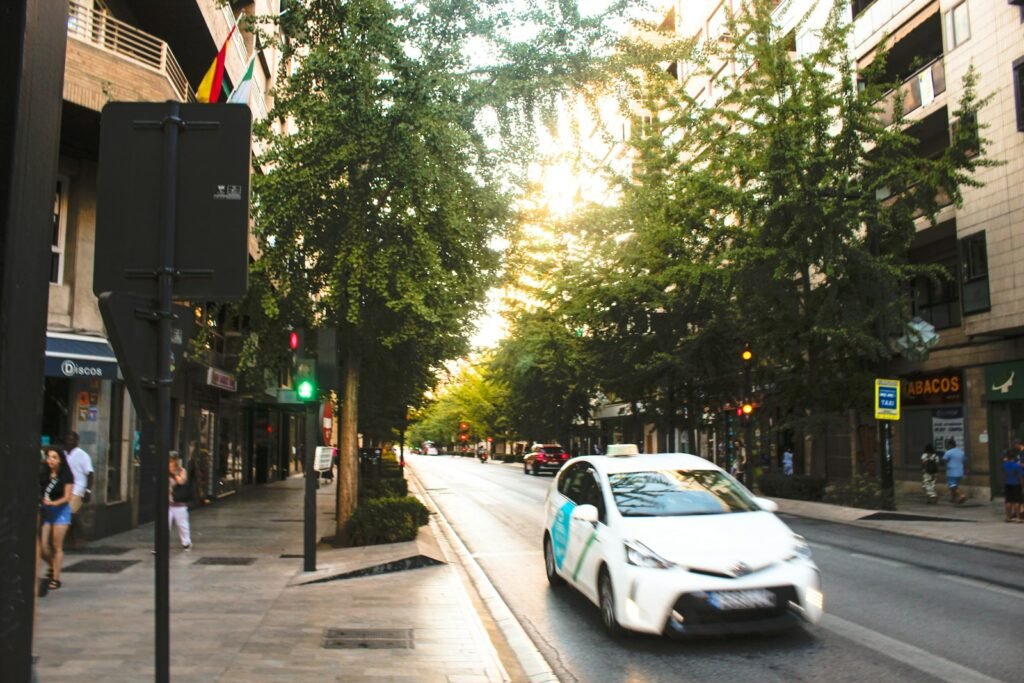
Tesla put a car on a public street in Austin this week that has no steering wheel, no pedals and no side mirrors. Within hours of the first paying passenger climbing in, the federal agency that decides which cars are allowed on American roads opened a file asking how that car got there.
Both things are true at once, and the gap between them is the whole story. The Cybercab is real, it is carrying real people, and its legal right to exist is now an open question at the National Highway Traffic Safety Administration.
The short version
- What launched: Tesla unveiled the two seat Cybercab at an Austin event on September 3 and opened public rides the following evening
- The hardware: no steering wheel, no pedals, no conventional side mirrors, running on Tesla’s camera only sensing stack
- The fleet: 45 Cybercabs registered in Texas, folded into a local Tesla robotaxi fleet of roughly 420 vehicles
- The probe: NHTSA opened Audit Query AQ26002 on the same day, covering about 1,000 Cybercabs
- The question: Tesla certified the Cybercab as road legal by itself. NHTSA wants to see the work
What actually happened in Austin
Tesla has been promising a purpose built robotaxi since 2024, and for two years the Cybercab existed mostly as a prop at press events. That changed on September 3, when the company held a launch event in Austin and quietly added the vehicle to the fleet already serving its Robotaxi app in the city. Paid public rides opened on Friday, September 4, at 5 p.m. Central.
The scale is smaller than the headlines suggest. Texas registration records show 45 Cybercabs, sitting inside a broader Tesla robotaxi operation in the area of roughly 420 cars, most of them ordinary Model Y vehicles wearing Robotaxi branding. If you open the app in Austin, you are still far more likely to be matched with a Model Y than with the thing that has no steering wheel.
What is genuinely new is the vehicle itself. Previous Tesla robotaxi rides happened in production cars that a human could take over at any moment, because the controls were right there. The Cybercab removes that option at the hardware level. There is nothing in the cabin for a person to grab.
The fare is the pitch
Tesla’s argument for a two seat car with no controls is cost. Fewer parts, fewer seats and no driver should mean a cheaper ride, and early Austin pricing does show that gap opening up.
Riders comparing the same route in the app found a four seat Model Y robotaxi quoted around $12.10 while the Cybercab came in at $7.77. That is a meaningful discount for anyone traveling alone, which describes most rideshare trips.
| Option | Seats | Sample Austin fare | Human in the car |
|---|---|---|---|
| Tesla Cybercab | 2 | $7.77 | None |
| Tesla Robotaxi Model Y | 4 | $12.10 | None |
| Uber EV (Waymo partner market) | 4 | $12.96 on a comparable trip | Varies |
Treat those numbers as a snapshot rather than a price list. Robotaxi fares move with demand the same way Uber and Lyft fares do, and a launch week price is a marketing number as much as an economic one. Every operator in this business has discounted early rides, and the interesting question is always what happens after the subsidy ends. We ran that comparison in detail when we looked at whether a Waymo ride actually costs less than an Uber, and the honest answer was that it depends heavily on the city, the hour and how badly the operator wants your trip.
Why the federal government opened a file
Here is the part that matters more than the fare. In the United States, a manufacturer does not apply for permission to sell a car. It certifies, on its own authority, that the vehicle complies with the Federal Motor Vehicle Safety Standards, and NHTSA audits that claim afterward if it has reason to.
That system works cleanly for a car with a steering wheel, because the standards were written assuming one exists. Dozens of the rules reference driver controls, mirrors, windshield wipers, defrosters and the driver’s field of view. A car with no driver’s seat does not fail those tests so much as fall outside them.
Tesla self certified the Cybercab, and part of that certification appears to rest on the position that certain standards simply do not apply to a vehicle with no manual controls. NHTSA’s audit query says so almost directly: the agency wants to examine the process and technical data Tesla relied on, including the extent to which the certification depended on deciding that some standards were inapplicable.
That is not a small administrative question. It is the central legal question of purpose built robotaxis, and Tesla answered it in its own favor without asking first.
Zoox already ran this experiment
The reason regulatory watchers reacted so sharply to AQ26002 is that there is a direct precedent, and it did not go quickly.
Amazon’s Zoox built a similar thing: a purpose built pod with no steering wheel and no pedals. In 2022, Zoox self certified it as compliant with federal standards, taking essentially the position Tesla is taking now. NHTSA responded with a special order demanding information, then a formal audit query, the same instrument now pointed at Tesla.
Zoox eventually gave up on the argument and went the other route. It filed a petition for a temporary exemption, and NHTSA granted it on July 31, 2026, allowing paid rides in Las Vegas with a two year term and a cap of 2,500 vehicles a year. The exemption explicitly waives requirements tied to equipment a driverless pod does not have, including certain mirror, wiper, defroster and manual brake control rules.
From self certification to permission took roughly four years. That is the clock Tesla is now standing next to.
Why an exemption and a self certification are not the same thing
- An exemption is granted. The agency reviews the petition, publishes it for comment, and issues a decision with limits attached
- A self certification is asserted. The manufacturer decides it complies and ships, and the review happens afterward if at all
- The risk profile differs. An exemption caps your fleet but protects your deployment. Self certification lets you move now and find out later
The scale gap nobody at Tesla wants highlighted
Tesla’s autonomy pitch has always been that camera only sensing plus enormous fleet data will beat lidar heavy rivals on cost and eventually on capability. The Cybercab is that thesis in metal. It is also arriving into a market where somebody else has a very large head start.
| Measure | Waymo | Tesla Robotaxi |
|---|---|---|
| Driverless vehicles in service | About 4,000 | About 420 in Austin, 45 of them Cybercabs |
| Cities | 14 in the US | A short list, led by Austin |
| Paid trips per week | Roughly 500,000 | Not disclosed |
| Unsupervised autonomous miles | More than 200 million | About 1 million |
| Sensing approach | Lidar, radar and cameras | Cameras only |
A 200 to 1 gap in real world driverless miles is not a rounding error, and it is the number that hangs over every safety claim in this segment. Tesla’s robotaxi program has already drawn scrutiny on that front, including reporting that its robotaxis were crashing at a rate several times higher than human drivers earlier this year. Tesla’s counterargument is that miles accumulate fast once a fleet scales, and that its manufacturing cost per vehicle is far below Waymo’s. Both points are fair. Neither is a safety record.
What happens next
An audit query is the quiet stage of a federal investigation. NHTSA collects documents, asks technical questions and decides whether to escalate. It can end in nothing, or it can turn into a formal defect investigation, a recall demand, or a finding that the vehicles were never legally certified in the first place.
Nothing about the current file stops Tesla from operating. The Cybercabs in Austin are still picking people up while the paperwork gets read. The company has also filed plans to build more than 125,000 Cybercabs a year, which is the number that makes the certification question urgent rather than academic. Forty five cars under legal doubt is a manageable problem. A production line running six figures a year is not.
The broader pattern here is familiar. American autonomy rules are being written after the fact, in response to vehicles that already exist, and the agencies involved keep arriving a step behind the deployment. We saw the same sequence play out on the freight side when California opened its highways to autonomous semi trucks and immediately drew a lawsuit over how the rules were written.
The honest read
Tesla did something genuinely difficult this week. Building a car with no controls, getting it manufactured, and putting paying strangers in it is not a press release, whatever you think of the company’s timelines.
It also skipped a step that its closest competitor took four years to complete, and the agency that noticed opened a file the same day. The Cybercab’s real test over the next year is not whether it can drive across Austin. It is whether Tesla’s answer to a question about federal safety standards holds up when somebody outside Tesla reads it.
