

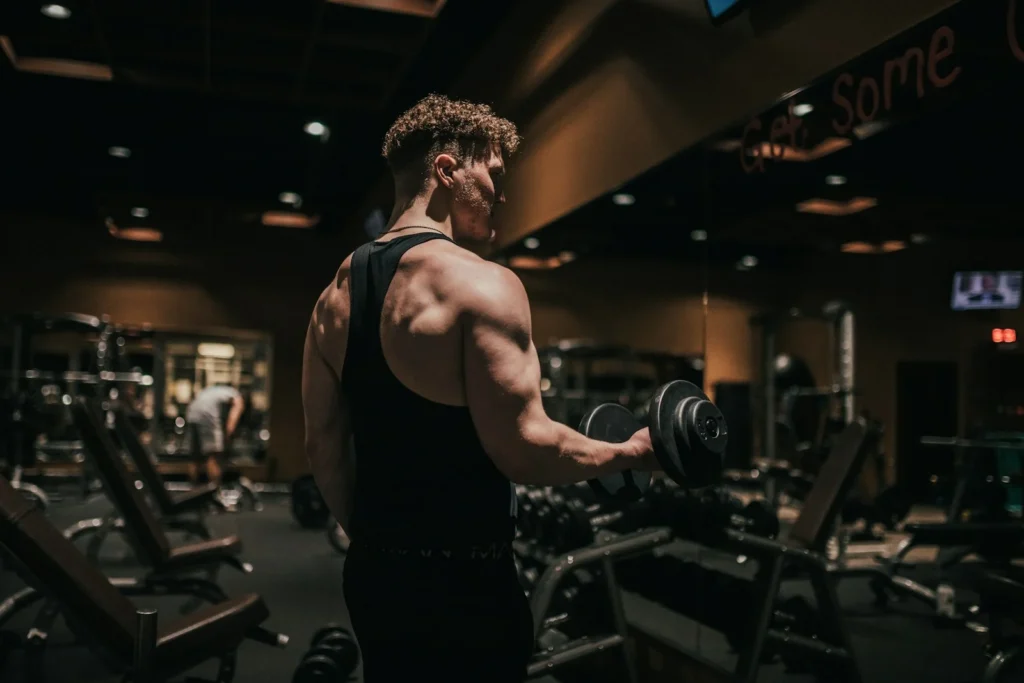
If the back of your upper arm looks flat, the fix is usually smarter triceps training, not more biceps curls. The triceps make up a large share of your upper arm, and one part of the muscle, the long head, is often undertrained. Below are five well established exercises that hit the triceps from different angles, with form tips and a simple weekly plan.
Why triceps can look flat
The triceps brachii has three heads: the long head, the lateral head and the medial head. All three straighten the elbow, but the long head also crosses the shoulder joint. That detail matters. When your arm is raised overhead, the long head is stretched, and when your arm is pulled back behind your torso, it is in a shortened, fully contracted position. Many people only do pushdowns with their elbows at their sides, which works the muscle well but skips those two positions.
So the goal is variety: some exercises with your elbows up near your head, and some where your arm finishes behind you. Body fat also affects how defined the back of the arm looks, and no exercise can spot reduce fat in one area. Strength training builds the muscle; overall diet and activity decide how visible it is.
The 5 best exercises for fuller triceps
A study sponsored by the American Council on Exercise (ACE) and run by researchers at the University of Wisconsin La Crosse compared common triceps moves using muscle activity readings. Diamond push ups (the study called them triangle push ups) came out on top, followed closely by kickbacks and dips. It was a small study with 15 young women, so treat it as a useful guide rather than the final word. The two overhead moves below round out the list because they train the long head in its stretched position.
1. Diamond push ups
Place your hands close together under your chest so your thumbs and index fingers form a diamond. Keep your body in a straight line from head to heels, lower your chest toward your hands with your elbows tracking back along your sides, then press up. If full push ups are too hard, start with your knees on the floor or your hands on a bench.
2. Dumbbell kickbacks
Hinge forward with a flat back, one hand braced on a bench. Lift your working elbow so your upper arm sits parallel to the floor and close to your body. Straighten the elbow until your arm is fully extended behind you, squeeze for a second, then lower slowly. Keep the upper arm still; if it swings, the weight is too heavy.
3. Dips
Bench dips are the easier version, with your hands on a bench behind you and your feet on the floor. Parallel bar dips are harder because you lift your whole body. Lower only as far as your shoulders stay comfortable, keep your chest up and press back to straight arms. People with shoulder pain often do better skipping deep dips.
4. Overhead dumbbell extension
Sit or stand tall and hold one dumbbell with both hands above your head. Keeping your elbows pointed forward and fairly close to your head, lower the weight behind you, then straighten your arms. A bench with a back support helps keep your ribs down and your lower back neutral. A cable rope works the same way and keeps tension on the muscle through the whole movement.
5. Lying triceps extension (skull crusher)
Lie on a flat bench with an EZ bar or two dumbbells held above your chest. Let your upper arms angle slightly back toward your head, then bend only at the elbows to lower the weight toward the top of your head. Straighten your arms without letting your elbows drift forward. That slight backward angle increases the stretch on the long head. Start light; this is not a lift to rush.
| Exercise | Arm position | Equipment | Level |
|---|---|---|---|
| Diamond push ups | Beside the body | None | Beginner to intermediate |
| Kickbacks | Behind the body | Dumbbell or cable | Beginner |
| Dips | Beside and slightly behind | Bench or bars | Beginner to advanced |
| Overhead extension | Overhead, stretched | Dumbbell or cable rope | Beginner |
| Lying extension | Angled overhead | EZ bar or dumbbells | Intermediate |
How often to train and how many reps
The NHS recommends muscle strengthening activity on at least two days a week, covering all major muscle groups, arms included. Guidance from the American College of Sports Medicine (ACSM) generally points to 8 to 12 repetitions per set for building strength and muscle, with one to four sets depending on your goals and experience.
A practical approach is to pick two or three of the five exercises per session, do two to four sets of each, and rotate the others in on your next arm day. Choose a weight that makes the last couple of reps challenging while your form stays clean. When you can complete all your reps comfortably, add a little weight or a few more reps. That gradual progression is what drives results over weeks and months.
Use your tech to track progress
Small strength gains are easy to miss, so a log helps. Most smartwatches let you start a strength training workout to record time and heart rate, and fitness apps such as Apple Fitness, Google Fit or dedicated lifting apps let you note sets, reps and weights for each exercise. Reviewing that history makes it obvious when you are ready to go heavier. Your phone camera is useful too: a quick side view video of a set shows whether your elbows flare or your upper arm swings during kickbacks.
FAQ
Which triceps head makes the arm look fuller?
All three heads contribute, but the long head is the one most often undertrained. Overhead extensions and lying extensions target it in a stretched position.
Can I build triceps at home without weights?
Yes. Diamond push ups and bench dips need no equipment, and a resistance band or a filled backpack can stand in for dumbbells on kickbacks and overhead extensions.
How long until I see a difference?
It varies with training history, diet, sleep and genetics. Consistent training on at least two days a week over a couple of months is a realistic starting point.
Will triceps exercises get rid of arm fat?
No exercise burns fat from one specific spot. Building muscle helps shape the arm, while overall diet and activity determine how much fat covers it.
The verdict
Flat looking triceps usually come from training them in only one position. Mix overhead work with moves where your arm finishes beside or behind you, train at least twice a week, keep your form strict and add load slowly. Track your sets on a watch or app, and get professional advice if anything hurts.
Updated October 2026: rewritten as a general guide to five proven triceps exercises, with form tips, weekly guidance from the NHS and ACSM, and ways to track progress.
Featured photo: Luke Witter on Unsplash.
About this article: GeekBlog covers U.S. technology news, AI, phones, smartwatches and gaming. Every story is written and checked under our Editorial Policy. Spotted a mistake or have a story tip? Contact our editors.
