

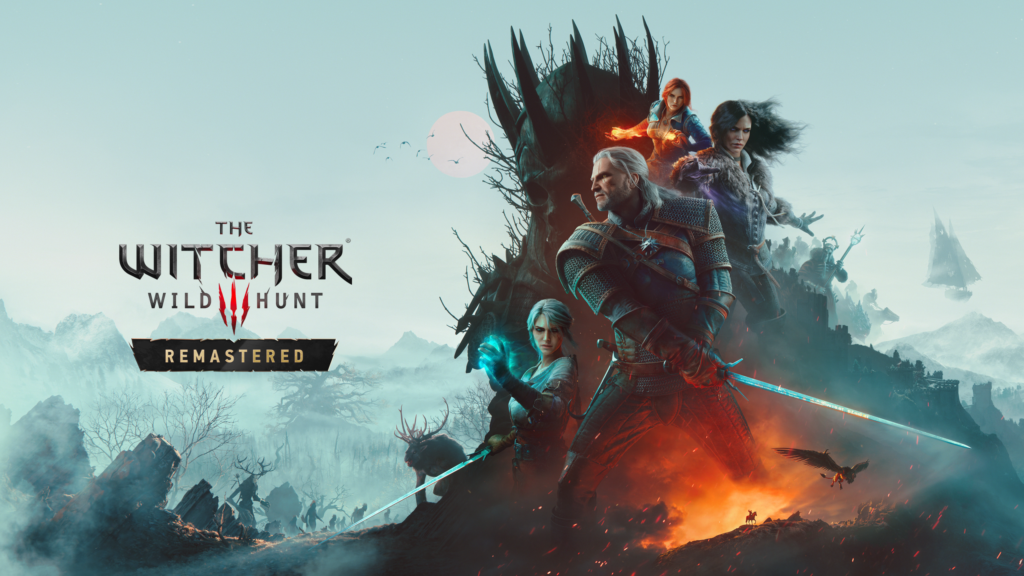
Featured image: Official key art via CD PROJEKT RED
CD Projekt Red picked an odd week to remind everyone how old The Witcher 3 has gotten. The game turns eleven this year, and on September 29 it gets treated like a launch title again. Every owner, on every platform, receives a free overhaul called The Witcher 3: Wild Hunt Remastered, and folded into the same announcement was the confirmation of the game’s first new expansion in a decade.
That is two separate pieces of news arriving as one. The remaster is free and lands in four days. The expansion, Songs of the Past, is paid, arrives in 2027, and is being built with a studio full of Witcher 3 veterans who left CD Projekt Red years ago to start their own thing.
The short version
- What’s free: The Witcher 3: Wild Hunt Remastered, out September 29 for everyone who already owns the base game
- Also free: Both existing expansions, Hearts of Stone and Blood and Wine, now included for every owner
- Platforms: PS5, Xbox Series X|S, Nintendo Switch 2, and PC
- What’s paid: Songs of the Past, a third expansion arriving in 2027, developed with Fool’s Theory
- Unlock time: 10:00 AM GMT / 3:00 AM PDT / 6:00 AM EDT / 12:00 PM CEST / 7:00 PM JST on September 29
What actually changes in the remaster
“Remastered” has become a loaded word in gaming, usually shorthand for a resolution bump and not much else. CD Projekt Red is promising more than that here, though how much more will only be clear once players get their hands on it. According to the studio, the update touches combat, traversal, and monster behavior, not just lighting and texture resolution.
The confirmed changes include:
- Reworked combat, movement, and traversal, including how Roach handles on rough terrain
- Revamped monster behavior and encounter pacing
- A rebuilt skill tree for Geralt, replacing the somewhat clunky original progression system
- New visual effects for the Witcher Signs
- Transmogrification, so armor stats and appearance can finally be separated
- An expanded photo mode
- New finishing moves in combat
- General visual and performance upgrades across the board
Individually, none of these are shocking. Together, they read like CD Projekt Red trying to close the gap between how The Witcher 3 plays and how its own later games, and the genre around it, have evolved since 2015. That includes RPGs built by the studio’s own former staff. Our review of The Blood of Dawnwalker, made by Rebel Wolves, a studio full of ex-CD Projekt Red developers, made a similar point about how much the genre has moved since Geralt’s last adventure. The remaster looks like CD Projekt Red’s attempt to keep the original from feeling like it is standing still next to its own imitators.
How the platforms compare
Not every version is getting the same treatment, and CD Projekt Red has been more specific about some platforms than others so far.
| Platform | Ray tracing | Notable tech | Status |
|---|---|---|---|
| PC | Path tracing, ray-traced hair, Ray Reconstruction | DLSS 4.5, FSR 4, XeSS 2.0, native DirectX 12 | Confirmed |
| PS5 Pro | Ray tracing alongside a high frame rate | First console version to run both at once | Confirmed |
| PS5 (standard) | Not yet detailed | Resolution and performance modes still unannounced | Pending |
| Xbox Series X|S | Not yet detailed | Specific modes still unannounced | Pending |
| Nintendo Switch 2 | Not applicable | Native edition; original Switch owners get it free | Confirmed |
PC is getting the fullest technical showcase, with path tracing and ray-traced hair alongside support for all three major upscalers. The standout console claim is the PS5 Pro running ray tracing and a high frame rate at the same time, something the original 2022 next-gen update could not manage without trading one for the other. Sony and CD Projekt Red have not yet published the equivalent breakdown for standard PS5 or Xbox Series X|S, so expect more detail closer to launch day.
Your save file survives, your mods might not
For anyone worried about losing hundreds of hours of progress, CD Projekt Red has confirmed that existing save files carry over, and cross-progression keeps working between the old and new versions. You will not be starting the Northern Kingdoms from scratch on September 29.
Mods are the messier part of the story. Most should keep functioning, but the studio has warned that some will break given how much has changed under the hood, and the rebuilt skill tree is the most obvious friction point. If your existing save has skill points already spent under the old system, that allocation runs into a system that no longer works the same way. PC players who have built a heavily modded install are the ones most likely to notice something broken on day one.

Songs of the Past is not DLC, CD Projekt Red insists
The bigger long-term news might be the expansion. CD Projekt Red has gone out of its way to call Songs of the Past an expansion rather than DLC, the same distinction it drew around Hearts of Stone and Blood and Wine a decade ago, and the studio is positioning it at a similar scale.
Here is how the three stack up on what is currently known:
| Expansion | Release year | Setting | Price today |
|---|---|---|---|
| Hearts of Stone | 2015 | Redania and the Oxenfurt region | Free with the remaster |
| Blood and Wine | 2016 | The duchy of Toussaint | Free with the remaster |
| Songs of the Past | 2027 | Letten, a newly introduced region | Paid, price not yet announced |
Story details are still thin, which tracks for something arriving more than a year out. CD Projekt Red describes Letten as an idyllic land built on rural tradition, full of bountiful harvests and lavish festivals, hiding a dark secret underneath that pulls Geralt back into monster-hunting duty against foes the series has not shown before. It is a deliberately old-fashioned Witcher premise: pretty village, rotten core, Geralt gets dragged into it anyway.
CD Projekt Red has also framed Songs of the Past as a farewell of sorts, one more adventure as Geralt before The Witcher 4 hands the controller over to Ciri. Whether that framing holds up once the expansion actually ships is impossible to judge yet, but it explains why the studio is treating a decade-old game’s send-off as a bigger deal than a typical remaster campaign would call for.
Who is actually building it
Songs of the Past is not purely an in-house CD Projekt Red project. It is being co-developed with Fool’s Theory, a Polish studio founded in 2015 by Jakub Rokosz, formerly a senior quest designer on the original Witcher 3. Reports on the project put roughly 190 developers on it, the majority of them from Fool’s Theory rather than CD Projekt Red itself.
That arrangement fits a pattern that has become common across the Polish RPG scene over the past few years: studios founded by former Witcher 3 developers circling back to work on Witcher content, or on spiritual successors to it, once they have built up a track record of their own. Fool’s Theory previously worked on The Witcher Remake before taking on Songs of the Past, and it is far from the only studio built this way. It is the same dynamic behind Rebel Wolves and The Blood of Dawnwalker, which is worth remembering the next time a trailer credits a small, unfamiliar studio name. There is a decent chance some of the people behind it used to work down the hall from Geralt’s original writers.
A crowded month for franchises that refuse to stay finished
The Witcher 3’s second act is not happening in isolation. September has been an unusually busy month for publishers digging into their back catalogs and legacy franchises rather than only chasing new IP. Blizzard used BlizzCon earlier this month to confirm Diablo 5, a full sequel rather than a remaster, but the instinct is the same one CD Projekt Red is acting on: a decades-old franchise still has an audience worth investing in twice.
Meanwhile, the hardware side of the industry keeps looking further ahead than the games running on it. Leaked specs for Sony’s rumored PS6 handheld describe a device Sony has not confirmed, aimed at a market that will not exist for years, while the remaster arriving this month has to run well on the PS5 hardware people already own today. It is a reminder that even as next-generation rumors pile up, a big chunk of what actually ships in any given month is still built for the console already sitting under someone’s TV.
What to actually do before September 29
If you already own The Witcher 3 on any platform, there is nothing to buy and nothing to pre-order. The remaster replaces the base game automatically through the usual update channel for your platform, and the two expansions unlock alongside it at no extra cost. New players picking the game up for the first time will simply get the remastered version by default going forward.
The one thing worth doing ahead of time, especially on PC, is checking whether any mods you are running have posted compatibility notes before the update lands. Beyond that, the wait is short. Whatever changes CD Projekt Red has made to an eleven-year-old game will be fully playable in four days, and the harder question, whether Songs of the Past can justify calling itself Geralt’s real send-off, will not get answered until sometime in 2027.
About this article: GeekBlog covers U.S. technology news, AI, phones, smartwatches and gaming. Every story is written and checked under our Editorial Policy. Spotted a mistake or have a story tip? Contact our editors.
