

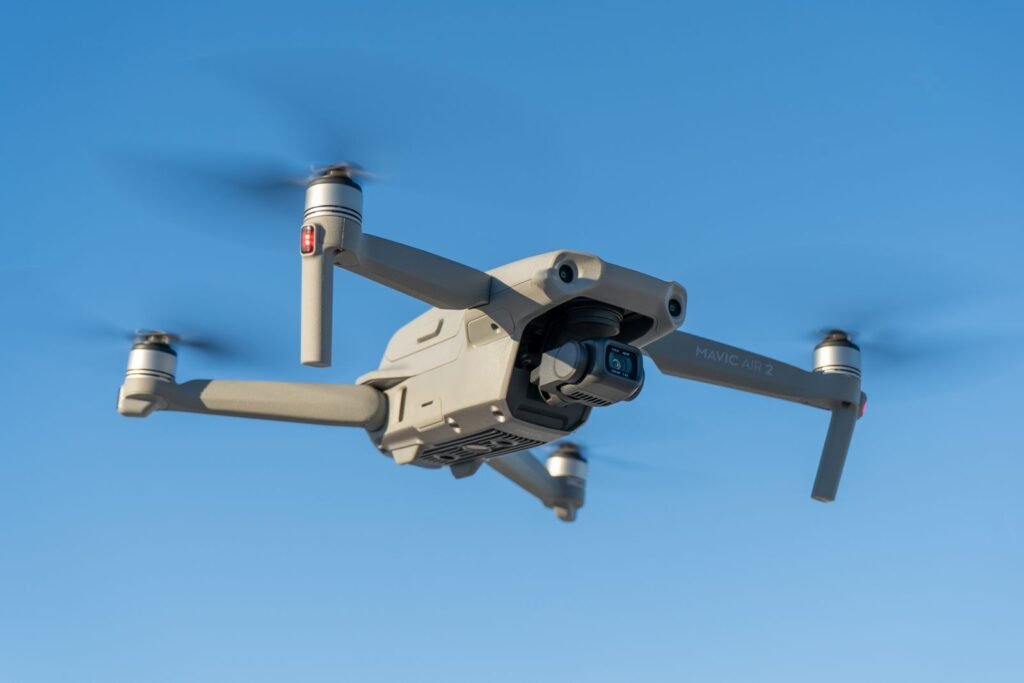
Amazon has been promising drone delivery since Jeff Bezos put a prototype on television in 2013. For most of the decade that followed, the promise stayed a promise. This week the company put a number on it: nearly 500 cities and towns across the United States by the end of 2026, up from a footprint that currently covers seven states.
That is a sixfold expansion in roughly four months. It is also, if you read the specs rather than the press release, a much narrower service than “Amazon delivers by drone now” makes it sound.
The short version
- The target: nearly 500 US cities and towns by the end of 2026, a sixfold increase
- Live today: 11 sites across Arizona, Florida, Kansas, Louisiana, Michigan, Nebraska and Texas
- Next up: the Chicago, Syracuse, Cleveland, Atlanta and Boise metro areas
- The aircraft: the MK30, carrying up to five pounds within roughly 7.5 miles of a site
- The speed: deliveries in as little as 30 minutes
- The catch: the regulation that makes national scale possible is still not final
Where it works right now
Prime Air currently operates from 11 sites across seven states, and each one serves an area of roughly 175 square miles. That is a circle, not a state. Living in Texas does not mean you can get a drone delivery, it means somebody in Texas can.
David Carbon, the vice president running Prime Air, framed the expansion in terms of what Amazon has already shipped this way. “We’ve already delivered hundreds of thousands of packages to customers by drone this year, and by the end of 2026 we plan to reach customers in nearly 500 cities and towns,” he said.
| Status | States and metros |
|---|---|
| Flying today | Arizona, Florida, Kansas, Louisiana, Michigan, Nebraska, Texas |
| Launching next | Chicago, Syracuse, Cleveland, Atlanta, Boise |
| Named in the expansion | Detroit, Dallas, Houston, Omaha, Tampa and more later this year |
| Coverage per site | About 175 square miles, roughly a 7.5 mile radius |
The five pound rule decides everything
The aircraft doing this work is the MK30, an electric drone with a maximum takeoff weight of about 83 pounds that carries a payload of five. It is quieter than the model it replaced, it can fly in light rain, and it uses onboard obstacle detection to decide whether your yard is clear before it drops anything.
Five pounds sounds restrictive until you look at what people actually order. Amazon says the limit still covers more than 60 percent of its most commonly purchased products. Toothpaste, phone chargers, batteries, over the counter medication, cosmetics, a single box of pasta. The stuff you run out of, not the stuff you plan for.
That is the actual product here, and it is worth being clear about it. Prime Air is not a replacement for the van. It is a convenience store that flies, aimed squarely at the trip you would otherwise make to a pharmacy at nine at night.
How ordering works
If you are inside a coverage area, the option shows up in your Amazon account without you doing anything. Eligible items are flagged during browsing. At checkout you pick and confirm a delivery spot in your yard or driveway, and you can save it as your standing drone drop point.
When the drone arrives it hovers, scans the area for obstacles, people and pets, and only releases the package once it decides the spot is clear. If it is not clear, it does not drop.
If you live in an apartment, this is not for you
Every part of the current design assumes a private outdoor space that a drone can descend into. No balcony, no shared courtyard, no street level drop. Drone delivery is, for now, a suburban product, and the 175 square mile coverage circles reflect that.
The regulation nobody has finished writing
Here is the part the announcement skipped. Flying a delivery drone beyond the operator’s line of sight is the single thing that makes this economically viable, and the federal rule that would make it routine is still not on the books.
The FAA published its proposed Part 108 framework in August 2025, which would let qualifying operators run beyond visual line of sight flights inside defined risk categories without applying for individual waivers. A final rule was widely expected in spring 2026. It has not arrived. Companies including Amazon have been building toward it on the assumption that it lands, operating in the meantime under a patchwork of approvals.
That is a real dependency, not a footnote. Amazon’s 500 city target is a commercial commitment made partly on a regulatory forecast. If Part 108 slips again, the schedule slips with it.
Amazon has crashed these before
Prime Air has a safety history, and it is not spotless. The program paused flights after an incident in Arizona and later resumed, a sequence we covered when Amazon restarted drone delivery following the Arizona crash. More recently, a Prime Air drone crash in Darlington in the UK drew an investigation from British air accident authorities.
None of that is unusual for aviation at an early stage, and Amazon’s incident rate against hundreds of thousands of deliveries is not obviously alarming. But scaling sixfold multiplies the number of flights, the number of neighborhoods, and the number of people standing underneath. The regulatory scrutiny scales with it.
The reaction has been exactly what you would expect
The announcement did what Amazon announcements do, which is generate jokes. “Oh great, now I have to climb up onto my roof to get my packages,” ran one reply. “Finally, a way for my impulse purchases to arrive before the regret does,” ran another. British customers, as ever, asked why they were still waiting on next day delivery like chumps.
Underneath the jokes is a real thing worth noticing: the median reaction was not fear or fascination, it was resignation. Drone delivery has been announced so many times that the eleventh announcement lands as a shrug. That is arguably Amazon’s biggest problem with this product, and it is why the company keeps leading with hard numbers now instead of concept video.
What this means for the rest of Amazon
Ultrafast delivery is a moat, not a feature. Same day shipping reshaped the company’s warehouse network, and 30 minute delivery reshapes it again, because a drone needs a launch site within 7.5 miles of the customer. That means hundreds of small sites rather than a handful of enormous ones, and it means Amazon needs local zoning approval in every one of those places.
It is the same operating pattern the company applies everywhere: build the physical infrastructure first, ask questions later, absorb the friction. We saw the sharper end of that approach when an AirTag hidden in a box of rare books turned up inside an Amazon AI facility. The logistics machine moves faster than the conversation about what it is doing.
What to watch next
- Part 108. The final BVLOS rule is the gate. Everything about the 500 city timeline depends on when it clears.
- Local pushback. Noise complaints killed early Prime Air trial sites. The MK30 is quieter, but 500 towns means 500 city councils.
- The weight limit moving. Five pounds is a hardware constraint. If Amazon ships a larger airframe, the addressable share of orders jumps well past 60 percent.
- Whether rivals keep pace. Zipline and Wing have been flying commercially for years and in some markets are ahead. The 500 number is aimed at them as much as at customers.
For now, the honest summary is this. If you live in one of a few hundred suburban coverage circles and you need something small in a hurry, this is about to become genuinely useful. Everyone else gets to keep reading about it.
About this article: GeekBlog covers U.S. technology news, AI, phones, smartwatches and gaming. Every story is written and checked under our Editorial Policy. Spotted a mistake or have a story tip? Contact our editors.
