Close Menu
GeekBlog

    Subscribe to Updates

    Get the latest creative news from FooBar about art, design and business.

    What's Hot

    This Clock Would Take 260 Billion Years to Lose One Second. The Universe Is 13.8 Billion Years Old.

    October 4, 2026

    One UI 9 Watch Beta Now Covers Three Galaxy Watch Generations: What You Get and How to Join

    October 4, 2026

    NASA Found Possible Signs of Life on Mars. To Check, It Went to a Beach in Scotland.

    October 4, 2026
    Facebook
    GeekBlog
    • Home
    • Mobile
    • Tech News
    • Blog
    • Gaming
    • Smartwatch
    • How-To Guides
    • AI & Software
    Facebook
    GeekBlog
    Home»Tech News»IBM and NASA Develop a Digital Twin of the Sun to Predict Future Solar Storms
    Tech News

    IBM and NASA Develop a Digital Twin of the Sun to Predict Future Solar Storms

    Michael ComaousBy Michael ComaousAugust 25, 20254 Mins Read
    Share Facebook Twitter Pinterest LinkedIn Tumblr Email Copy Link
    IBM and NASA Develop a Digital Twin of the Sun to Predict Future Solar Storms
    Share
    Facebook Twitter LinkedIn Pinterest Email Copy Link

    Recommended for you:

    11 secret Fire TV remote shortcuts I use to unlock hidden features and menus
    Tech News·Aug 26, 2025

    11 secret Fire TV remote shortcuts I use to unlock hidden features and menus

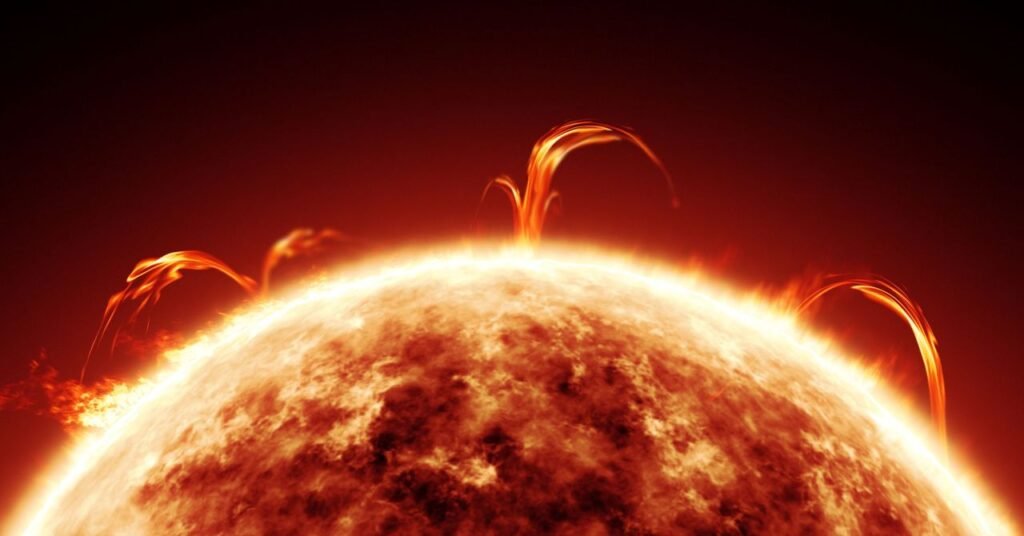
    The Sun’s most complex mysteries could soon be solved thanks to artificial intelligence. On August 20, IBM and NASA announced the launch of Surya, a foundation model for the sun. Having been trained on large datasets of solar activity, this AI tool aims to deepen humanity’s understanding of solar weather and accurately predict solar flares—bursts of electromagnetic radiation emitted by our star that threaten both astronauts in orbit and communications infrastructure on Earth.

    Surya was trained with nine years of data collected by NASA’s Solar Dynamics Observatory (SDO), an instrument that has orbited the sun since 2010, taking high-resolution images every 12 seconds. The SDO captures observations of the sun at various different electromagnetic wavelengths to estimate the temperature of the star’s layers. It also takes precise measurements of the sun’s magnetic field—essential data for understanding how energy moves through the star, and for predicting solar storms.

    Historically, interpreting this vast amount of diverse and complex data has been a challenge for heliophysicists. To address this challenge, IBM says that Surya’s developers used the SDO data to create a digital twin of the sun—a dynamic virtual replica of the star that is updated when new data is captured, and which can be manipulated and more easily studied.

    The process began with unifying the various data formats fed into the model, allowing it to process them consistently. Next, a long-range vision transformer was employed—AI architecture that enables detailed analysis of very high-resolution images and the identification of relationships between their components, regardless of their distance.

    The model’s performance was optimized using a mechanism called spectral gating, which reduces memory usage by up to 5 percent by filtering out noise in the data, thereby increasing the quality of the processed information.

    More Accurate Predictions in Less Time

    Its developers say that this design gives Surya a significant advantage: Unlike other algorithms that require extensive labeling of the data that’s fed to them, Surya can learn directly from raw data. This allows it to quickly adapt to different tasks and deliver reliable results in less time.

    During testing, Surya demonstrated its versatility in integrating data from other instruments, such as the Parker Solar Probe and the Solar and Heliospheric Observatory (SOHO), two other spacecraft that observe the sun. Surya also proved to be effective in various predictive functions, including predicting flare activity and solar wind speed.

    According to IBM, traditional prediction models can only predict a flare one hour in advance based on signals detected in specific regions of the sun. In contrast, “Surya provided a two-hour lead by using visual information. The model is thought to be the first to provide a warning of this kind. In early testing of the model, the team said they achieved a 16 percent improvement in solar flare classification accuracy, a marked improvement over existing methods,” the company said in a statement.

    NASA stresses that, although the model was designed to study heliophysics, its architecture is adaptable to different fields, from planetary science to Earth observation. “By developing a foundation model trained on NASA’s heliophysics data, we’re making it easier to analyze the complexities of the sun’s behavior with unprecedented speed and precision,” said Kevin Murphy, NASA’s director of data science, in a statement. “This model empowers broader understanding of how solar activity impacts critical systems and technologies that we all rely on here on Earth.”

    The risk posed by abnormal solar activity is not minor. A major solar storm could directly affect global telecommunications, collapse electrical grids, and disturb GPS navigation, satellite operations, internet connections, and radio transmissions.

    Andrés Muñoz-Jaramillo, a solar physicist at the Southwest Research Institute in San Antonio, Texas, and lead scientist on the project, emphasized that Surya’s goal is to maximize the lead time for these possible scenarios. “We want to give Earth the longest lead time possible. Our hope is that the model has learned all the critical processes behind our star’s evolution through time so that we can extract actionable insights.”

    This story originally appeared on WIRED en Español and has been translated from Spanish.

    Recommended for you:

    The 16 best portable Bluetooth speakers for 2025
    Tech News·Aug 25, 2025

    The 16 best portable Bluetooth speakers for 2025

    About this article: GeekBlog covers U.S. technology news, AI, phones, smartwatches and gaming. Every story is written and checked under our Editorial Policy. Spotted a mistake or have a story tip? Contact our editors.

    NASA
    Share. Facebook Twitter Pinterest LinkedIn Tumblr Telegram Email Copy Link
    Previous ArticleThe 16 best portable Bluetooth speakers for 2025
    Next Article You can now add AI images directly into LibreOffice documents – here’s how
    Michael Comaous

      Michael Comaous is a dedicated professional with a passion for technology, innovation, and creative problem-solving. Over the years, he has built experience across multiple industries, combining strategic thinking with hands-on expertise to deliver meaningful results. Michael is known for his curiosity, attention to detail, and ability to explain complex topics in a clear and approachable way. Whether he’s working on new projects, writing, or collaborating with others, he brings energy and a forward-thinking mindset to everything he does.

      Related Posts

      11 Mins Read

      This Clock Would Take 260 Billion Years to Lose One Second. The Universe Is 13.8 Billion Years Old.

      11 Mins Read

      NASA Found Possible Signs of Life on Mars. To Check, It Went to a Beach in Scotland.

      9 Mins Read

      Apple Put Video Into CarPlay and Millions of Drivers Cannot Find It. The Missing Piece Is the Car.

      11 Mins Read

      DoorDash’s AI Will Look Inside Your Fridge and Order Dinner. The Early Build Quoted the Wrong Prices.

      12 Mins Read

      NASA’s $30 Million Rescue Failed. It Turned the Falling Telescope Back On Anyway.

      12 Mins Read

      Nikon Is Investigating Its Contest Winner for Using AI. Its Own Profile Said He Does.

      Top Posts

      Best Free Online Music Apps in 2026

      July 7, 20263 Views

      Samsung Phones With the Best Camera Quality, Ranked

      July 4, 20262 Views

      When Is Anthropic Going Public? IPO Status 2026

      July 4, 20262 Views
      Stay In Touch
      • Facebook

      Subscribe to Updates

      Get the latest tech news from FooBar about tech, design and biz.

      Most Popular

      The Mesh Router Placement Strategy That Finally Gave Me Full Home Coverage

      September 9, 20263 Views

      Best Android Smartwatches in 2026: Which One Actually Fits Your Phone

      September 7, 20262 Views

      Gears of War: E-Day Reviews Are In: Best Gears in 15 Years, but the Campaign Drags

      October 1, 20261 Views
      Our Picks

      This Clock Would Take 260 Billion Years to Lose One Second. The Universe Is 13.8 Billion Years Old.

      October 4, 2026

      One UI 9 Watch Beta Now Covers Three Galaxy Watch Generations: What You Get and How to Join

      October 4, 2026

      NASA Found Possible Signs of Life on Mars. To Check, It Went to a Beach in Scotland.

      October 4, 2026

      Subscribe to Updates

      Get the latest creative news from FooBar about art, design and business.

      HEICJPG.online - Convert HEIC to JPG online
      Facebook
      • About Us
      • Contact us
      • Privacy Policy
      • Disclaimer
      • Terms and Conditions
      • Editorial Policy
      • Cookie Policy
      • Your Privacy Choices
      © 2026 GeekBlog

      Type above and press Enter to search. Press Esc to cancel.