

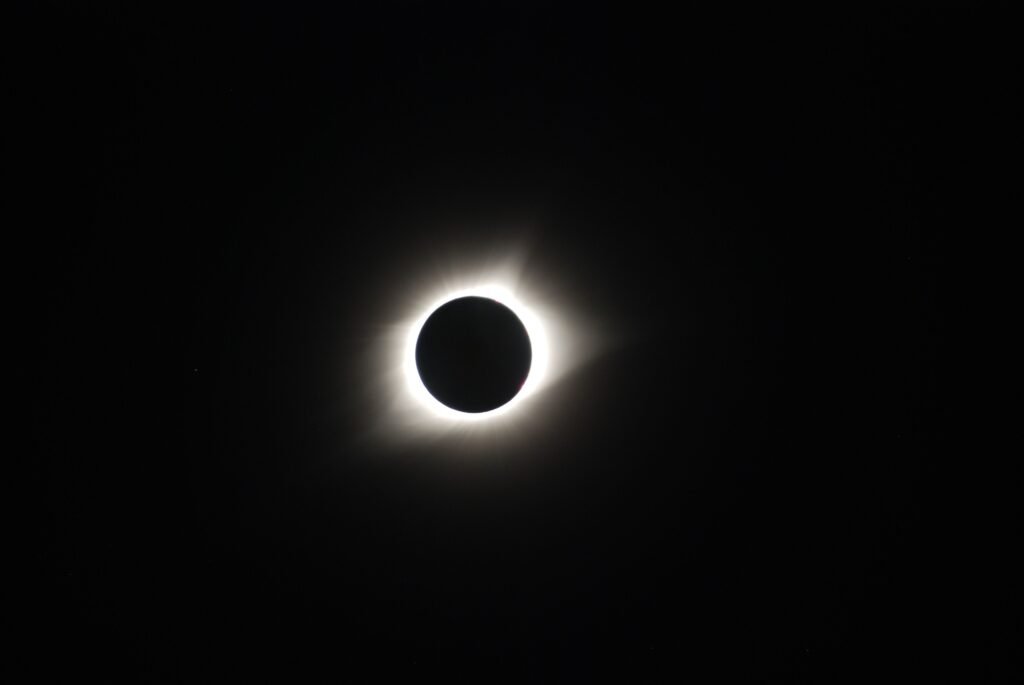
On August 12, the moon will pass in front of the sun and produce the first total solar eclipse visible from mainland Europe since 1999. Millions of people are going to watch it, and a very large fraction of them are going to instinctively pull out a phone and point it at the sky. NASA would like a word before that happens.
Why a Phone Camera Is Actually at Risk
The usual objection is reasonable: people photograph sunsets constantly and nothing melts. What makes an eclipse different is a combination of duration, magnification, and the fact that everybody stares at the same tiny, extremely bright object for well over an hour.
A phone’s image sensor sits behind a small lens that concentrates incoming light onto a sensor surface measured in millimeters. Point that at the sun with nothing in front of it and you have built a small, efficient device for focusing solar energy onto delicate silicon. Brief exposure usually survives. Sustained exposure, especially while you are lining up a shot, adjusting framing, and recording video, is where the trouble starts.
Add magnification and the math gets worse fast. A clip-on telephoto lens or a phone attached to a telescope or spotting scope gathers far more light and concentrates it further. NASA’s guidance singles this out specifically: the risk of damage increases dramatically with any sort of magnifying attachment, and longer exposure times compound it.
The consequence is what makes this worth caring about. A damaged sensor does not heal. You end up with a permanent hot spot, discoloration, or dead pixels that appear in every photo and every video the phone takes for the rest of its life. It is not an eclipse problem. It is a phone-you-paid-a-lot-for problem.
The Protection Is Genuinely Simple
There is no clever workaround here, and there does not need to be. The same certified eclipse glasses protecting your eyes will protect your camera.
| Do this | Not this |
|---|---|
| Hold certified eclipse glasses or a solar filter flat against the phone’s lens | Regular sunglasses, welding glass of unknown rating, smoked glass, exposed film |
| Cover the lens before you raise the phone toward the sun | Framing first and adding the filter once you find the sun |
| Use a tripod and a delayed shutter for steadiness at zoom | Handheld maximum zoom while squinting upward |
| Keep the filter on the entire time in the US, where the sun is never fully covered | Removing the filter because the light looks dimmer |
| Lock focus and exposure manually if your camera app allows it | Letting autofocus hunt across a bright sky for several minutes |
The one exception is totality itself, the brief window when the moon fully covers the sun’s disk and the corona becomes visible. During those seconds, and only inside the narrow path where totality actually occurs, filters come off for both eyes and cameras. That window is under two and a half minutes even at the center of the path, and it does not touch North America at all this time.
Where the Eclipse Actually Happens
This is where a lot of coverage gets muddled, because “total solar eclipse” and “the eclipse you will personally see” are two very different things on August 12.
The path of totality is narrow, roughly 182 miles wide, and it runs across the Arctic Ocean, Greenland, Iceland, northern Spain, and a small sliver of northern Portugal. Spain and Portugal are the headline, since this is the first time totality has touched mainland Europe since August 1999. There, the sun goes dark in the late evening, low in the sky and not long before sunset, which is going to produce some genuinely strange photographs.
| Location | What you get | Notes |
|---|---|---|
| Iceland, Greenland, northern Spain | Totality | Under 2.5 minutes; Spain sees it low and close to sunset |
| UK and Ireland | Deep partial, above 90% in many places | Dramatic, but filters stay on the whole time |
| Alaska | Best US view, roughly 37% at Fairbanks | Anchorage around 28%; morning event |
| Northern Maine | Best in the lower 48, up to about 29% | Bangor about 24%, Portland about 19%, early afternoon |
| Northeast, Mid-Atlantic, Upper Midwest | Modest partial | Visible from New York, Michigan, Minnesota, the Dakotas and more |
Set expectations accordingly if you are watching from the United States. A quarter of the sun covered does not dim the sky in any way you will notice without looking. The temperature will not drop, streetlights will not come on, and if you did not know it was happening you would walk right past it. The only way to experience it is through a proper filter, which brings the safety point back around: this is exactly the scenario where people improvise, and improvising is what damages eyes and sensors.
Getting a Shot Worth Keeping
If you are going to photograph it anyway, a few practical things separate a usable image from a white blob.
- Filter first, always. Tape or hold the eclipse glasses over the lens before the phone points anywhere near the sun. Do this on the ground, not while aiming.
- Stabilize. Even modest zoom amplifies hand shake into unusable blur. A cheap tripod with a phone clamp costs less than a repair and makes the difference between a keeper and a smear.
- Use the delay. A two second timer or a delayed shutter removes the wobble from your finger tapping the screen.
- Drop the exposure. Through a solar filter, most phone cameras still want to brighten the frame. Tap the sun, then slide exposure compensation down until the disk has a defined edge instead of a glowing halo.
- Shoot the ground, not just the sky. The most interesting eclipse photos are frequently the crescent-shaped shadows cast through tree leaves, which act as thousands of tiny pinhole projectors. No filter needed, and no risk to anything.
- Take a wide shot of the people. Everyone comes home with a mediocre photo of the sun. Almost nobody photographs a street full of strangers looking up together.
A Word on Heat and Your Phone Generally
Standing outside in August, holding a phone in direct sun while recording video for an hour, is a reliable way to trigger thermal throttling and a shutdown warning right when something interesting happens. Keep the phone in shade between shots, take it out of a thick case if it starts to feel hot, and do not leave it face up on a car hood or a dark surface.
It is worth remembering how much abuse these devices quietly absorb and how many of their failure modes are avoidable. Phones have gotten far more durable across the years, as the long arc of iPhone hardware changes since 2007 shows clearly, but no amount of engineering protects a sensor from being aimed at a star. And the fixes that do exist for common accidents tend to be simple ones, in the same way that clearing water out of a speaker takes a specific technique rather than luck. Sensor burn is the rarer category: there is no recovery procedure, only prevention.
The Short Version
August 12 is a genuinely rare event, the first mainland European totality in 27 years, and if you are anywhere in Iceland, Greenland, or northern Spain it is worth rearranging your day for. If you are in the US, you are getting a partial eclipse that is interesting rather than spectacular, topping out near 37% in Alaska and 29% in northern Maine.
Wherever you are, the rule is the same and it takes five seconds to follow. Certified filter over your eyes, certified filter over your lens, the entire time any sliver of the sun is showing. The eclipse lasts a couple of hours. A burned sensor lasts as long as you own the phone.
About this article: GeekBlog covers U.S. technology news, AI, phones, smartwatches and gaming. Every story is written and checked under our Editorial Policy. Spotted a mistake or have a story tip? Contact our editors.
