Close Menu
GeekBlog

    Subscribe to Updates

    Get the latest creative news from FooBar about art, design and business.

    What's Hot

    A Toddler Needed a $20,000 Wheelchair. A High School Robotics Team Built Him One Instead.

    August 5, 2026

    AI’s Memory Boom Is Quietly Crushing the Budget Smartphone

    August 5, 2026

    Scientists Didn’t Say Earth Is Becoming Uninhabitable. Here’s What the “Hothouse Earth” Study Actually Says

    August 5, 2026
    Facebook X (Twitter) Instagram Threads
    GeekBlog
    • Home
    • Mobile
    • Tech News
    • Blog
    • How-To Guides
    • AI & Software
    Facebook
    GeekBlog
    Home»Uncategorized»Deepest-Ever Field Image of Giant Galaxy Cluster Is a Brutal Reminder of Your Cosmic Insignificance
    Uncategorized

    Deepest-Ever Field Image of Giant Galaxy Cluster Is a Brutal Reminder of Your Cosmic Insignificance

    Michael ComaousBy Michael ComaousAugust 6, 20253 Mins Read
    Share Facebook Twitter Pinterest LinkedIn Tumblr Email Copy Link
    Deepest-Ever Field Image of Giant Galaxy Cluster Is a Brutal Reminder of Your Cosmic Insignificance
    Share
    Facebook Twitter LinkedIn Pinterest Email Copy Link

    Recommended for you:

    Verizon Family Weekend: Back-to-School Tech Deals And Parental Control Tools Launch
    Uncategorized·Aug 8, 2025

    Verizon Family Weekend: Back-to-School Tech Deals And Parental Control Tools Launch

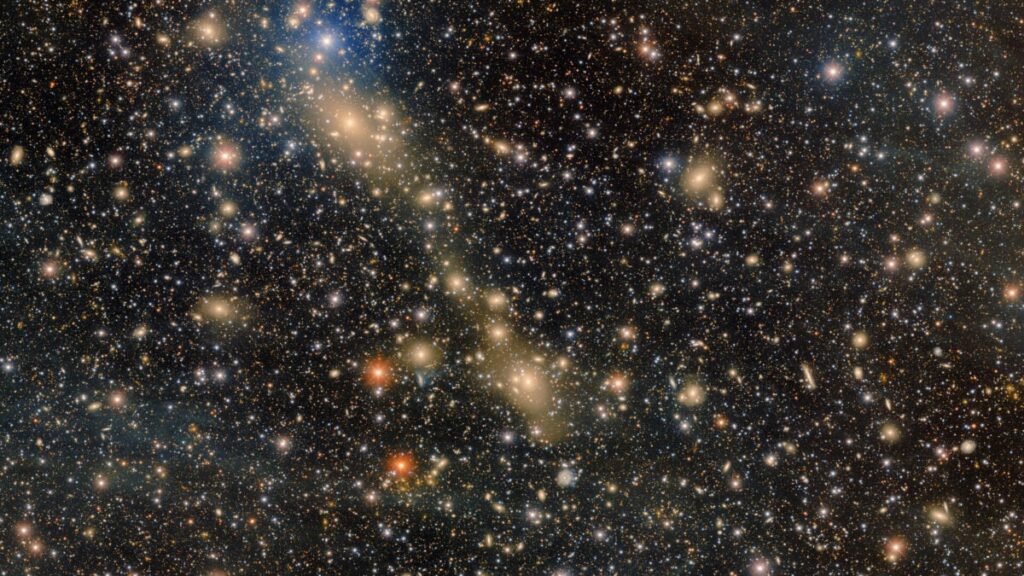
    When it comes to deep space observations, our cosmological insignificance seems to grow with the resolution of our telescopes’ cameras. In the latest advance, astronomers constructed the deepest-ever images of Abell 3667, a massive galaxy cluster located 700 million light-years from Earth—and most of the tiny dots you see represent entire galaxies.

    But the latest images of Abell 3667 also offer “whispering evidence of past galactic interactions,” which astronomers document in detail in a paper published today in The Astrophysical Journal Letters. The team, led by astronomers from Brown University, caught Abell 3677 at a particularly lustrous moment in space-time, during a merger of two of the clusters’ brightest galaxies. The stellar union, resembling a starry bridge stretching across the cluster, generated powerful gravitational bursts that yanked away the occasional stray star from other galaxies. 

    Together, these lone stars emit a faint glow known as intracluster light (ICL)—and it’s this phenomenon that researchers are investigating to explore Abell 3677’s past. Specifically, it appears likely that Abell 3667 also formed from the rapid merger of two galaxy clusters, which previous X-ray and radio observations had predicted. This latest observation, however, represents the first ever optical evidence to support this idea.

    “This is the first time a feature of this scale and size has been found in a local galaxy cluster,” Anthony Englert, study lead author, said in a statement. “We knew that it was possible for a bridge like this to form between two galaxies, but it hadn’t been documented anywhere before now. It was a huge surprise that we were able to image such a faint feature.”

    The team had an unusually long observation period for this project, which partly enabled them to construct such a detailed image. In addition to the intracluster light, the researchers captured faint, wispy puffs of cosmic dust called integrated flux nebulae, seen as bluish ribbons of light streaking across the image.

    “It was just a happy coincidence that so many people had imaged Abell 3667 over the years, and we were able to stack all of those observations together,” Englert noted.

    “What we did is just a small sliver of what Rubin is going to be able to do. It’s really going to blow the study of the [intracluster light] wide open.”

    The researchers have some outstanding questions about Abell 3677 and, more importantly, intracluster light. Fortunately, their timing couldn’t have been more impeccable; with the Rubin Telescope officially up and running, astronomers are now better equipped to further probe these questions. 

    “Rubin is going to be able to image ICL in much the same way as we did here, but it’s going to do it for every single local galaxy cluster in the southern sky,” Englert said. “What we did is just a small sliver of what Rubin is going to be able to do. It’s really going to blow the study of the ICL wide open.”

    Essentially, if this new image doesn’t make you feel small, you might want to wait for the soon-to-come Rubin versions of this image. In fact, if Englert is right, we’ll be seeing multiple versions of this image, and in higher resolution, too. So, for better or worse, we humans will only get smaller from here.

    Recommended for you:

    Android phone feeling slow? How I changed one setting to instantly double the speed
    Uncategorized·Aug 8, 2025

    Android phone feeling slow? How I changed one setting to instantly double the speed

    Galaxy
    Share. Facebook Twitter Pinterest LinkedIn Tumblr Telegram Email Copy Link
    Previous ArticleThe Motorola Edge (2025) caught my attention at $100 off — here’s why
    Next Article Google is rolling out a fix for Pixel back button issues
    Michael Comaous
    • Website

    Michael Comaous is a dedicated professional with a passion for technology, innovation, and creative problem-solving. Over the years, he has built experience across multiple industries, combining strategic thinking with hands-on expertise to deliver meaningful results. Michael is known for his curiosity, attention to detail, and ability to explain complex topics in a clear and approachable way. Whether he’s working on new projects, writing, or collaborating with others, he brings energy and a forward-thinking mindset to everything he does.

    Related Posts

    6 Mins Read

    MakuluLinux’s New AI-OS Wants to Run Your Whole Desktop, Not Just Answer Questions

    7 Mins Read

    The Light Flip Wants to Sell You a Phone That Does Less

    8 Mins Read

    Made by Google 2026: Everything to Expect From the Pixel 11 Launch on August 12

    6 Mins Read

    The iPhone 18 Pro Just Leaked Through a Breach at One of Apple’s Own Suppliers

    6 Mins Read

    Anthropic Is Reportedly Building Its Own AI Chip, and Samsung Wants In

    6 Mins Read

    Samsung Killed Its $2,899 TriFold Phone After Just 3 Months. Here Is Why.

    Top Posts

    Best Stores for Buying MP3 and Digital Music You Can Keep Forever (2026)

    August 2, 202530 Views

    Every iPhone Camera Ranked in 2026 (Best to Worst)

    July 6, 202613 Views

    How to Fix PS5 Controller Stick Drift (2026): 7 Working Methods

    July 10, 20268 Views
    Stay In Touch
    • Facebook

    Subscribe to Updates

    Get the latest tech news from FooBar about tech, design and biz.

    Most Popular

    Best Stores for Buying MP3 and Digital Music You Can Keep Forever (2026)

    August 2, 2025930 Views

    Discord will require a face scan or ID for full access next month

    February 9, 2026770 Views

    Trade in your old phone and get up to $1,100 off a new iPhone 17 at AT&T – here’s how

    September 10, 2025383 Views
    Our Picks

    A Toddler Needed a $20,000 Wheelchair. A High School Robotics Team Built Him One Instead.

    August 5, 2026

    AI’s Memory Boom Is Quietly Crushing the Budget Smartphone

    August 5, 2026

    Scientists Didn’t Say Earth Is Becoming Uninhabitable. Here’s What the “Hothouse Earth” Study Actually Says

    August 5, 2026

    Subscribe to Updates

    Get the latest creative news from FooBar about art, design and business.

    Facebook
    • About Us
    • Contact us
    • Privacy Policy
    • Disclaimer
    • Terms and Conditions
    © 2026 GeekBlog

    Type above and press Enter to search. Press Esc to cancel.