

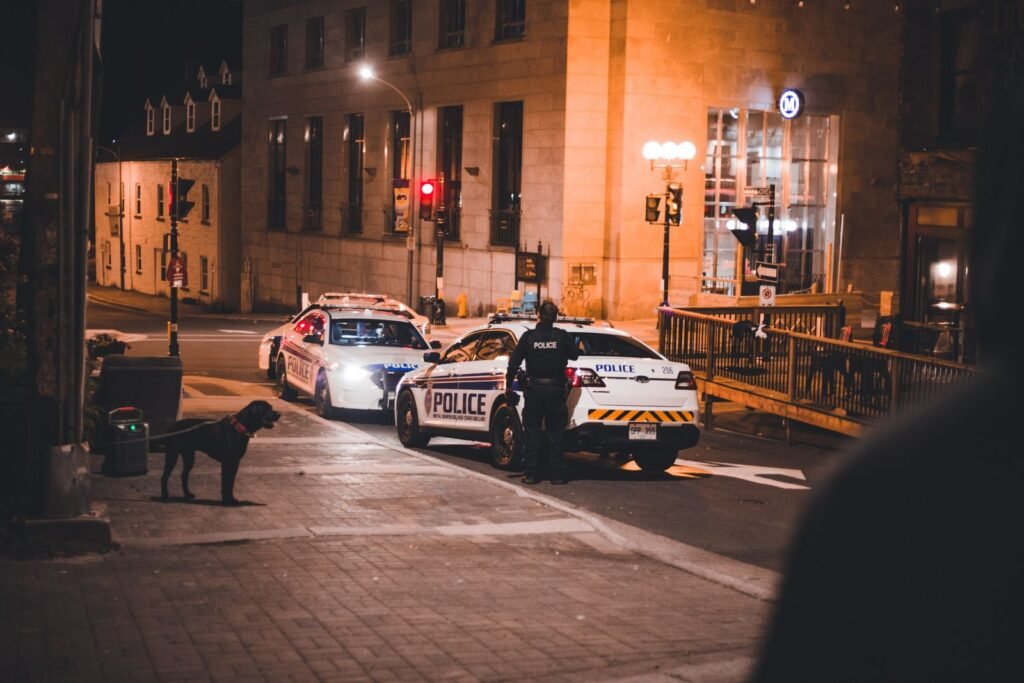
A Canadian software engineer pointed a cheap camera at the road outside his house, taught it to recognize police cruisers, and started logging every one that drove past. Eleven days after he posted the second video about it, two officers knocked on his door.
The conversation lasted about half an hour. According to his account of it, the officers wanted to know what he planned to do with the data, and warned that mapping where police vehicles go could put officers in danger. Which is roughly the argument privacy groups have been making about automated license plate readers for the better part of a decade, only pointed in the other direction.
The short version
- Who: Anthony Sistilli, a software engineer and YouTuber with roughly 140,000 subscribers, based in the Toronto area
- What he built: a homemade automated license plate reader, trained to trigger only on vehicles that look like police cars
- The parts: an inexpensive camera bought on Amazon, a laptop, a phone for GPS, and an off the shelf machine learning model he trained in about 20 minutes
- What happened: officers from Ontario’s Peel Regional Police came to his home on September 20, about 11 days after his second video
- Their concern: that a map of police movements could endanger officers and help people committing crimes
- His point: that this is the same objection the public raises about Flock Safety cameras, which now run in the tens of thousands across the United States
What he actually built
The important thing about Sistilli’s project is how unremarkable the engineering is. He did not reverse engineer anything, did not break into a network, and did not buy specialist hardware. He assembled a surveillance system out of consumer parts in an afternoon.
He described the detection step in plain terms. The model watches the video feed and decides whether it is looking at a police car. If it is confident enough, the system moves on to reading the plate.
“If the software is confident that a vehicle is a police car, it tries to read its licence plate,” he said. “My phone supplies GPS information to the laptop, and everything gets stored in a database so I can look at it on a map later: the picture, the time, the location and the licence plate.”
That last step is the whole argument. A camera that sees a car and forgets it is a camera. A camera that writes down the plate, the time and the place, and keeps doing it, is a tracking system. The gap between the two is a database, and the database is the cheap part.
The knock on the door
Sistilli posted two short videos about the build. The first one travelled a long way, reportedly passing 1.6 million views. On September 20, roughly 11 days after the second video went up, two Peel Regional Police officers arrived at his address.
He says the interview ran about 30 minutes and focused almost entirely on his intentions, specifically whether he was planning to publish a live map of police movements.
“I found it extremely ironic that when I decided to point the camera the other way and watch the watchers, they had the same privacy concerns as we do,” he said.
His summary of their position is worth quoting in full, because it is the part that has travelled.
“Their concern was that mapping police movements could put officers at risk and help people committing crimes. They also made the case that their own cameras and ALPR technology weren’t as concerning as I was suggesting. My impression was that they weren’t familiar with many of the controversies or examples of misuse in the United States.”
Anthony Sistilli, describing the September 20 conversation
A Peel Regional Police spokesperson confirmed to local outlet INSAUGA that the force had received information about a YouTube channel operated by Sistilli featuring content demonstrating the use of automated licence plate recognition technology. The department has not published a fuller account of the visit.
One narrator, so far. Almost everything we know about what was said at that door comes from Sistilli. The force has acknowledged that it looked into his channel, but it has not disputed, confirmed or expanded on his description of the officers’ arguments. No charges have been reported and no equipment was seized. Read the quotes as his recollection of a private conversation, not as an agreed record of one.
Two sets of privacy concerns, side by side
Strip the personalities out and you are left with a genuinely interesting symmetry. The objections the officers raised to being logged are, almost line for line, the objections civil liberties groups raise about drivers being logged.
| The worry | Raised about police being tracked | Raised about drivers being tracked |
|---|---|---|
| Physical safety | A map of patrol patterns could help someone ambush or avoid officers | A searchable location history can help an abuser find someone who has moved away |
| Pattern exposure | Repeated sightings reveal shift changes, routes and station activity | Repeated sightings reveal a home, a workplace, a clinic, a place of worship |
| No consent | Officers did not agree to have their movements catalogued by a stranger | Drivers did not agree to have their movements catalogued by a vendor |
| Who holds it | A private individual, with no audit trail and no oversight | A private company, with audit trails critics call insufficient |
Both columns are reasonable. That is the point Sistilli says he was trying to make, and he has been explicit that he was not trying to build the thing the officers feared.
“I never intended to create a giant network mapping every police officer, and I still don’t,” he told Straight Arrow News. “I wanted to see whether it was feasible and use the irony to illustrate a point. Sometimes it’s easier to show people what this kind of surveillance means by turning it around than by simply explaining what companies like Flock are doing.”
The numbers behind the irony
The asymmetry here is the reason the story resonated. One hobbyist with one camera prompted a house call within a fortnight. The commercial version of the same technology operates at a scale that is difficult to picture.
That misuse figure is the heart of the public backlash. A review of media reports published since 2024 counted at least 28 separate cases of law enforcement officers using plate reader systems to track former partners. Flock’s chief executive Garrett Langley has responded by making audit logs mandatory, a step the American Civil Liberties Union dismissed as window dressing.
Audit logs only help if somebody reads them and acts. We have seen what happens when nobody does: in one Florida case, an officer ran his wife’s plate 717 times and the system dutifully asked him for a reason each time and accepted the answer. Langley has also had to account for cameras that turned out to be reachable from the open internet, which he attributed to a bad batch of SIM cards.
The part Sistilli is uneasy about
To his credit, he has not pretended the reaction was uniformly healthy. The response to his videos included people who wanted to turn the idea into something considerably less abstract.
“A lot of people supported it, and some wanted to build a shared map,” he said. “But there was also the darker side of social media, with people talking about violence or tracking down individual officers. I don’t condone any of that.”
This is not a hypothetical problem. Apps that let the public report the location of federal immigration officers have already been pulled from app stores after exactly this argument was made about them. The line between accountability tooling and targeting tooling is thin, and it is drawn almost entirely by what the operator chooses to publish.
Sistilli says he tried to bring that nuance into the conversation at his door and did not get far. “I brought up approaches used in the U.S., such as clear data-retention policies and audit logs that don’t expose personally identifying information or details of specific cases,” he said. “I don’t think I managed to get that distinction across.”
Why this one stuck
The reason this story spread well beyond a hobbyist’s channel is that it collapsed an abstract policy debate into a single afternoon of work and a single knock on a door.
Public patience with plate readers has been thinning for a while. People have torn cameras off poles, crowdsourced maps of where every camera in the country is mounted, and voted the contracts out at city council meetings. A 77 year old named Carl Gunn picked up the nickname the Flock Blocker for the straightforward tactic of standing a sign reading DOWN WITH FLOCK CAMERAS directly in front of a lens.
What Sistilli added was a demonstration rather than an argument. The technology that makes a nationwide tracking network possible is not expensive, not proprietary and not hard. It is a camera, a laptop, a free model and twenty minutes. The only thing that makes a surveillance network a surveillance network is the decision to keep the records and connect them up.
If you want to know what is watching your street
- Check the community maps. Volunteers have catalogued plate reader installations across much of the United States. Finding out whether your commute passes one takes a couple of minutes
- Look up your local contract. Plate reader deployments usually go through a city council or police board vote, which means there is a public record of what was agreed, how long data is kept and who can search it
- Ask about retention, not cameras. The camera is not the privacy question. How long the records live and who can query them is the privacy question
- Audit logs are only as good as the audit. A system that logs every search and never reviews the logs has documentation, not oversight
The bottom line
A software engineer spent an afternoon building a plate reader out of a cheap camera and a laptop, trained it to notice police cars, and got a visit from two officers eleven days later. They told him that logging where vehicles go could endanger the people in them. He agreed, which was the entire point.
Nothing here suggests Sistilli did anything unlawful, and nothing suggests the officers behaved improperly either. The story matters because of what it proved rather than what it accused anyone of. The hard part of building a surveillance network was never the technology. It was getting permission, and the cameras on the poles already have it.
Sources and further reading
- UNILAD Tech: YouTuber gets surprise visit from cops after building own DIY flock system to track police cars
- Straight Arrow News: He built his own Flock style camera to track police. The police didn’t like it
- Gizmodo: YouTuber says cops paid him a visit after he built a Flock style camera to track cops
- INSAUGA: Police visit Mississauga YouTuber after post about video tracking in Brampton
- Cybernews: YouTuber tracks cops with Flock style camera
About this article: GeekBlog covers U.S. technology news, AI, phones, smartwatches and gaming. Every story is written and checked under our Editorial Policy. Spotted a mistake or have a story tip? Contact our editors.
