

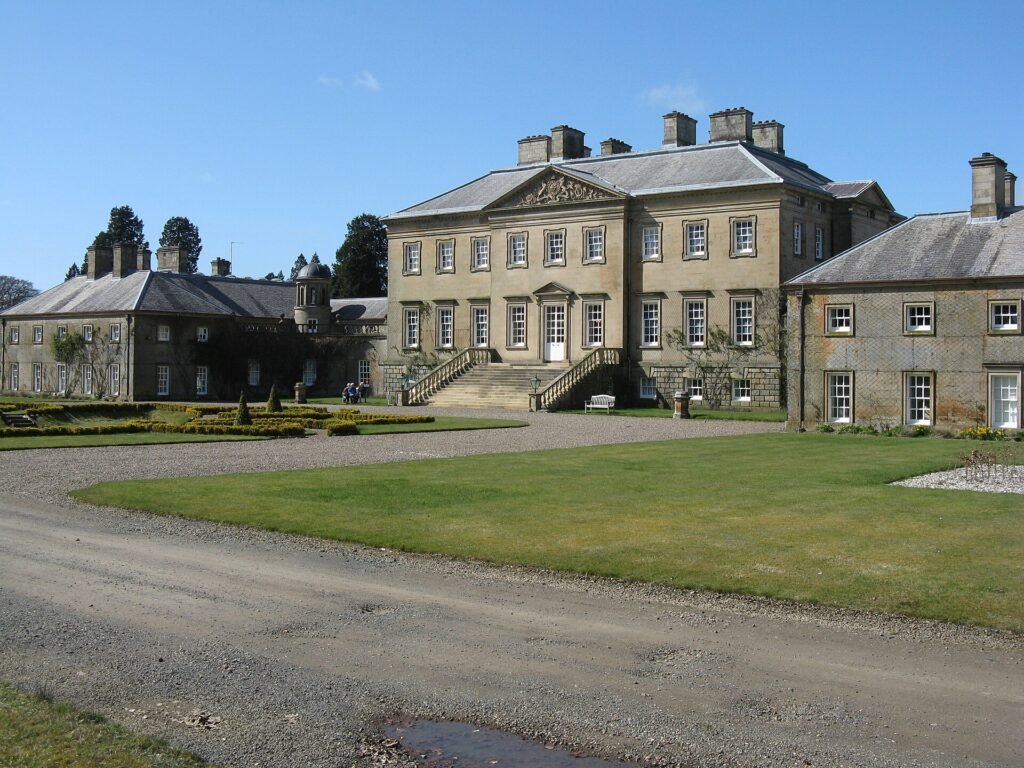
Dumfries House sits in East Ayrshire, about an hour south of Glasgow, and it is mostly known for having been rescued. In 2007 the Georgian estate and its Chippendale furniture were about to be broken up and auctioned off, and the then Prince of Wales led a consortium that bought the lot and kept it together.
On September 17 it hosted something considerably stranger. King Charles III convened senior figures from Nvidia, OpenAI, Anthropic and Google DeepMind, along with Britain’s AI minister, and asked them whether anyone was still in control of what they are building.
“Surely, we need sufficient means of control before it is all too late?” he said.
The short version
- King Charles hosted AI industry leaders at Dumfries House in Scotland on September 17
- In the room: Nvidia CEO Jensen Huang, Google DeepMind’s Demis Hassabis, OpenAI CFO Sarah Friar, representatives from Anthropic, and UK AI minister Kanishka Narayan
- The session was convened under the Ditchley Foundation, not by the UK government
- The King called AI’s pace “intriguing and deeply concerning in equal measure” and raised existential risk directly
- Nothing binding was agreed. Delegates discussed whether a shared set of guiding principles was even possible
- It came days after Anthropic’s Dario Amodei published an essay arguing the industry should deliberately slow down
What a king can and cannot do here
It is worth getting the constitutional point out of the way, because it explains both why this happened and why it produced nothing enforceable.
The British monarch has no power to make law, no power to regulate an industry and, by convention, no business publicly instructing a government on policy. What the office does have, in quantities no minister can match, is the ability to get people into a room.
That is not a small thing. A UK AI minister asking Jensen Huang to spend a Thursday in rural Ayrshire is a scheduling request. A head of state doing it is an invitation that is socially expensive to decline. The Ditchley Foundation, the geopolitical convening body that organized the session, exists precisely to trade on that kind of access, and it works.
| Organization | Who turned up | What that signals |
|---|---|---|
| Nvidia | Jensen Huang, chief executive | Top of the house. Nvidia takes reputational meetings seriously right now |
| Google DeepMind | Demis Hassabis | A London lab with a Nobel laureate at the top. Home turf, and a natural fit |
| OpenAI | Sarah Friar, chief financial officer | Senior, but not the CEO and not a safety lead. Read into that what you like |
| Anthropic | Company representatives | Attended days after its CEO published an essay urging the industry to slow down |
| UK government | Kanishka Narayan, AI minister | Present, but this was not a government summit and produced no government policy |
The OpenAI line is the one worth sitting with. Sarah Friar is a serious executive and the chief financial officer of the most prominent AI company in the world. She is also not Sam Altman, and she is not the person who runs safety. When a head of state convenes a meeting about whether your product might be dangerous and you send the person responsible for revenue, that is a statement about how the meeting was categorized internally.
What the King actually said
The language from Dumfries House was more direct than the usual royal register, which tends toward the carefully inoffensive.
“The development of AI, its substance and its pace, are both intriguing and deeply concerning in equal measure,” Charles said in his opening remarks. He pressed the attendees on what Buckingham Palace described as the urgency of considering the dangers of AI falling into the wrong hands and being used in potentially catastrophic ways.
The Palace framing for the session was that shared principles should guide the technology’s future “not merely as a driver of capability and efficiency, but as a tool that upholds human dignity and contributes to the flourishing of both people and the planet.”
This is not new territory for him. In November 2023 he addressed the world’s first AI Safety Summit at Bletchley Park and compared the technology’s significance to “the discovery of electricity, the splitting of the atom, the creation of the World Wide Web, or even the harnessing of fire.” Three years on, the comparisons have got darker and the venue has got smaller.
Bletchley produced a document. This produced a conversation.
The contrast with 2023 is the most useful way to measure what happened this week.
Bletchley was a diplomatic event. Twenty eight countries and the European Union put their names to a declaration, and while that declaration committed nobody to anything enforceable, it created an institution, the UK AI Safety Institute, that has since done real pre-deployment evaluation work with the major labs.
Dumfries House was not that. It had no states at the table beyond the host country, no text to sign, and no mechanism by which any commitment could have been made. Delegates discussed whether a shared set of guiding principles could be established. That is the output: a conversation about whether it would be possible to agree on something later.
The timing is the interesting part
This did not happen in a vacuum. It landed in the middle of the strangest fortnight the AI industry has had.
Days earlier, Anthropic’s Dario Amodei published an essay arguing that the industry should deliberately slow its capability gains, with a specific warning about agent swarms on the open internet. Sam Altman agreed publicly. So did Elon Musk. Reporting has since suggested the major labs had already been talking privately about how to slow each other down, which is the only way a slowdown works when nobody wants to be the one who blinks first.
Meanwhile, in Washington, Geoffrey Hinton spent Wednesday evening telling lawmakers they have maybe a year to regulate AI before recursive self-improvement puts it out of reach. Microsoft published a 38 page code of conduct for its own models that includes an explicit rule against resisting shutdown.
So the King’s question was not eccentric. It was the same question everybody else was asking that week, asked by the one person in the conversation with no commercial interest in the answer.
Why this kind of meeting is not worthless, even with no output
- It creates a record. Executives who nodded along at Dumfries House can be quoted back to themselves later
- It is off the record enough to be honest. Closed rooms produce conversations that congressional hearings cannot
- It sets a social norm. Three years ago “existential risk” was a fringe framing. A head of state now uses it in opening remarks
- It costs the industry something. Attendance implies the question is legitimate, which is precisely what parts of the industry have spent the year denying
- But it substitutes for nothing. Not one line of enforceable rule came out of it, and none was ever going to
The uncomfortable read
There is a less flattering interpretation of events like this, and it deserves airing.
Voluntary, non-binding, high-prestige gatherings are extremely convenient for a regulated-in-theory industry. They demonstrate engagement. They generate photographs of chief executives looking thoughtful in wood-panelled rooms. They cost a day. And they consistently arrive at the conclusion that the right next step is further dialogue, which is the one outcome that requires nobody to change anything.
The companies in that room have collectively spent this year arguing that AI is dangerous enough to need coordination and simultaneously racing each other to ship faster. Both statements are sincerely held inside these firms, by different people, sometimes by the same people. A summit cannot resolve that, because the tension is not a misunderstanding. It is a structural feature of a market where the reward for caution goes to your competitor.
What to watch
- Whether Ditchley publishes anything. A set of principles with names attached would be a real output. Silence means it was a conversation
- Whether the UK government picks it up. The AI minister was in the room. A policy paper citing these discussions would matter more than the meeting did
- Whether OpenAI sends Altman next time. The seniority of the delegation is the cleanest available measure of how seriously a company takes the venue
- Whether the phrase survives. “Firmly in the service of humanity” is the kind of line that either becomes a standard or disappears in a fortnight
Charles has been doing versions of this for a long time, on the environment, on architecture, on farming, with a consistent method: convene the people who can act, ask the question nobody in the room wants to ask out loud, and let the discomfort do the work. It is a slow instrument and its results are almost impossible to attribute.
Whether it is adequate to a technology its own builders describe as potentially civilization-altering is a different question. A monarch can get Jensen Huang to Ayrshire. He cannot make anybody slow down after they leave.
Sources and further reading
About this article: GeekBlog covers U.S. technology news, AI, phones, smartwatches and gaming. Every story is written and checked under our Editorial Policy. Spotted a mistake or have a story tip? Contact our editors.
