

Elon Musk has a net worth somewhere around $920 billion, depending on which index you trust and what Tesla did that week. Earlier this year he briefly crossed into trillionaire territory, which is a sentence that would have read as satire a decade ago.
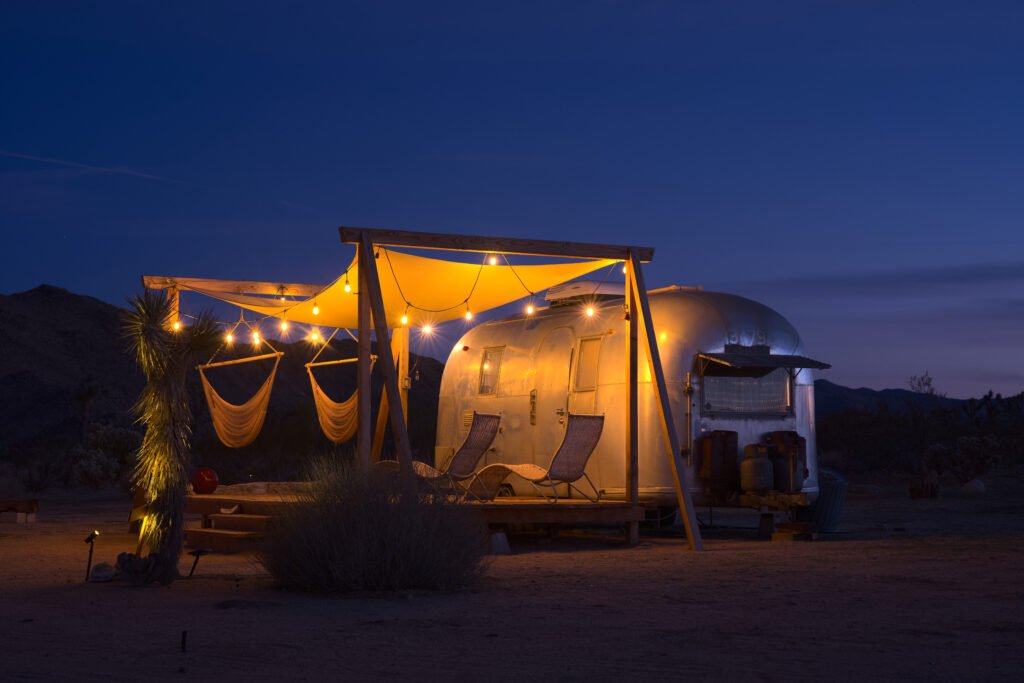
He has spent recent months sleeping in a travel trailer in Memphis, Tennessee.
Musk confirmed it during a taping of the All-In podcast, sitting alongside SpaceX president Gwynne Shotwell, and described the Airstream as his “palace.” He has been on site for stretches of weeks, and the reason is straightforwardly logistical: the trailer is parked at xAI’s data center campus, and living there means he wakes up a short walk from the machines.
The short version
- Musk is living in an Airstream trailer at xAI’s Memphis data center campus while the buildout continues
- He called it a “palace”, apparently with some irony. Gwynne Shotwell said he “sleeps on the factory floor”
- The site is Colossus 2, also referred to as Macrohard, in the Whitehaven area of South Memphis
- Reported scale: on the order of 555,000 GPUs, roughly $18 billion, and a target of 2 gigawatts
- Its power comes from 27 methane gas turbines across the state line in Southaven, Mississippi
- The NAACP is suing xAI over those turbines, alleging they were built and run without a Clean Air Act permit
- The Department of Justice has intervened on xAI’s side in the litigation
The trailer is not a bit
It would be easy to file this as billionaire cosplay, and some of the reaction has. But the pattern is long and consistent enough that the simplest explanation is probably the right one.
During Tesla’s Model 3 production crisis Musk slept on the factory floor in Fremont. After taking over Twitter in 2022 he was repeatedly reported sleeping in the office. For years his primary residence near SpaceX’s Starbase facility was a rented house valued at around $50,000, chosen because it was close.
The common thread is not frugality as a value. It is an unusual intolerance for commuting. Shotwell’s comment on the trailer was blunt about it: “This is Elon, by the way. Doing what people don’t believe he does: he sleeps on the factory floor. He’s in Memphis, helping build buildings.”
Whether that is admirable or a symptom depends on your view of how executives should work, and reasonable people land in very different places. What is not in dispute is that it is real behavior rather than a press stunt, and it tends to show up when a project is at a stage Musk considers critical.
What he is actually standing next to
Here is where the story stops being charming and starts being consequential, because the thing that justifies sleeping on site is one of the largest industrial construction projects in the United States.
The first Colossus cluster went up in 122 days in 2024, a timeline the data center industry found genuinely difficult to believe. Colossus 2, at 5420 Tulane Road in Whitehaven, is the follow-on, and it is the site Musk has been camped at. A fourth facility, announced in late July under the name Minihard, extends the campus further.
Speed on that scale is the actual achievement here, and it is worth acknowledging plainly. Most organizations cannot bring a gigawatt of compute online in a year. The reason Musk is in a trailer is that he believes his presence compresses that timeline further, and on the evidence of Fremont and Starbase, he may be right.
The part of the campus that is in court
A gigawatt of compute needs a gigawatt of power, and the grid in that part of Tennessee was not built with this in mind. xAI’s answer was to generate its own, using methane gas turbines sited across the state line in Southaven, Mississippi.
The NAACP, together with the Mississippi State Conference of the NAACP and represented by Earthjustice and the Southern Environmental Law Center, has sued xAI and its subsidiary MZX Tech over those turbines. The core allegation is simple: the Clean Air Act requires a major source of pollution to obtain an air permit before it is built or operated, and 27 turbines were built and operated without one. A 60 day notice of intent to sue went out in February before the case was filed.
| Pollutant | Aggregate potential to emit, per year | Why it matters |
|---|---|---|
| Nitrogen oxides | 1,700 tons | Drives ground level ozone and aggravates asthma |
| Fine particulates (PM2.5) | 180 tons | Penetrates deep into the lungs, linked to cardiovascular harm |
| Carbon monoxide | 500 tons | Standard combustion byproduct, regulated as a criteria pollutant |
| Formaldehyde | 19 tons | A designated hazardous air pollutant |
Those are potential-to-emit figures, which is a regulatory term meaning maximum capacity rather than measured output. That distinction matters and xAI will lean on it. It is also exactly the number the permitting system is designed around, because the entire point of requiring a permit before construction is that you cannot assess the maximum after the fact.
The turbines sit near homes, schools and churches in North Mississippi, and the communities involved are the ones that tend to end up next to industrial siting decisions. That is the reason the NAACP is the plaintiff rather than a general environmental group.
The Department of Justice has since intervened in the case on xAI’s side, which is an unusual posture for the federal government in a Clean Air Act citizen suit and tells you how political this has become.
The tension in one paragraph
A man worth close to a trillion dollars is sleeping in a $100,000 aluminum trailer to personally supervise construction of a facility that his neighbors say is polluting their air without a permit. Both halves of that sentence are true, and the first half is the one that went viral.
Why the trailer story travels and the turbine story does not
This is worth naming, because it is a mechanism rather than a conspiracy.
“World’s richest man lives in a trailer” is a complete story in eight words. It is surprising, it is human, it flatters a certain idea of the founder, and it requires no background. “Unpermitted gas turbines at a data center are the subject of a Clean Air Act suit with DOJ intervention” needs three paragraphs of setup before anyone can tell whether it is a big deal.
The result is that the charming detail becomes the public understanding of the project, and the substantive dispute stays inside the local press and the legal trade coverage. That is not xAI’s doing. It is just how attention works, and every large infrastructure project in the country benefits from it.
It is also not unique to Memphis. The energy demands of frontier AI have quietly become the sector’s hardest constraint, which is why Google went and bought half a Finnish nuclear plant’s output through 2049 rather than build turbines in somebody’s neighborhood. Different companies are solving the same problem with very different levels of friction, and the choice of solution is largely a choice about whose objections you are willing to absorb.
What to watch
- Whether the turbines get a permit retroactively. Mississippi’s regulators, not the court, will decide the practical outcome
- Whether the 2 gigawatt target holds. Power, not GPUs, is the binding constraint on every one of these projects
- Who the leased capacity goes to. Reporting suggests Google and Anthropic among them, which makes rivals into landlords and tenants
- How long Musk stays. He left the factory floor when Model 3 volumes stabilized. The trailer leaving Memphis would be a real signal about the buildout
Musk was at the All-In Summit when he described the trailer, the same event where the President called AI safety a hoax on Jensen Huang’s speakerphone. That is a reasonable summary of where this industry is right now: enormous physical construction, genuine personal commitment from the people building it, an unresolved argument about the risks, and a set of communities downwind who were not asked.
The Airstream is a good story. It is also, conveniently, the smallest object on a site measured in gigawatts.
Sources and further reading
About this article: GeekBlog covers U.S. technology news, AI, phones, smartwatches and gaming. Every story is written and checked under our Editorial Policy. Spotted a mistake or have a story tip? Contact our editors.
